


Moses Lake Industries working on raw material recovery process
MOSES LAKE — The owners of Moses Lake Industries are exploring a process designed to recover more of a key component provided by MLI for the manufacture of semiconductors. Company officials are working to determine if the research done so far could lead to further testing in Moses Lake.
"We're currently deep into the R&D state of this, but we're also working on setting up a full- scale unit in Moses Lake," said Brent Hansen, MLI chief operations officer.
Among other things, Moses Lake Industries produces chemicals and substances that are used in semiconductor manufacturing; copper being one of them. Company officials set out to determine if more of the raw copper used to produce semiconductors could be reclaimed and reused to build more semiconductors.
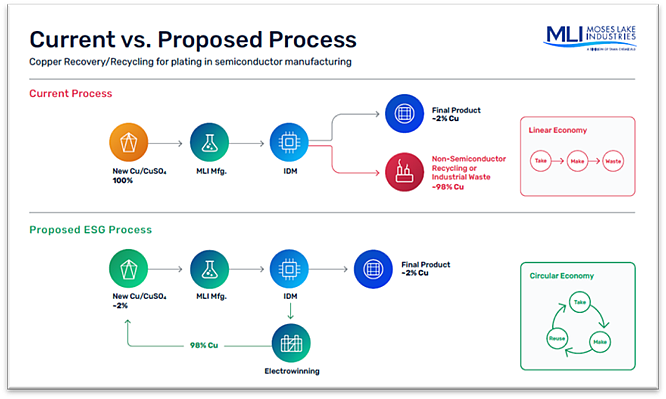
Copper is a critical component in semiconductor manufacture, but the existing process only uses about 2% of the copper that comes in. Some manufacturers do recover more of that copper, but what they get back is not usable in semiconductor manufacturing, according to a MLI press release.
"The key step is the recovery of the copper metal from the liquid waste; it's called electrowinning. That's what we use, anyway," said Katie Lingscheit, MLI research and development manager. "That is a process that's pretty well known. There are some (manufacturers) that have been using that to recover copper from their waste streams for a while, but they're not necessarily using that copper back into semiconductor manufacturing. They're maybe recycling it back to other industries."
The MLI process is designed to make a lot more of the recovered copper usable in semiconductor manufacturing. The company announced in late August that it has demonstrated it can be done.
"That's what we're good at," Lingscheit said. "Our purification process is highly advanced, and we're taking copper metal and making a very good, high-quality product from it."
Recycling the material helps MLI control costs too.
"If we can regain that copper back and use at the beginning of our process, we can buy a lot less raw material copper, and we would benefit from that as well," she said.
John Sukamto, MLI chief technical officer, said the process does make the higher-quality copper more expensive, but semiconductor manufacturers may be willing to pay for it.
"Part of the economics is because of the application. The application is in semiconductors, and the stuff that they make in semiconductors, as you know if you try to buy a new phone, for example, they're not cheap," he said. "There's a premium that the semiconductor industry is willing to pay. They also have the need for high purity because the products are becoming more and more advanced. Whether specific high purity is required is unknown, but in the business, why would one take a chance if you don't have to? That's why they'd be willing to pay the premium."
Semiconductor manufacturers want consistent quality, and raw copper has variants.
"If we can recycle copper the way Katie is talking about, it's going to reach some sort of steady state," he said.
Company officials are working to determine interest among potential customers, Lingscheit said.
"We're trying to engage with as many of our customers as can to see if they're interested in working on this project with us," she said.