In Grant County Judge debate, Bevier, Chadwick place emphasis on experience and constitutional interpretation
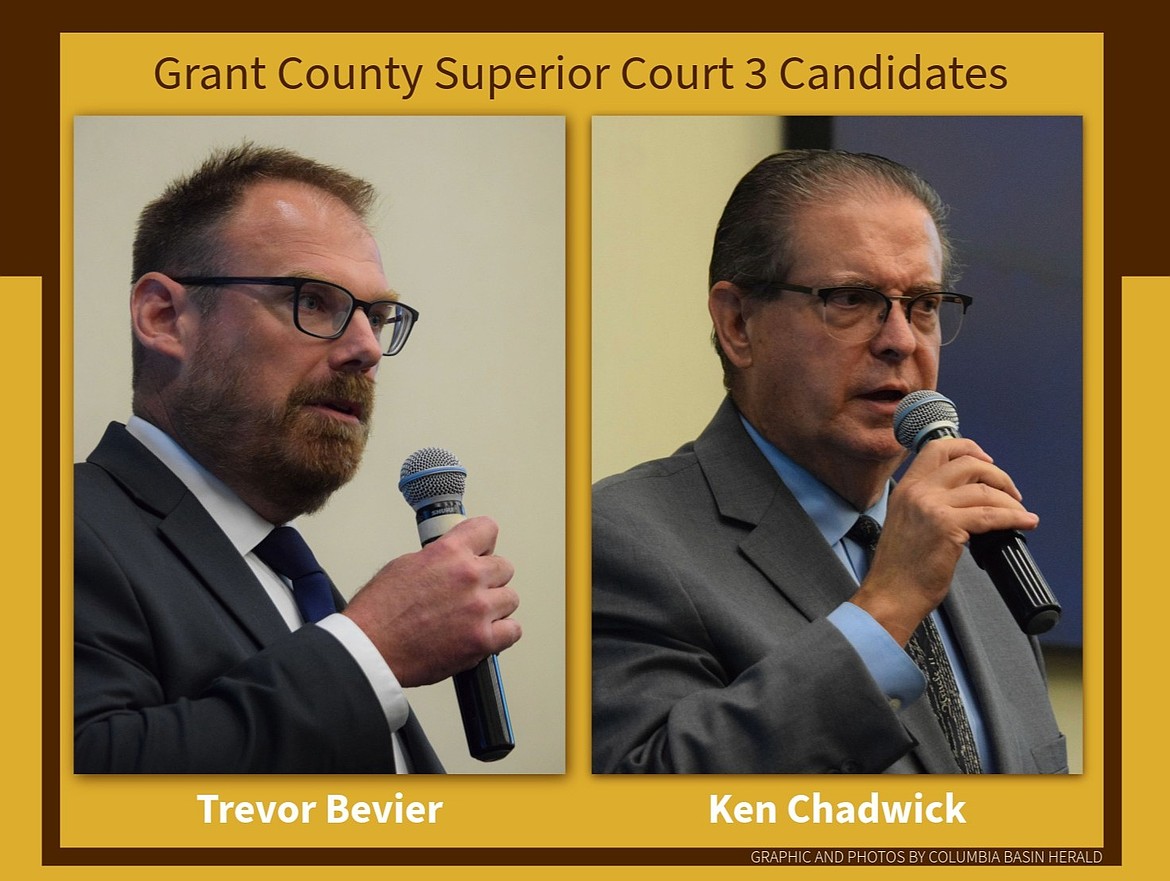
EPHRATA — The two candidates seeking Grant County Superior Court Judge Position 3 highlighted their legal experience, views on constitutional interpretation and approaches to property rights and criminal justice during a debate hosted by the Grant County Republican Party at the Ephrata Recreation Center.
Attorney Trever Bevier and attorney Kenneth "Ken" Chadwick advanced to the general election after defeating Gov. Bob Ferguson appointed incumbent Judge Jennifer Richardson in the August primary. During the debate, both candidates argued they possess the experience and judicial temperament necessary to serve on the county's Superior Court bench.
Why they're running
Bevier, a Grant County local who currently works in the Grant County Prosecutor's Office, said his campaign is rooted in his connection to the community and desire to preserve opportunities for future generations.
"I want you to have the same experience that I had growing up," Bevier said, referring to his young son. "I need to do everything within my power to ensure that happens."
Bevier pointed to his work in civil litigation, real estate, probate matters and government law as evidence he is prepared for the bench.
Chadwick said his legal career, combined with 15 years in law enforcement, gives him a unique perspective on the justice system.
"I am the deepest, broadest experienced candidate prepared for the job," Chadwick said. "I've done literally everything in the Grant County courts."
Chadwick, an Ephrata attorney and former police sergeant, said he moved to Grant County in 2007 and has spent nearly two decades practicing law in the county.
Trial experience
Asked about their experience with jury trials and evidence rules, both candidates stressed their courtroom backgrounds.
Chadwick said he has spent his career as a trial attorney handling both criminal and civil cases.
"It's really important that a judge has a clear understanding of the rules of evidence," Chadwick said, noting judges are responsible for ensuring improper evidence is excluded from trials.
Bevier said lawyers "live, breathe, eat and sleep" the rules of evidence throughout every stage of litigation.
He said his experience evaluating evidence before, during and after trial, has prepared him to make timely and consistent rulings from the bench.
"As a judge, it would simply be taking those tools that I've developed and applying them to make those decisions quickly, fairly and consistently," Bevier said.
Property rights
Property rights became one of the most substantive topics of the evening as candidates were asked whether income should be considered property.
Chadwick offered a direct answer.
"Yes. Income is property," Chadwick said, arguing that previous Washington Supreme Court decisions have established income as a form of property.
He said the distinction is important because Washington's constitutional limitations on property taxes could affect future discussions surrounding income taxation.
Bevier noted the issue is likely to remain politically relevant but declined to offer an opinion on specific policy proposals.
He emphasized the importance of protecting private property rights.
"It's one of the things that we have that we can own, touch, feel as citizens, as individuals, and that's what makes us free," Bevier said.
Government authority
Candidates also were asked about situations in which government agencies seek to take or regulate private property.
Both agreed the burden of proof generally rests with the government or party seeking action against a property owner.
Chadwick referenced eminent domain, arguing government agencies must justify why property is needed for a public purpose.
"The government has the burden to prove that they have a right to your property," Chadwick said.
Bevier similarly said property owners are entitled to challenge governmental actions in court and referenced constitutional protections against the taking of private property without compensation.
"No property shall be taken without just compensation," Bevier said.
Constitutional interpretation
One of the most philosophical portions of the debate centered on judicial interpretation of the Constitution.
Bevier said he begins with the text itself and relevant legal precedent.
"Words matter," Bevier said. "There's a reason why words were put there."
He said judges should examine constitutional text, dictionary definitions, historical writings and prior court decisions when confronted with new legal questions.
Chadwick described himself as a constitutional textualist and cited retired U.S. Supreme Court Justice Antonin Scalia as a major influence.
"I have never bought the idea that there is a living Constitution that changes with the social mores of the time," Chadwick said.
He argued courts should enforce constitutional language as written and reject laws that conflict with constitutional protections.
"The public has to have an absolute clear understanding of what the law is," Chadwick said.
Repeat offenders
The candidates offered nuanced responses when asked how courts should address repeat offenders in a criminal justice system increasingly focused on reducing reliance on cash bail.
Chadwick said judges must balance public safety concerns against constitutional protections.
"If a person is a direct threat to the community, bail can be set to stop that person from getting out and creating more antics," he said.
At the same time, he noted judges must consider constitutional restrictions against excessive bail.
Bevier said the issue extends beyond decisions made in the courtroom.
"The courts' hands are somewhat tied by both the Legislature and Supreme Court decisions," Bevier said.
He argued that addressing repeat criminal behavior may require broader solutions, including legislative changes and improved access to community resources.
"I think it's a multi-pronged approach," Bevier said.
Final pitch
During closing remarks, both candidates returned to the issue of qualifications.
Bevier pointed to his local roots and experience in numerous practice areas, including criminal law, civil litigation, probate matters and governmental representation.
"I've sat in the plaintiff chair. I've sat in the defendant chair. I've sat on the prosecution. I've sat on the defense," Bevier said.
He added that his work ethic and understanding of Grant County residents make him the strongest candidate.
Chadwick countered by highlighting what he described as the broadest legal experience in the race, including nearly 40 years combined in law enforcement and the legal profession.
"I have practiced in nearly every area of the law," Chadwick said.
He also pointed to his experience serving as a pro tem judicial officer, arbitrator and trial attorney, along with endorsements from current and former judges.
"I am simply the most qualified candidate," Chadwick said.
The winner of the Nov. 3 general election will become Grant County's newest Superior Court judge, filling Position 3 after voters chose not to advance the incumbent through the primary election.