


Fighting wildfires from above
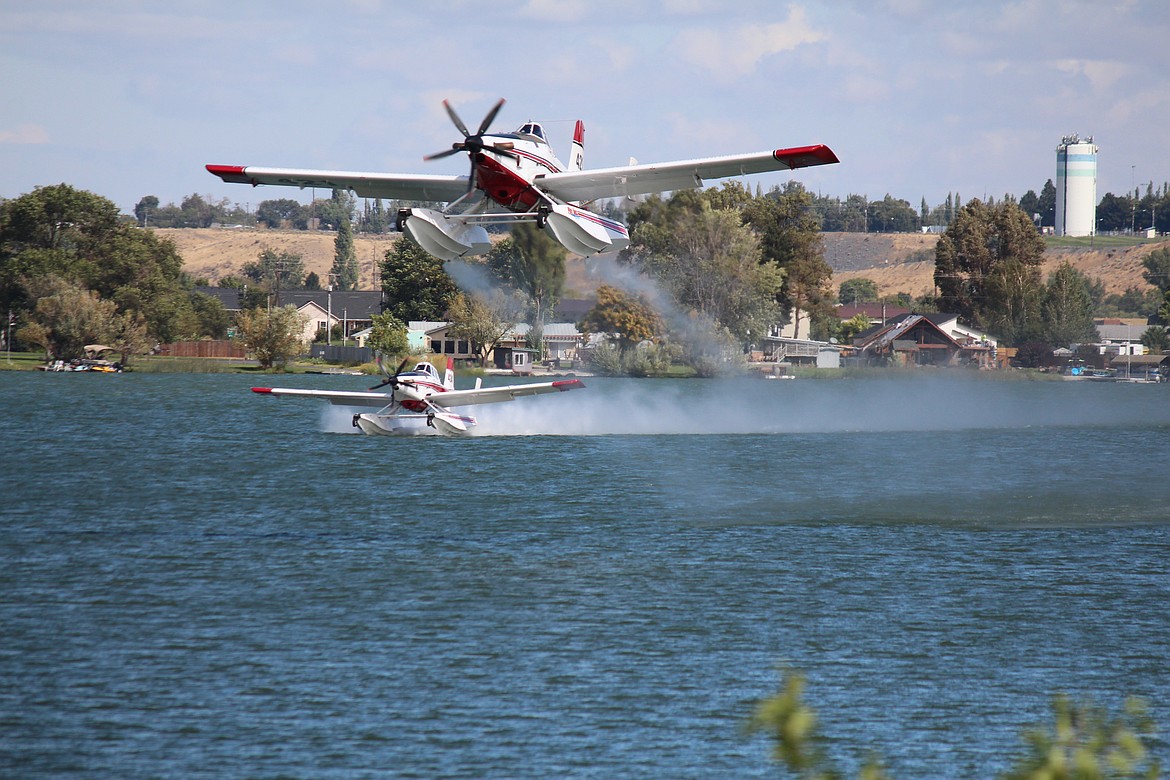
Matt Gilstrap takes off from Moses Lake with a full load of water during an aerial firefighting training run, with fellow pilot and firefighter Tom Wade in the background.
CHERYL SCHWEIZER/COLUMBIA BASIN HERALD
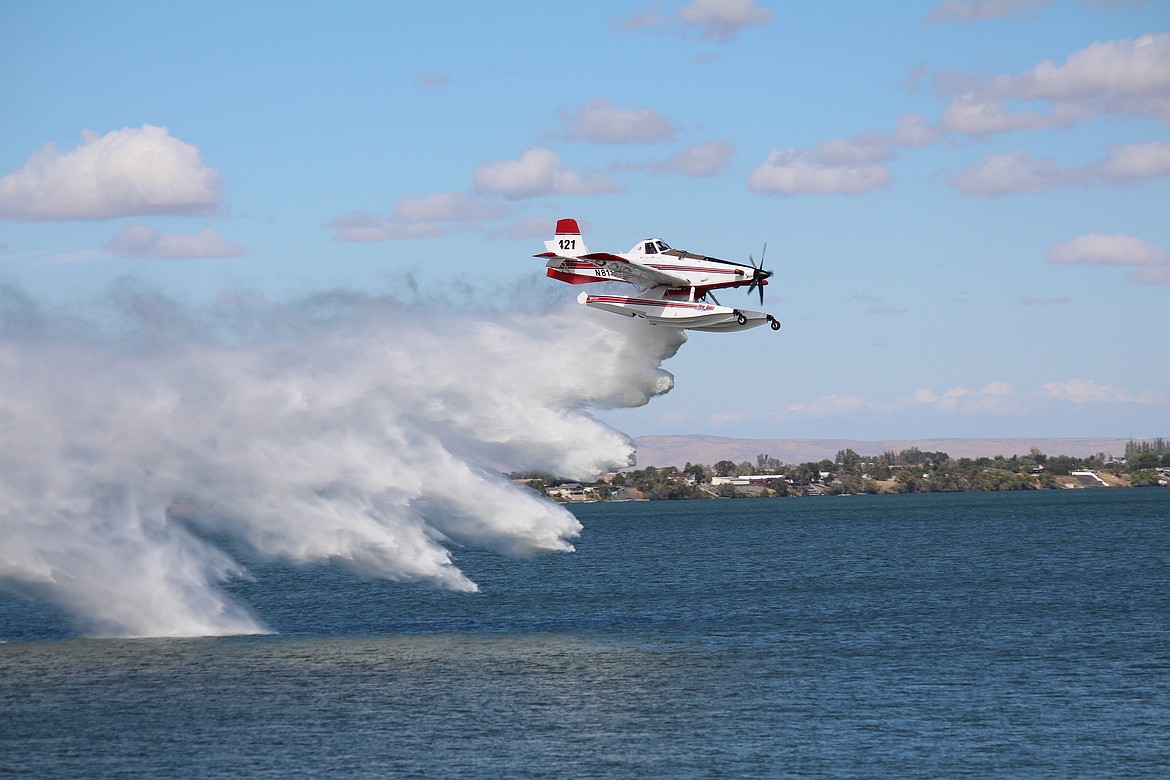
Aerial firefighters drop a load of water back into Moses Lake during a training exercise.
MOSES LAKE — Wildland fires can be fierce and chaotic. Fighting them, however, is a precision task, even when it looks like it would be hard to be precise.
Matt Gilstrap, an aerial firefighter with Henry’s Aerial, said the aircraft that apply water and retardant have a specific purpose in mind.
“You don't want to just run out to the front of the fire and try to stop it. What you're trying to do is make it where the guys on the ground have a safe place to go to if the wind changes,” Gilstrap said. “You usually start on one corner of the fire, and you start trying to push that fire in. A fire wants to grow out with the wind. You don't want to just run out to the front of the fire and try to stop it.”
Aerial water and retardant aircraft work to narrow the fire’s path and the areas of potential spread, he said. Their focus is giving the ground crews room to work.
Gilstrap, fellow pilot Tom Wade and a support crew have been flying out of the Grant County International Airport for about a month. Prior to that, they spent most of the summer fighting Okanogan County fires.
To sharpen their skills, the two took their aircraft out on Sept. 3, scooping water off Moses Lake and dumping it in a designated area.
Aerial firefighting brings with it its own set of challenges; smoke and shifting wind currents are only the start. Gilstrap said knowledge of the drop zone and the surrounding area is critical.
“Where the drop is, our entry into the drop and our exit away from the drop. You don’t want to be dropping straight into the side of a hill, so you want to drop with lowering terrain,” he said. “Wind currents are always an issue. The one thing about fire is, you get smoke with it, so it's easy to read the wind.”
The water on board is the most crucial factor
“Maybe the most critical thing that I take into account before I do a drop is where am I going to go if this load doesn't come off?” Gilstrap said. “Because the load of water I’ve got weighs as much as the airplane. Having a plan of what you’re going to do if the gate doesn’t open is very critical.”
Henry’s Aerial is a private company that provides contracted firefighting services. There are lots of similar companies, and pilots from all of them work together over a fire scene. Four aircraft are considered the core unit, called a flight.
“Sometimes we work with pairs of two or pairs of four, or I've been in a line with 14 other aircraft at a time,” he said. “Your situational awareness around you when you're working is crucial.”
Ground and air controllers keep track of the activity
“The lead of each flight (talks) to Air Attack. We have an airplane above us, typically, that's telling us what he wants done on the fire, and he's answering to the guys on the ground,” Gilstrap said. “The guys on the ground make the call, and they talk to Air Tech and tell him, ‘Okay, we want to work on this portion of the fire. This is what we want to accomplish.’ Then Air Attack tells us (the location).”
Pilots use the coordinates to get to a fire, but once they’re on scene, directions can get very local.
“Typically they're going to use ground references. He'll ask me, "Do you see the junction of the road? Do you see the four fire trucks that are parked at the junction of the road? We want to tie it in right there and go to the west with it,’” Gilstrap said.
The amphibian aircraft flown by Gilstrap and Wade are filled by skimming the surface of a lake or river. That too involves close attention to conditions.
“All of our scoop sites, we do some pre-mission planning to determine which one is going to be closest to the fire and then use our resources available to check water depths and current conditions and wind,” Gilstrap said.
Rough water conditions are a challenge, but so are very calm conditions
“You would think a nice smooth piece of water is the best, but it’s the hardest,” Wade said. The surface tension tries to hold onto the airplane. It doesn't want to let it go.”
Judging the approach is difficult over calm water, Wade said.
“If you were descending into a mirror, it would be harder to know where the ground is. If it's perfectly flat, you kind of lose that perception of how high you are above the water. You have to use your periphery to judge,” he said.
Pilots can fly a maximum of eight hours per day, and the fuel capacity puts a limit of about three and a half hours per flight. The number of water is determined by the proximity of the water source to the fire, Gilstrap said.
The Pacific Northwest fire season is winding down, but there’s still plenty of work nationwide. “Texas, Oklahoma – their fire season is just picking up,” he said.
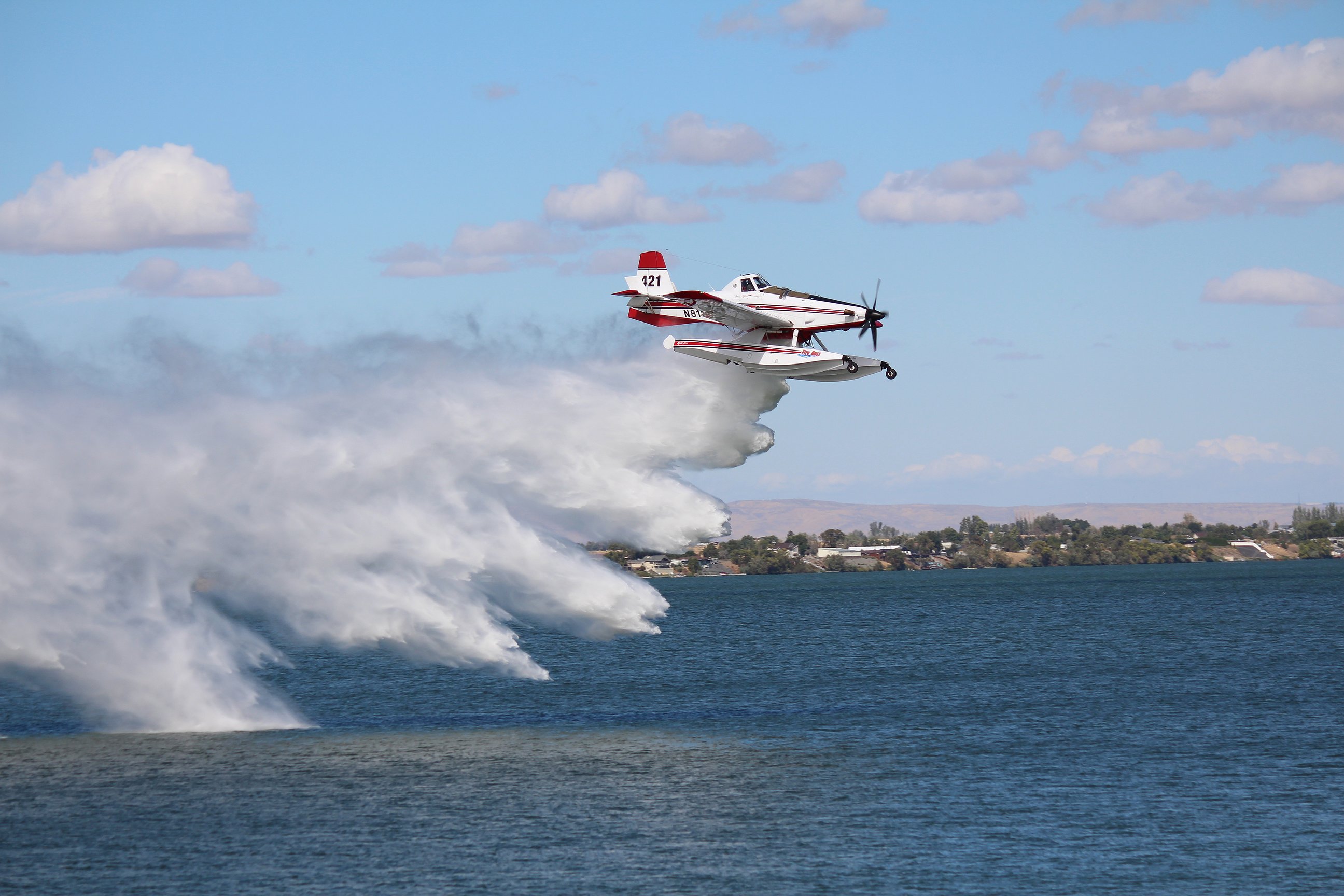 Aerial firefighters drop a load of water back into Moses Lake during a training exercise.