


Thursday, September 03, 2026
66.0°F

Survival of the endangered Columbia Basin pygmy rabbit hinges on sagebrush
by KEN SMITH
Managing Editor | September 3, 2026 3:45 AM

EPHRATA — The Columbia Basin pygmy rabbit was once prolific in the region, numbering in the thousands. But with agricultural development, its numbers have plummeted to around 100-150 fragmented populations. However, a dedicated group of people and organizations are working to preserve its habitat, primarily corridors of shrub cover, critical to their survival.  

The dense stands of sagebrush that once filled the land of the Columbia Basin are now limited to small pockets of native habitat. It is this sagebrush that provides the pygmy rabbit year-round shelter and food. Without it, the rabbits would not survive.  

“We are seeing positive trends in our work, in our reintroductions, and in the two wild populations that we've established in the area at Beazley Hills and Sagebrush Flats,” said John Gallie, a regional non-game biologist with the Washington Department of Fish and Wildlife, who has spent a great deal of his time working on the pygmy rabbit recovery program. “Those two populations have remained fairly stable over the last couple years, and currently we are releasing rabbits into the Rimrock Meadows area, which is fairly close to Sagebrush Flat, and we are now in our third year of releasing rabbits there to try and get a subpopulation established.” 

He said the goal is to get a third subpopulation established at Rimrock. The state Fish and Wildlife Department is working closely with the Nature Conservancy and Conservation Reserve Program for habitat restoration and population recovery. 

Gallie said the three micro ecosystems that the rabbits live in are about five miles a part.  

“Our goal there is hoping that we haven't seen them expand into Rimrock Meadows because there's a lot of agriculture and development in between the two,” he said. “So, we're releasing into Rimrock Meadows to further facilitate them establishing that area, and eventually we hope there will be some connectivity between the two groups.” 

The Beazley population remains stable, he said, after a reintroduction program, which was discontinued in 2021. The rabbits have spread out over the area, he said, and remain strong. The lifespan of a pygmy rabbit is short, lasting around three years, and they face predation from coyotes, and birds with talons, so it is a daily fight for survival for the diminutive rabbits, which grow to 12 inches and weigh around 16 ounces.  

Wildfires have been the greatest threat to their survival as an entire population can be wiped out in one fire, which happened in 2017 in Beazley Hills. 

“That really set us back in 2017,” Gallie said. “I think all total, we lost 85 rabbits in that fire. In addition to all the 30 plus 1000 acres of mature sagebrush habitat, so it was definitely an enormous setback.” 

In 2020, the Pearl Hill Fire was even more devastating, Gallie said. 

“It wiped out the entire Burton Draw recovery area in central Douglas County,” he said. “It's up by the upper ends of Moses Coulee by Jameson Lake, and that was our fastest growing release area that we had up to that time. We had two captive breeding enclosed sites there, and all total, I think when we calculated, 43% of all of our known pygmy rabbits in Washington we lost in that fire alone, and again not to mention the hundreds of thousands of acres of shrub steppe habitat that burned up with that.” 

It’s a constant struggle in the recovery effort, he said, maintaining habitat while combating the destructive force of wildfires upon those habitats.  

“The reality is, is one lightning strike or a cigarette thrown in the wrong area under the bad fire conditions, and we can lose them overnight,” he said. “Which really is kind of driving all of our efforts, trying to get them established in as many places as we can.” 

The pygmy rabbit has evolved to survive exclusively on sagebrush plants. It is this specialty that also makes it vulnerable to development, climate change and wildfires.  

“They rely on the leaves heavily for forage,” Gallie said. “Most of their fall and winter diet is almost all sagebrush, and only pygmy rabbits and sage grouse are really the only species that we have that have evolved the ability to subsist solely on sagebrush plants at certain times of the year. They forage on grasses and flowering plants when they're green during the spring and early summer. But as we see, almost everything is dried out right now. And sagebrush is one of the few plants that has any moisture left in it on the landscape. But it's a really harsh plant. It has a lot of difficult compounds for herbivores to deal with, and so the pygmy rabbit is pretty specialized in its ability to subsist solely on sagebrush. So, it's pretty unique in that regard.” 

In addition to foraging on the sagebrush, they also construct burrow systems under the tall, mature sagebrush plants, Gallie explained. They not only rely on it for food but also for cover from aerial predators and for their burrow systems that they use for rearing their young and escape from predators. It’s also critical for surviving the extreme heat and cold of the desert landscape.  

“They are 100% limited by sagebrush habitat,” Gallie said. “They can't survive on the landscape without it.” 

The elimination of sagebrush over the decades from agricultural development with crop fields and orchids has replaced the once abundant native landscape of sagebrush. But a collaboration effort with farmers under the Conservation Reserve Program, a federal farm bill program has allowed for the conversion of farmland back to native habitat for various environmental benefits like erosion and pollinators and wildlife habitat, and in some situations hunting.  

“It allows a lot of that deep soil habitat that wasn't necessarily economical farming,” Gallie said. “And it gives it a purpose of providing habitat and erosion control on the   landscape, and our rabbits have shown a high affinity for some of those restored habitats. And actually, in some regards, the majority of our wild rabbits are living in those CRP fields.” 

“It wasn't designed for pygmy rabbits,” Gallie continued. “We're just kind of lucky that the program provides habitat conditions on soil sites that rabbits were always going to be attracted to. So, it's really a win, win. It's popular with farmers for their farm income, and it's popular with our pygmy rabbits and sage grouse in the Columbia Basin.” 

Moving forward, the survival of Columbia Basin pygmy rabbits isn’t so much a matter of numbers increasing overall, but the depth of terrain the rabbits inhabit.  

“For me it's kind of on the map how many different locations on the landscape do we have rabbits,” Gallie said. “That's what I like, and so I would hope in the next couple years, we're able to continue with Rimrock and hopefully get another area where we're starting to reintroduce them. That makes me feel good when I can look at a a map and look at numerous sites that we have on them.” 

He said they are averaging 30 to 60 adult rabbits in each of the population locations, which is a sustainable number.  

“I think we're learning we're able to have smaller numbers of rabbits,” he said. “But what is more beneficial is having more areas on the landscape occupied by rabbits, rather than one or two giant populations. We'd probably rather have five or six medium small populations.” 


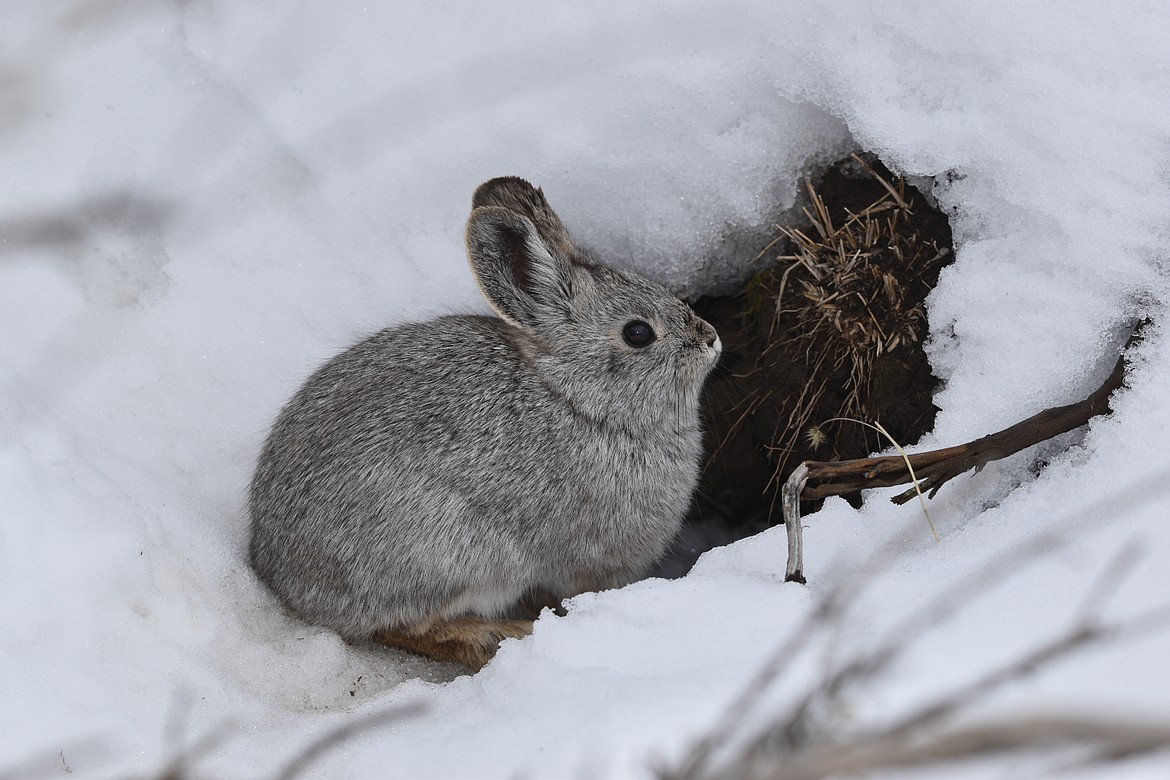
    A pygmy rabbit relies on sagebrush for shelter and food.
 
 
    A pygmy rabbit is released into the wild as part of the recovery effort.
 
 
    Reintroduction of pygmy rabbits to the wild relies a lot on semi-wild breeding enclosures to produce juveniles that are released into suitable habitat with the goal of establishing self-sufficient populations.