Tuesday, September 01, 2026
73.0°F

Like other local districts, Quincy’s school enrollments declining

by CHERYL SCHWEIZER
Staff Writer | September 1, 2026 3:45 AM

QUINCY — The trend is gradual, but it’s the same in the Quincy School District as other Columbia Basin school districts, and districts statewide – student enrollment is declining.  

For the 2026-27 school year, QSD officials are projecting enrollment at the equivalent of about 3,120 students, plus 48 children in the district’s transitional kindergarten class. The 2025-26 school year ended with the equivalent of 3,181 students, but the graduating senior class was considerably bigger than the incoming kindergarten class.  

The Class of 2026 was about the equivalent of 287 students, and the incoming kindergarten is projected at about 215 students.  

District superintendent Nik Bergman said Quincy is affected by the same demographic factors as most Washington schools.  

“We had these massive bubble classes that showed up 10 years ago,12 years ago, and they're slowly graduating and leaving our system, and that's where you're seeing that trend statewide,” Bergman said. “A lot of school districts are seeing those large senior classes, that large secondary population age out, and the classes coming in are not the same student populations.” 

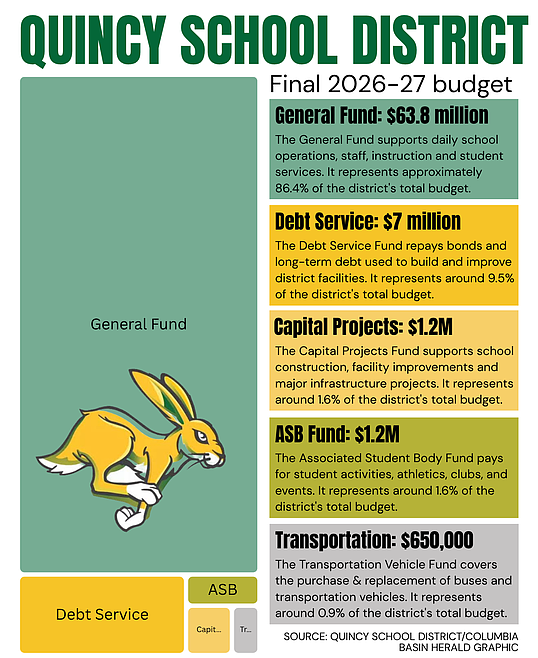
The QSD general fund, which pays for most salaries and district operations, was budgeted at about $63.7 million. The debt service fund pays back bonds issued to pay for capital projects; the budget projection for it was about $7.1 million.  

The transportation vehicle fund pays for buses and other district-owned vehicles and was budgeted at about $650,000. 

For 2026-27, QSD officials plan to spend about $575,000 to buy new school buses, according to information from the district.  

The Associated Student Body fund was budgeted at about $1.2 million, most of it raised by the students.  

The capital projects fund pays for facility-related projects and was projected at about $1.2 million. The district received a $200,000 grant through the Healthy Kids-Healthy Schools program, which must be spent on nutrition improvements, physical education improvements, or both. About $957,000 is allocated for repairs and improvements district wide.  

Bergman said more housing is being built, and Quincy is growing, so the decline is gradual when compared to some other districts. 

“We’re not seeing people leaving; we’re just seeing not as many students at lower grades,” he said.  

The biggest factor in Quincy, he said, is that there are fewer children in general.  

“There are multiple factors driving that, and I think what we are also seeing is a trend in low birth rates. Fewer people are having children, or they’re waiting until they’re in their late 20s to mid-30s to have children, and if they do, they’re having one or two children,” Bergman said. 

In Washington, school funding is driven by enrollment, and fewer students means less funding. It also means fewer teachers and less support staff are needed. Bergman said QSD has been able to absorb those by not filling open positions.  

“We’ve had fewer kids at the middle school, but we’ve been able to make adjustments through attrition,” he said. “It’s not some sweeping traumatic cut, it's just us really closely examining every position, looking at our student populations in each building and making sure we’re adjusting accordingly,” he said.  

Quincy does benefit from a robust tax base, Bergman said, and the district is eligible for more federal funding due to its economics.  

“We have higher federal dollars than some of the surrounding areas. We have a higher multilingual population. We are still a low-income district, so we still receive a lot of title funds that other districts don't,” Bergman said. “But we're seeing a change in that.” 

The percentage of students qualifying for free or reduced-price meals has declined from about 67% to 72%, he said.