


Assessor candidates discuss fair valuations, transparency and taxpayer service
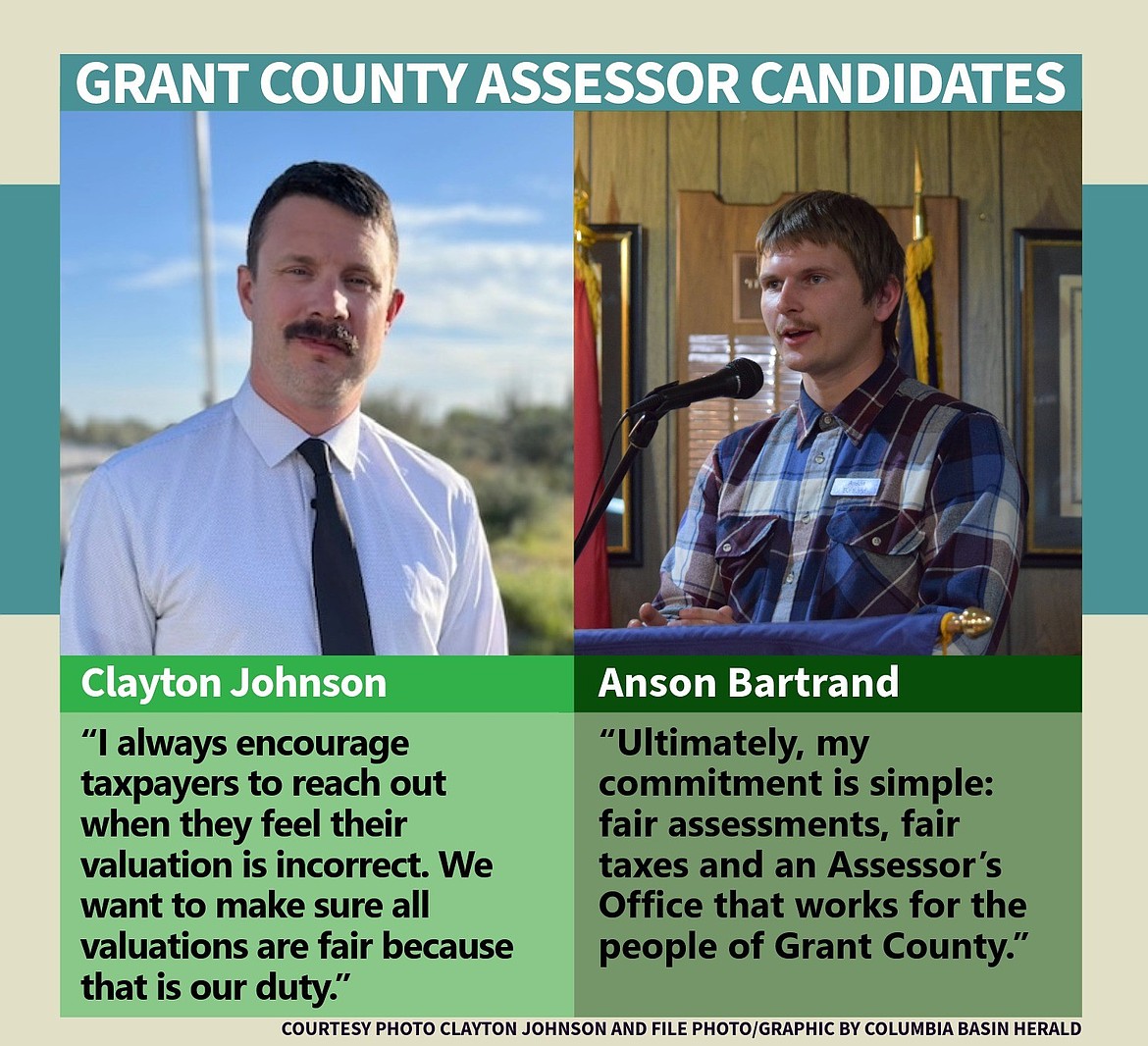
EPHRATA — With ballots due Nov. 3, Grant County voters will soon decide who will serve as the county's next assessor, an office responsible for valuing property, administering exemptions and ensuring assessments comply with state law. The position plays a key role in determining the property values used to calculate local property taxes for homeowners, farmers, businesses and other property owners throughout the county.
The race features Clayton Johnson, a longtime employee of the Grant County Assessor's Office who currently serves as the county's senior sales analyst, and Anson Bartrand, a chief financial officer who says his background in finance, real estate and organizational management would bring a fresh perspective to the office.
The Columbia Basin Herald asked both candidates about their qualifications, assessment practices, taxpayer concerns and potential improvements to the assessor's office. Their responses, published below, have been edited only for style and clarity.
Ballots must be postmarked or returned to an official ballot drop box by Nov. 3. Voters can verify their registration status and access election information through VoteWA.gov. Grant County voters may also contact the Grant County Elections Office at 509-754-2011, ext. 2704, with election-related questions.
Question: Why are you running for Grant County Assessor, and what experience or qualifications make you the best person to oversee property assessment for county taxpayers?
Johnson: I am running for Grant County Assessor because I want an assessor's office that best serves the public because that’s what the taxpayers deserve. I have worked in the assessor’s office for nine years, seven of those as the commercial and industrial appraiser, and the last two years in the senior position of sales analyst. I have over 250 hours of continuing education in property assessments. That knowledge and experience, mixed with a desire for continual improvement, are why I am the best candidate to be the next assessor.
Bartrand: I am running because Grant County taxpayers deserve an Assessor’s Office that is efficient, transparent, accurate and responsive. Property taxes are a significant burden for families, farmers and businesses, and taxpayers deserve confidence that their assessments are completed correctly and on time.
My background includes years of experience as a chief financial officer for a land investment and management company, multiple directly applicable college degrees, and a commitment to conservative values. This combination gives me a strong foundation in financial management, real estate, organizational efficiency and understanding the laws that govern the office.
Just as importantly, effective leadership requires listening. I want to work collaboratively with taxpayers, assessor’s office employees and other county departments to identify problems, improve communication and find practical solutions. Government works best when people work together rather than allowing disagreements to interfere with serving the public.
I will lead with humility, accountability and a willingness to learn. My goal is to make the office more efficient, eliminate unnecessary waste and ensure that required work is completed on time.
Ultimately, my commitment is simple: fair assessments, fair taxes and an assessor’s office that works for the people of Grant County.
Question: Property values have fluctuated significantly in recent years. How would you explain the assessment process to residents who believe their property has been overvalued or unfairly assessed?
Bartrand: I would begin by listening to the property owner and explaining how the assessment was determined. Washington law generally requires property to be assessed at its true and fair market value as of the applicable assessment date. But that does not mean the Assessor’s Office is incapable of making mistakes.
One improvement I hope to implement is a more formal mediation process that gives property owners an opportunity to express their concerns, review the evidence and work toward a resolution with the Assessor’s Office before escalating the matter to the Board of Equalization. The Board of Equalization operates under a statutory framework that presumes the assessor’s valuation is correct, placing the burden on the taxpayer to demonstrate otherwise. Resolving misunderstandings or correcting errors earlier could save taxpayers and the county time, money and frustration.
A good assessor must lead with humility. I will never assume that my office is automatically right simply because we made the assessment. I am human, and I can make mistakes. When the evidence shows that we got something wrong, we should acknowledge it and correct it.
Taxpayers deserve a fair hearing, a clear explanation and a process that treats their concerns seriously and respectfully.
Johnson: Property in Washington state is valued at 100% of its true and fair market value. In Grant County we use a market-adjusted cost approach to determine fair market value. The cost approach is based on replacement cost new less depreciation, what it would cost to build your home or building today, minus depreciation based on the age and condition. That is then compared to what homes are selling for and adjusted to bring it up to fair market value. As sales prices change, property valuations will change as well. If you believe that your property value is incorrect, you can appeal to the Board of Equalization. We will review the valuation to ensure the value is supported by the market and if not, we will make the necessary adjustments. If the value is supported and no adjustments are able to be made you can continue on to the Board of Equalization hearing where a third party will weigh the evidence of both parties and determine the fair market value. I always encourage taxpayers to reach out when they feel their valuation is incorrect, we want to make sure all valuations are fair because that is our duty.
Question: The assessor's office must balance accurate property valuations with taxpayer concerns. How would you ensure assessments are fair, consistent and transparent across the county?
Johnson: My experience and knowledge give me the tools necessary to ensure property valuations are fair and consistent by working directly with the appraisal staff to implement policies and procedures that will ensure property valuations are accurate. This includes maximizing efficiency in the inspection process as well as more detailed sales verification processes to ensure the sales data we are using for market adjustments is up to date and accurate. I would strive to make the valuation data clear and accessible for everyone so you don’t need a degree in finance or be an appraiser to understand how we came up with your value. And I will be out in the community explaining the processes and answering questions because that is what public servants should be doing!
Bartrand: Fairness begins with consistent methods, accurate data and accountability. Similar properties should be evaluated using consistent standards, while legitimate differences in location, condition, use and other relevant characteristics must be recognized.
I would emphasize quality control, regular review of valuation practices and compliance with state law and professional standards. I would also ensure that staff members have clear expectations, appropriate training and the resources necessary to complete their work accurately and on time.
Transparency means explaining how assessments are made and making relevant information accessible to property owners. When someone questions an assessment, the office should be able to explain the reasoning and supporting evidence in understandable terms.
I would also establish a culture in which mistakes are acknowledged and corrected rather than defended simply because they were made by the office. At the same time, decisions must be based on evidence and applicable law, not political pressure or personal relationships.
Question: What improvements, if any, would you make to the assessor's office to better serve property owners, farmers, businesses and other taxpayers?
Bartrand: I would begin with a thorough review of the office’s operations, budget, staffing, technology and workflow. Before asking the commissioners (and the taxpayers) for more money, we should identify opportunities to reduce unnecessary spending, eliminate duplication and use existing resources more effectively.
Meeting statutory deadlines would be a priority. Delays can create uncertainty for taxpayers and local governments that depend on timely assessment information. I would establish clear performance expectations and monitor progress so problems can be addressed before deadlines are missed.
I would also work to improve communication with property owners. People should be able to understand their assessments, find answers to common questions and learn how to correct errors or appeal decisions without navigating an unnecessarily complicated process.
Farmers and businesses can have specialized assessment questions involving agricultural land, current-use programs, improvements and other property classifications. I would ensure staff members understand the applicable rules and explain them consistently.
Finally, I would lead with humility and accountability. That means listening to employees and taxpayers, evaluating what works, correcting what does not and measuring improvements by results. My objective would be a more efficient, responsive office that respects taxpayers’ money while fulfilling every legal obligation.
Johnson: The improvements I would make mostly include the things I mentioned previously, maximizing efficiency in the appraisal process and making the data clear and accessible for all. I will also foster an office environment where staff feel respected and have the tools necessary to best serve the public. That will help ensure we keep experienced staff members around, which leads to more efficiency in property valuations. The answer to keeping experienced staff members around is simple: treat them with respect. It’s the golden rule, treat people how you want to be treated. People who feel respected and like where they work don’t look for other jobs.
Question: As assessor, your job is to follow state law, even when property owners are unhappy with the outcome. Tell voters about a situation where you would be willing to make an unpopular assessment decision, and why maintaining fairness is more important than avoiding criticism.
Johnson: As the current sales analyst for the Assessor’s Office I am responsible for a majority of the appeals of property values so I am quite experienced in assisting unhappy property owners who do not agree with their values! The key to dealing with these situations is remaining professional and focusing on the data and not emotion. There have been many situations where I have had to make unpopular assessment decisions based on the data. As many people have seen, in the last few years the real estate market has gone up pretty significantly. Homes have sold for much higher prices than in the past and that can cause your property value to go up as well. I have received criticism, sometimes publicly, over the increase in property valuations. However, it is my job to follow state law on how to value property, whether that is popular or not. I will continue to focus on making sure values are fair and consistent, while acting with compassion and respect, with the understanding that not everyone will always agree with the process.
Bartrand: Suppose a popular local business, a large property owner or a well-known community member believed their property should receive a lower assessment. If the evidence and applicable law supported the existing valuation, I would be willing to uphold it even if doing so brought criticism. Conversely, if the evidence showed the assessment was too high, I would expect the office to correct it, regardless of the owner’s identity. We cannot create special treatment for one owner while denying the same treatment to another owner in comparable circumstances.
The Assessor’s Office should not be used to reward friends, punish critics or avoid difficult decisions. Nor should an assessment be increased or decreased to achieve a desired tax outcome unrelated to the legal valuation process.
My responsibility would be to apply the law consistently, explain the evidence and treat people respectfully. Fairness sometimes means delivering an answer someone does not want to hear. Public trust depends on knowing that the answer was reached honestly and impartially.
