
Court candidates outline experience, judicial philosophy at Legion forum
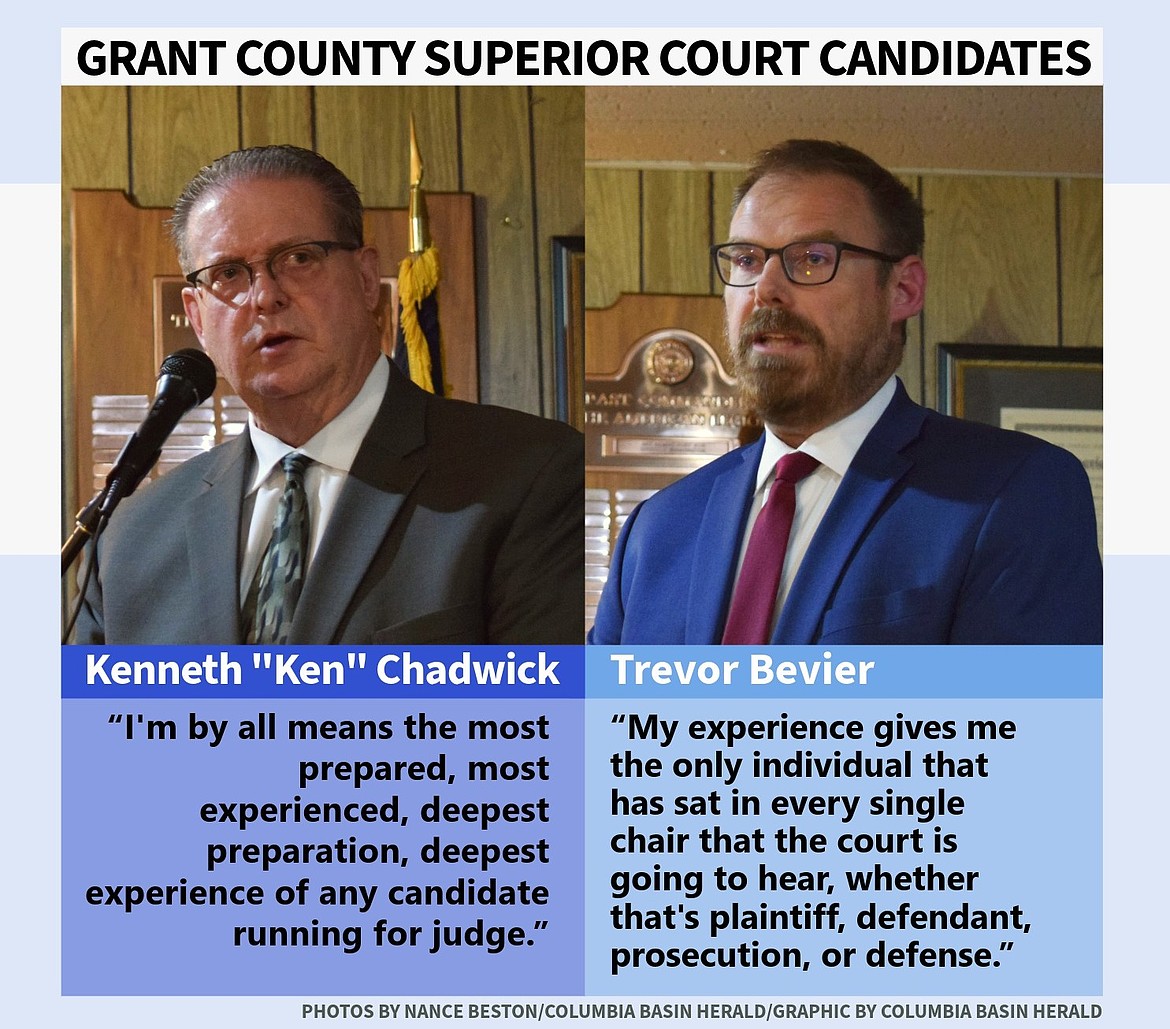

EPHRATA — Candidates for Grant County Superior Court judge offered differing perspectives on constitutional interpretation, therapeutic courts and their qualifications for the bench during an Oct. 21 forum hosted by the Art Semro American Legion Post 28.
Kenneth “Ken” Chadwick and Trevor Bevier both discussed their lengthy legal careers and courtroom experience while making the case for why voters should entrust them with one of the county’s highest judicial positions.
Chadwick, an Ephrata attorney, told attendees his background sets him apart from the field. Before becoming a lawyer, Chadwick spent 15 years in law enforcement as a police officer and sergeant and has practiced law in Ephrata since 2007.
“I've been in the courts for about 40 years,” Chadwick said. “I've been appointed by the superior court to be a pro tem judge, I have been appointed to be an arbitrator, so I do make decisions.”
He also talked about his volunteer work representing veterans and nonprofit organizations at no cost and said community service has been a constant throughout his career.
“I'm by all means the most prepared, most experienced, deepest preparation, deepest experience of any candidate running for judge,” Chadwick said.
Bevier talked about his local roots and broad legal background. A graduate of Ephrata High School, he said his early work as a farmhand, in construction and later in the title insurance industry taught him accountability and problem-solving before he pursued a law degree.
After earning degrees from Central Washington University and Gonzaga University, Bevier returned to Grant County and spent 14 years in private practice before joining the Grant County Prosecuting Attorney’s Office as a civil deputy prosecutor.
“My experience (makes) me the only individual who has sat in every single chair that the court is going to hear, whether that's plaintiff, defendant, prosecution, or defense,” Bevier said. “I've sat in every one of those chairs.”
Asked whether they had ever disagreed with the Washington Supreme Court, both candidates answered yes but framed their responses differently.
Chadwick said some decisions have conflicted with his interpretation of the federal and state constitutions.
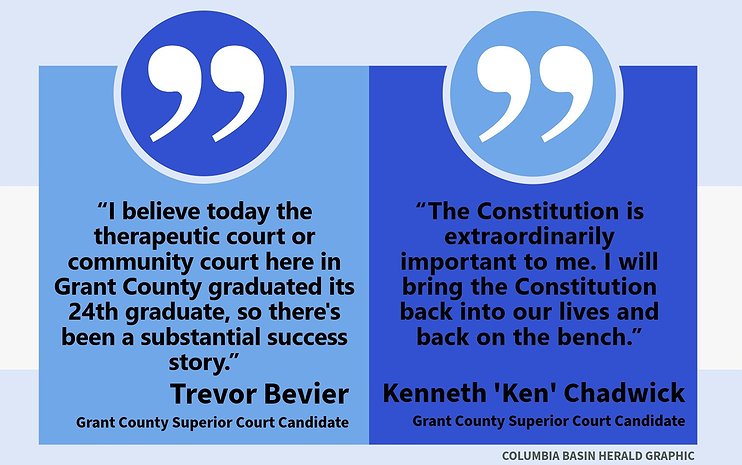
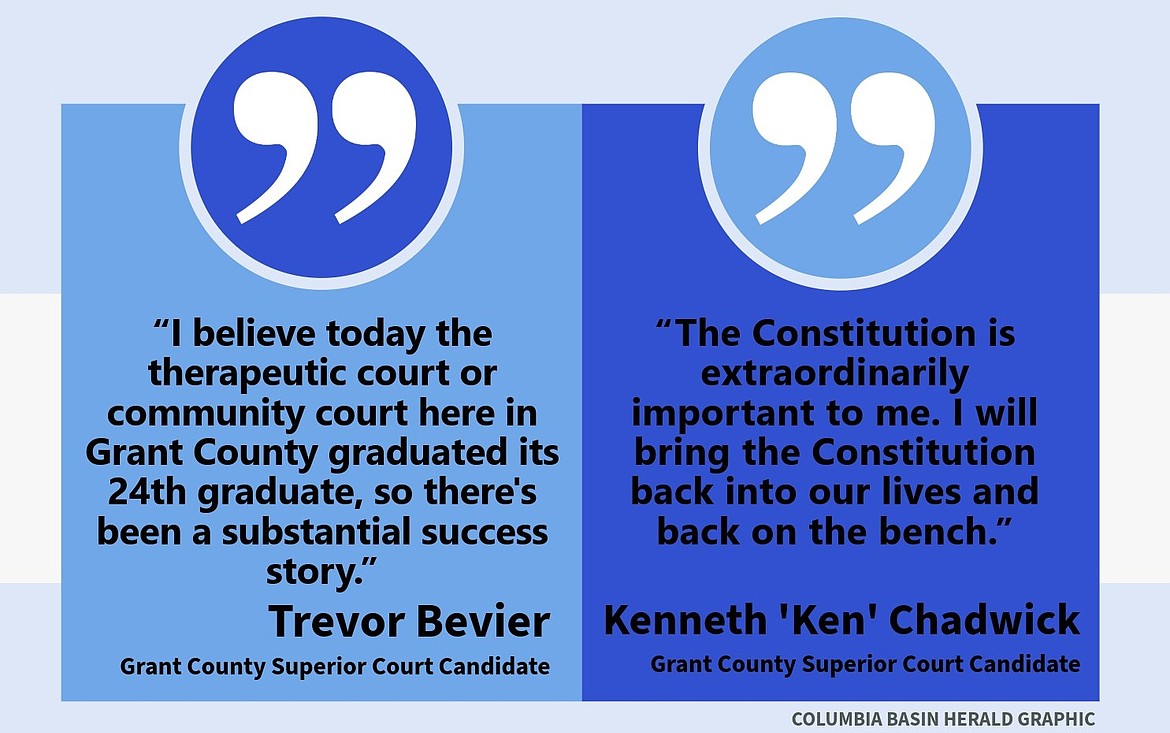
“The Constitution is extraordinarily important to me,” Chadwick said. “I will bring the Constitution back into our lives and back on the bench.”
Bevier said disagreement with appellate decisions is common among attorneys and judges and noted that some rulings are later overturned.
“I don't think there's any lawyer, any judge that can say they've always agreed with any decision that an appellate court makes,” Bevier said.
The candidates also addressed how they would uphold Washington law if elected.
Bevier said judges should begin with the text of a statute before reviewing precedent and applying both to the facts presented in court.
“Words matter. They're there for a reason,” Bevier said. “Precedent controls. That's what the Grant County Superior Court does: it applies the precedent that exists to the cases.”
Chadwick said constitutional analysis should accompany every judicial decision.
“The Constitution will be in the back of my mind whenever I am on the bench,” Chadwick said.
Both candidates cited jury trial experience as preparation for serving as a judge.
Chadwick said he has served as lead counsel in multiple civil and criminal jury trials, arguing evidentiary and constitutional issues before juries throughout his career.
“That's where the evidence rules meet the road,” Chadwick said.
Bevier said trial work requires attorneys to evaluate evidence, prepare witnesses and develop legal arguments under pressure.
“All that work primed me to be prepared and ready for the bench,” Bevier said.
One of the clearest distinctions between the candidates emerged during a discussion on therapeutic courts.
Bevier voiced support for the programs, saying they can address underlying issues that contribute to criminal behavior and pointing to graduates of Grant County’s program as evidence of success.
“I believe today the therapeutic court or community court here in Grant County graduated its 24th graduate, so there's been a substantial success story,” Bevier said.
Chadwick described himself as “ambivalent” about drug courts, saying he has seen participants fail to comply with program requirements and remains unconvinced of their overall effectiveness.
“I know that punishment works,” Chadwick said. “There has to be a carrot and a stick.”
The Nov. 3 election will determine which candidate voters select to serve on the Grant County Superior Court bench.