
Buyers beware: Sheriff's Office offers tips after stolen pickup sold online

“Don't pay for anything in advance. Don't give them a holding fee or put money down on something until you make that exchange of money for goods in person.”
— GCSO Public Information Officer Kyle Foreman
EPHRATA — A recent Grant County investigation involving a stolen pickup truck sold through Facebook Marketplace serves as a reminder that online bargains can sometimes come with costly consequences.
Grant County Sheriff's deputies arrested a Moses Lake man Friday after recovering a stolen 2004 Ford F-350 that had allegedly been sold to an unsuspecting buyer through Facebook Marketplace. During the investigation, deputies also located several additional stolen vehicles on property near Moses Lake, according to the Grant County Sheriff's Office.
The case emphasizes a growing concern for both law enforcement and consumers as more people turn to online marketplaces to buy vehicles, tools and other expensive items.
“Be very careful with who you're dealing with,” said Grant County Sheriff's Office Public Information Officer Kyle Foreman. “Do your due diligence to help prevent a scam from happening.”
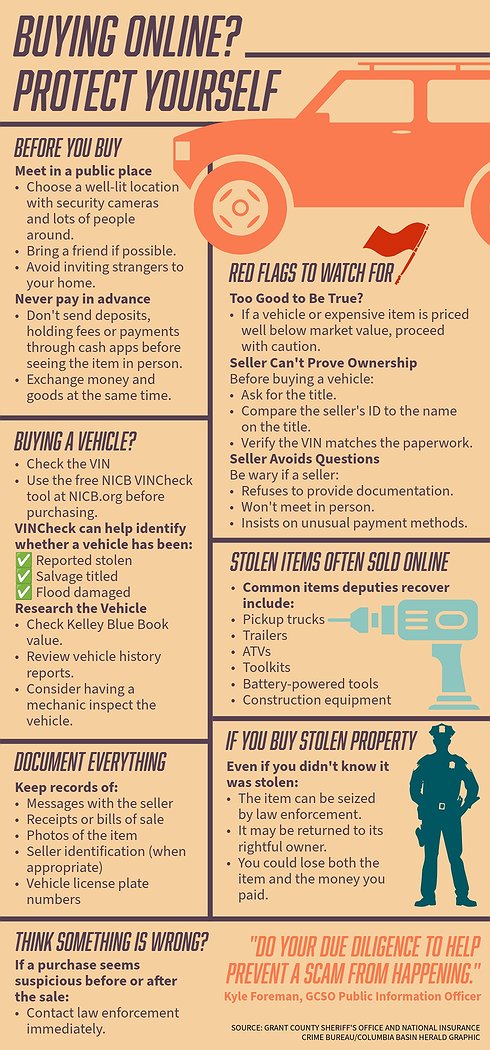
Foreman said one of the first considerations should be personal safety. Buyers and sellers should arrange to meet in a public location with good lighting, security cameras and other people nearby.
“Try not to invite people over to your house,” Foreman said. “You should go to someplace which is well lit, busy with other people around, security cameras.”
He also recommends bringing another person to the exchange and avoiding advance payments.
“Don't pay for anything in advance,” he said. “Don't give them a holding fee or put money down on something until you make that exchange of money for goods in person.”
When purchasing a vehicle from a private seller, Foreman said buyers should verify ownership by examining the title and matching it to the seller's identification.
“Do you have the title to the vehicle in hand?” Foreman said. “Ask for their identification as well. Look at their title, look at their identification to make sure the names match on the title.”
One of the biggest warning signs is a price that seems too good to be true.
“If the person's selling a late-model vehicle that is known to have great value and they're selling it for a price way below that value, I'd just ignore that one,” Foreman said. “That's a red flag. There's something wrong with that sale.”
Buyers can research a vehicle's approximate value through resources such as Kelley Blue Book and should take time to investigate any known mechanical issues before making a purchase, he added.
Foreman also encouraged buyers to inspect items carefully for signs that they may belong to someone else.
“When you get the item in your hands, take a good close look at it,” he said. “See if it has any property stickers on it, if it has anything engraved into the housing that would indicate who owns it.”
According to the National Insurance Crime Bureau, consumers should also check a vehicle's history before completing a purchase. The organization's free VINCheck tool allows users to determine whether a vehicle has been reported stolen and not recovered, or reported as salvage or flood-damaged by participating insurance companies.
The service can be accessed at NICB.org by entering a vehicle identification number.
The bureau also warns consumers about vehicle-cloning schemes, in which criminals copy a legitimate VIN from a legally owned vehicle, place it on a stolen vehicle and create counterfeit ownership documents before selling it to an unsuspecting buyer.
Even buyers who unknowingly purchase a cloned or stolen vehicle can lose both the vehicle and the money they paid.
“If they unknowingly purchased the property and we are able to trace that property, unfortunately they are out the money for what they purchased,” Foreman said.
Any property identified as stolen is typically seized and returned to its rightful owner, Foreman said.
Foreman said investigators regularly encounter cases involving stolen property being sold through online marketplaces.
“Those are frequent,” he said. “They happen weekly, several times a week, just because of the accessibility of online marketplaces.”
Tool kits, battery-powered tools and other easily transported items are among the most common types of stolen property that appear for resale online, according to Foreman.
To protect themselves, buyers should save records of transactions, photograph the seller's identification when appropriate, and document vehicle information, including license plate numbers.
If something seems suspicious before or after a purchase, Foreman said, contact law enforcement.
“Don't be afraid to come forward and ask if something you purchased may be stolen,” he said. “It's highly unlikely you're going to be charged with a crime just because you unknowingly purchased stolen property in good faith.”