


Candidates discuss rural priorities, budget concerns at forum
MOSES LAKE — Candidates in three races representing the 13th Legislative District and Washington’s 4th Congressional District shared their views on agriculture, mental health, government spending, water policy and rural representation during the Moses Lake Chamber of Commerce candidate forum Monday evening. This story covers the legislative and congressional contests, while additional stories will examine races for county offices, commissioner positions, sheriff and judge.
To watch the full forum, visit bit.ly/MosesLakeChamberForum.
Ballots must be postmarked or placed in an official ballot drop box by Nov. 3. Voters can verify their registration status and find election information at VoteWa.gov. Grant County voters with questions can also contact their county elections office at 509-754-2011 ext. 2704. Adams County voters with questions can contact their local elections office at 509-659-3249.
13th Legislative District Pos. 1
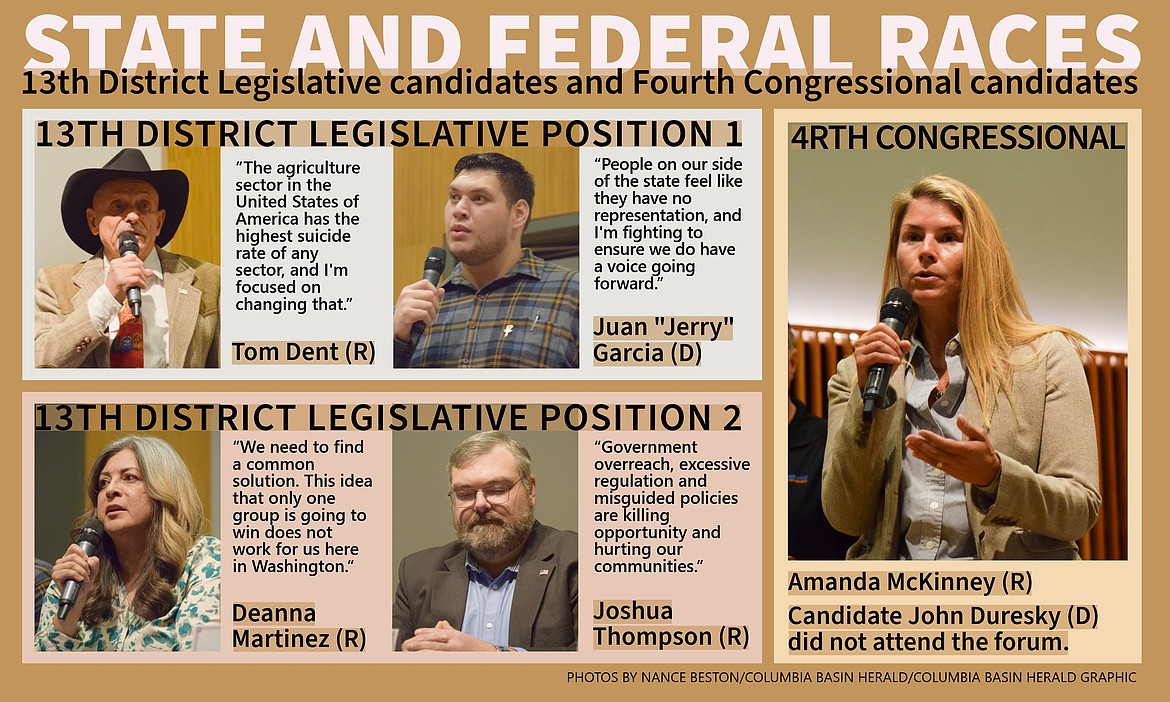
Republican incumbent Tom Dent and Democratic challenger Juan “Jerry” Garcia presented different approaches to addressing rural challenges during Monday's candidate forum, discussing agriculture, mental health, affordability and representation in Olympia.
Garcia centered much of his remarks on affordability and giving Eastern Washington residents a stronger voice in state government.
“Affordability is something,” Garcia said. “It's more public investment so we have something that's worthwhile for future generations.”
Garcia also talked about his independence as a candidate, telling attendees that his political affiliation does not define his views on rural issues.
“Just because I'm running as a Democrat, I'm not inherently beholden to their standards,” Garcia said. “I live in a rural area, and I believe that my diverse mindset is something that will benefit this district heavily.”
He said he does not accept corporate political action committee contributions and said many residents east of the Cascades feel disconnected from decision makers in Olympia.
“People on our side of the state feel like they have no representation,” Garcia said. “I'm fighting for our district to have more voice and ensure that we do have a voice for people going forward.”
When discussing agriculture, Garcia pointed to right-to-repair legislation as a way to help family farms reduce costs and gain greater control over equipment maintenance. He also talked about expanding mental health and substance abuse treatment programs and improving transportation access for people seeking services.
“We can save a lot of money,” Garcia said, by reducing repeat incarceration and expanding programs that help people access treatment and employment opportunities.
Dent focused his comments on the needs of the agricultural community and the importance of expanding rural mental health resources.
“The agriculture sector in the United States of America has the highest suicide rate of any sector, and I'm focused on changing that,” Dent said.
Asked how lawmakers should improve access to mental health and substance abuse treatment, Dent called for greater investment in recovery services and treatment facilities.
“We need to support new substance abuse centers,” Dent said. “We need more facilities and other folks that get there and give them a chance.”
Drawing on his own experience in recovery, Dent said people struggling with addiction need support rather than stigma.
“I've been in recovery for 39 years, and I got there because somebody gave me a hand up and believed in me and helped me get there,” Dent said. “We need to help them. Not a handout. A hand up.”
Dent also argued that state regulations have placed significant burdens on farmers and ranchers.
“Agriculture is overregulated,” he said. “We're crushing them on the regulations.”
He said lawmakers need to improve conditions for agricultural producers across Washington.
“The state of Washington is number 50 in agricultural profitability in the United States,” Dent said. “A farmer doesn't want a handout. He just wants a chance to make it work.”
13th Legislative District Pos. 2
Candidates for 13th Legislative District Position 2 also centered much of their discussion on state spending and protecting rural interests.
Republican candidate Deanna Martinez said the state government should focus on evaluating programs based on results rather than adding taxes.
“We need to look at what we're spending money on,” Martinez said. “Where's it going? Are we getting results for the money that we're spending?”
She said agencies and organizations receiving state funding should be accountable for demonstrating outcomes.
“Departments and organizations that are receiving money need to be transparent about what they're spending on,” Martinez said.
Martinez also voiced opposition to a state income tax.
“I don't agree that we need an income tax,” she said. “We need to learn how to spend within our own means.”
Addressing regional issues, Martinez highlighted the importance of collaboration on water resources.
“We need water for agriculture not only to feed our area, but to feed the world,” she said. “This idea that only one group is going to win does not work for us here in Washington.”
Republican candidate Joshua Thompson emphasized local control and frustration with state government.
“Too many decisions are being made in Olympia and not enough in our communities,” Thompson said during his introduction.
He criticized regulations affecting agriculture and called for a review of state spending.
“We've got departments that are overly aggressive, like the Department of Ecology, and look at what they've done to our farmers and ranchers here in Grant County,” Thompson said.
Thompson also expressed concern about future tax proposals.
“I don't want to see us end up with a state income tax,” he said. “We're going to have to fight back as much as we can.”
When discussing infrastructure and water issues, Thompson said they are critical to the district's future.
“Water and power are life-and-death issues for our farmers, our workers and our businesses,” he said.
Despite policy disagreements in Olympia, Thompson said relationships remain important to effective governing.
“It's about trying to separate the policy from the person and talk to the person first,” he said.
Fourth Congressional District
With her opponent, Democrat John Duresky, absent from the forum, Republican congressional candidate Amanda McKinney had the opportunity to answer questions alone in the race for Washington's 4th Congressional District seat.
McKinney told attendees that local concerns often receive less attention than national political debates.
“There's a lot of talk about national issues when we know locally it's the local issues that really matter to us,” McKinney said.
She cited water, agriculture, energy and jobs as the foundation of the region's economy and pledged to bring rural values to Congress.
“What's critical about Congress is making sure that the people who are voting in Congress on our behalf hold our values and carry them forward,” she said.
She said she would do her best to make sure her votes within Congress align with the fourth congressional district constituents.
Asked about challenges facing younger families and working-age residents, McKinney argued that government regulations and mandates often limit local decision-making.
“What we're seeing is stifling the desire to actually live here and be able to do what you want with your property,” McKinney said.
She repeatedly talked about restoring local control and reducing the influence of federal agencies on local communities.
The candidate also identified water policy as an issue where bipartisan cooperation remains possible.
“Water is why we are able to live in a desert, why we're able to grow food in a desert, why we're able to produce energy,” McKinney said.
She pointed to her work on the Yakima Basin Integrated Plan as an example of bringing together stakeholders from different backgrounds.
“That is a bipartisan issue,” McKinney said. “It's by staying out of the courtroom and actually working together.”