


Cybersecurity Awareness Month serves as reminder to slow down, verify before clicking
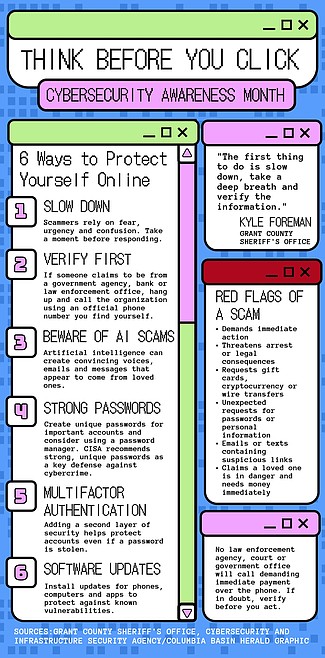
EPHRATA — As artificial intelligence makes fraudulent emails, phone calls and messages more convincing than ever, local officials say one of the best defenses against online scams remains surprisingly simple: slow down.
October is Cybersecurity Awareness Month, and cybersecurity experts are urging residents to take extra precautions as scammers increasingly use sophisticated technology to steal money and personal information. According to the U.S. Cybersecurity and Infrastructure Security Agency, cyber threats continue to evolve rapidly, with phishing attacks, stolen credentials and social engineering schemes remaining among the most common methods used by criminals.
Grant County Sheriff's Office Public Information Officer Kyle Foreman said scam attempts targeting local residents arrive daily through phone calls, emails and text messages.
"We receive reports daily from members of the community who have received attempts at scams," Foreman said.
Foreman said many victims are not careless or uninformed. Instead, he said, professional scammers are often highly skilled at manipulating emotions and creating a sense of urgency.
"The community needs to understand that the scammers are sophisticated, and it is their career to swindle people out of money," Foreman said. "We have to appreciate the fact that they're very good at their jobs."
In many cases, scammers operate from outside the United States, making it nearly impossible for victims to recover lost money once it has been sent.
Foreman said one of the most common scams reported locally involves callers claiming a person missed jury duty, failed to appear in court or has some other legal issue requiring immediate payment.
The tactic relies on fear.
"The swindlers always rely on fear or something to cause the victim to act quickly," Foreman said.
He said legitimate law enforcement agencies and government offices do not call residents demanding immediate payment to avoid arrest.
Another common scheme involves fake computer-security alerts. In those cases, criminals convince victims their computer has been hacked and persuade them to grant remote access. Once inside the system, scammers can steal financial records, passwords and other personal information.
According to CISA, phishing and social-engineering attacks continue to be among the most effective ways criminals gain access to sensitive information because they target people rather than technology. The agency encourages individuals and organizations to recognize and report suspicious messages before clicking links or providing information.
Artificial intelligence has added another layer of complexity.
Foreman said scammers are increasingly using AI-generated voices to impersonate family members in distress. A victim may receive a call that sounds exactly like a child, grandchild or spouse who has supposedly been injured, kidnapped or jailed and needs money immediately.
"Artificial intelligence can create your husband's, wife's, sister's, brother's, daughter's, grandson's voice very, very well to the point where you won't be able to tell the difference," Foreman said.
Those scams can be particularly effective because they bypass a victim's skepticism and immediately trigger concern for a loved one.
Instead of sending money, Foreman recommends independently verifying the person's safety by contacting them directly or asking someone else to reach them.
"The first thing to do is verify their loved one's safety," he said.
While scams often grab headlines, cybersecurity experts say protecting personal devices and accounts is equally important.
CISA recommends four basic cybersecurity practices for individuals and families: use strong and unique passwords, enable multifactor authentication, recognize phishing attempts and keep software updated. The agency also encourages the use of password managers to help maintain secure credentials.
Foreman echoed those recommendations and encouraged residents to maintain updated antivirus software, secure sensitive records and consider using a virtual private network, or VPN.
Parents also play an important role in online safety, he said.
Foreman encourages parents to monitor what their children are doing online, activate parental controls when appropriate and keep computers in common areas where activity can be observed.
"If you have younger children and they're going to be using the internet or their phones, make sure that computer is somewhere that you can see what they're doing online," he said.
Foreman's most important message for residents is not to trust unexpected communications simply because they appear legitimate.
Caller ID numbers can be spoofed, email addresses can be faked and AI-generated messages can sound authentic.
If someone claims to represent a government agency, bank, court or law enforcement office, Foreman recommends hanging up and independently locating the organization's official phone number rather than responding directly.
"Don't fall for any phone calls, emails or text messages where the person is saying they're from the sheriff's office, the court or any government agency where they're pressuring you," he said.
Residents who suspect they have been targeted by a scam can contact their local law enforcement agency or report suspicious activity to the appropriate organization.
Ultimately, Foreman said cybercriminals count on catching people during moments of stress, distraction or panic.
"The first thing to do is slow down, take a deep breath and verify the information," he said.