
Missiles Beneath the Sagebrush: Titan I and the Columbia Basin

This undated photo shows Miss Moses Lake and Miss Larson Air Force Base with a Titan I missile. The photo was altered; in reality, the missiles stood about 100 feet tall, according to the National Park Service.
COURTESY PHOTO/MOSES LAKE MUSEUM & ART CENTER
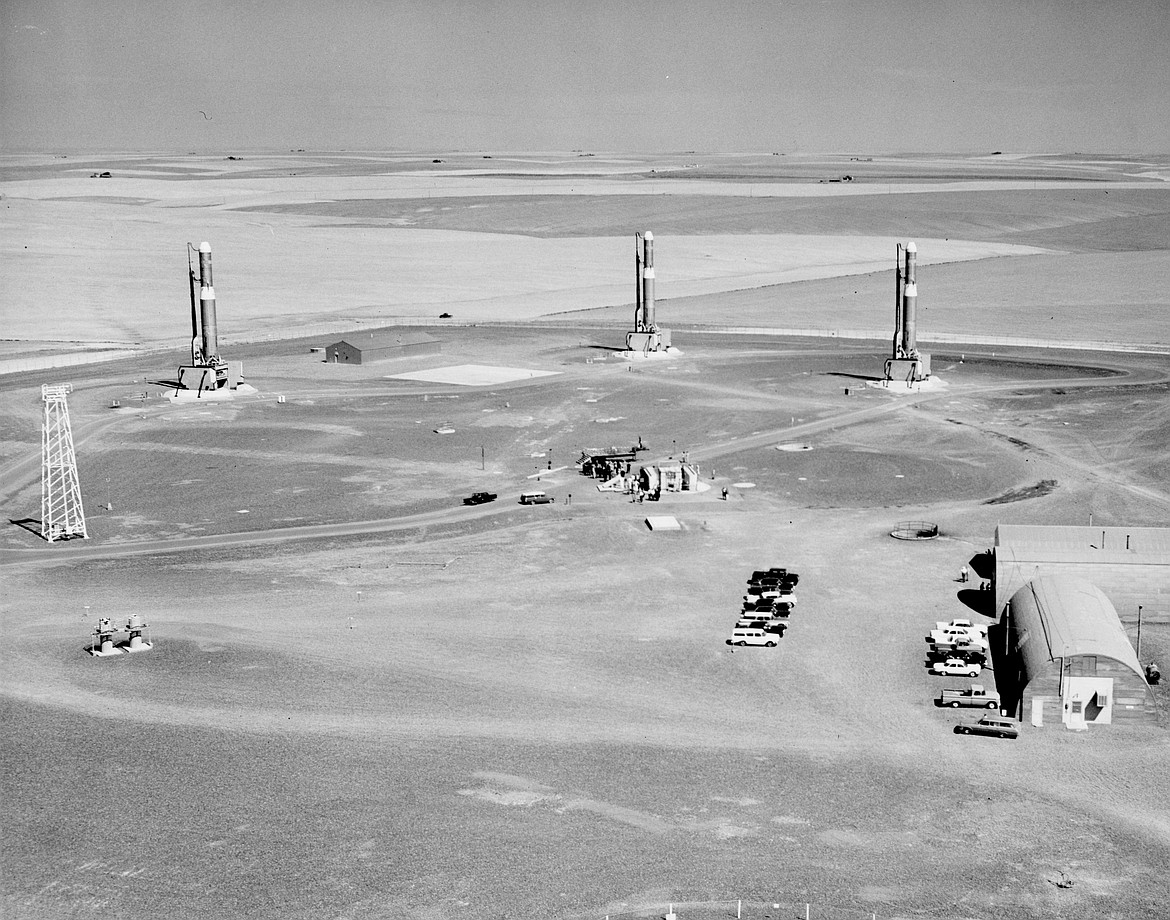
Three Titan I missiles with their silo doors open at Larson Air Force Base in July 1962.
COURTESY PHOTO/MOSES LAKE MUSEUM & ART CENTER
The Moses Lake Army Air Base had a crucial role to play in World War II, but after the Allied victory in 1945, the Base converted to standby status for a time. The Cold War quickly created a set of circumstances that made the military installation necessary and relevant again. The Base reopened as a permanent installation in November 1948 under the Air Defense Command. The mission of its F-82, F-94 and F-86 aircraft was to protect the Hanford Atomic Works, Grand Coulee Dam and the Pacific Northwest coast.
That mission was expanded even further when the military broke ground on the three Titan I missile sites in the Columbia Basin on Dec. 1, 1959. The sites were near Odessa, Quincy and Warden. Construction on the massive installations was completed in 1961, and they became operational in 1962. The 568th Strategic Missile Squadron had operational control of the 160-foot-deep silos which each housed three Titan I’s.
The Martin Marietta Titan I, the first generation of multistage intercontinental ballistic missiles, had an effective range of more than six thousand nautical miles and took fifteen minutes to load before the launch sequence could be initiated. The Titan I was a two-stage rocket, which gave it the range necessary to reach enemy targets, but its liquid oxygen-and-kerosene propellant was dangerous and hard to handle. After launch, the missiles could strike a target in the Soviet Union in 33 minutes.
The liquid fuel required that the missile be stored empty and fueled prior to flight. This meant delayed reaction time and the volatile liquid fuel made the fueling procedure dangerous. Technology moved fast post-war, and the issues with Titan I were solved in subsequent models which quickly made Titan I obsolete. The next generations of intercontinental ballistic missiles had more stable fuel sources and shorter launch times.
By the late 1950s, Moses Lakers were accustomed to the military presence in their town but the presence of missile silos in our backyard was a level of hard reality that asked something new of citizens. Historian Gretchen Heefner put it this way: “Cold War sacrifice has a different meaning – a sacrifice of patience and vigilance, the tedium of waiting and watching. It was also a sacrifice of space and security, as ranchers were asked to cede title to their property and communities were asked to shelter nuclear weapons.”
In February 1964, Secretary of Defense Robert McNamara announced the closing of the Titan I and Atlas E series. This national reduction in intercontinental ballistic missiles inactivated 140 intercontinental ballistic missile sites in June 1965, including the sites controlled by personnel at the recently renamed Larson Air Force Base.
Thankfully, the Air Force never had to deploy the missiles situated in our area but the Airmen who maintained the missiles and oversaw the program did not know that they would never be used. For them, preparing for the threat of thermonuclear war was a day at the office. Airman First Class Herbert T. Elofson was stationed here during that time. In a veteran’s oral history he recalled the complex series of weapons testing, clearances, codes, and permissions they practiced in mock alerts.
“You had to control all these several boards, and you had the phone and you were talking, getting clearances and doing all that,” he said. “I had to call the guy in charge of all the vehicles for moving the weapons and I had to get in charge of the people that were gonna get the weapons ready, and out of the bunkers and moved and, it was a real nightmare trying to get through it.”
An artifact from this era is currently on display at the NASA complex at Moffett Field, California. The Titan I missile, serial number 61-4492, from the Warden site, is a tangible reminder of the Cold War history that shaped Moses Lake in the early 1960s.
Today, the quiet sagebrush landscape of Grant County gives little indication that it once stood on the front line of a global nuclear standoff. Hidden beneath the Columbia Basin were missiles designed for a conflict everyone hoped would never come, yet thousands of military personnel trained and stood ready as if that day might arrive at any moment. Although the silos were deactivated in 1965 and Larson Air Force Base was permanently shuttered in 1966, the story of the Titan I missiles remains an important part of the Columbia Basin’s heritage and place in world history.
Back in the Day appears bi-weekly and looks at the rich and sometimes little-known history of the Columbia Basin.
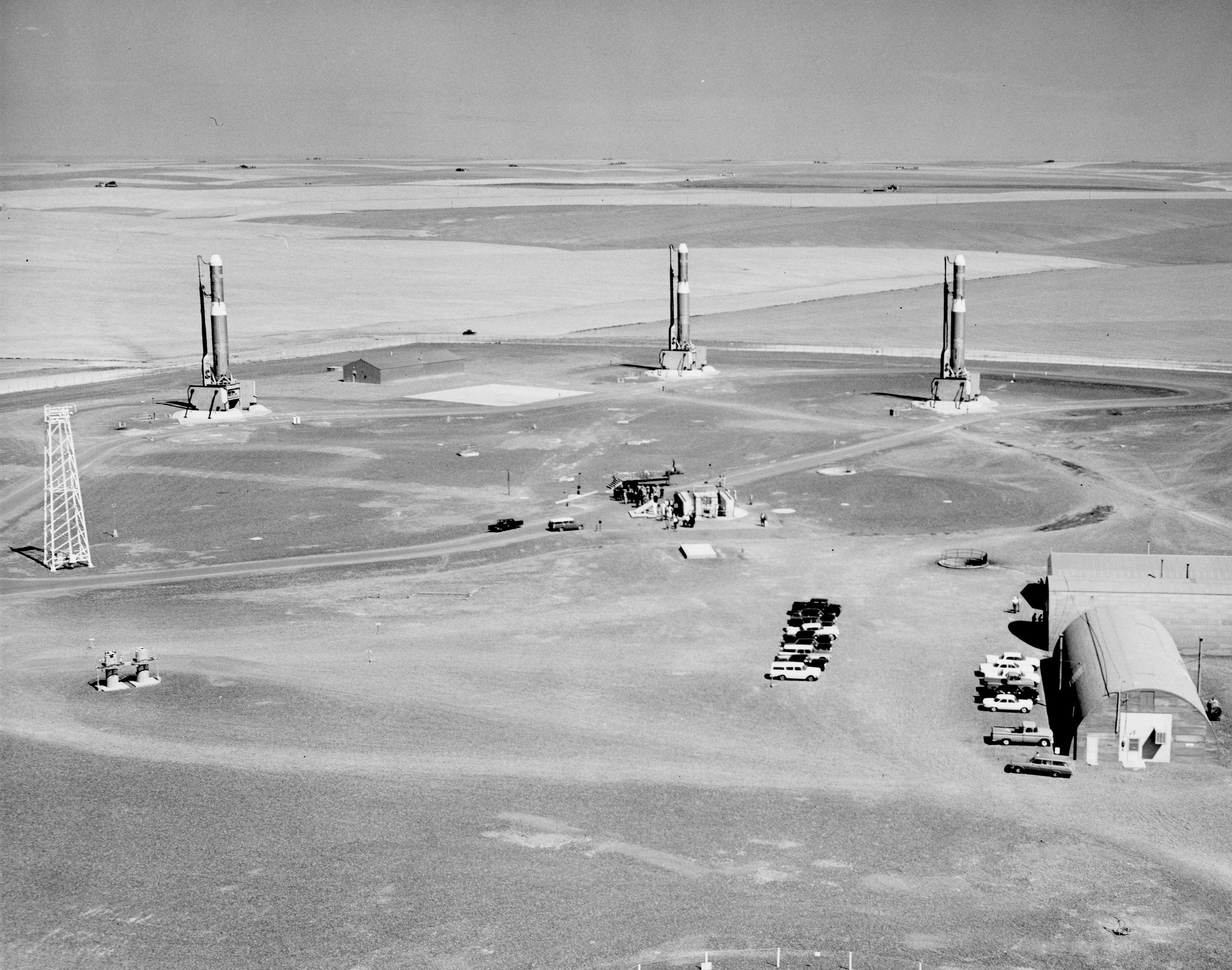 Three Titan I missiles with their silo doors open at Larson Air Force Base in July 1962.