
Grant County Board of Health urges local kratom bans amid rising concerns
“We’re definitely happy to see the conversations already happening in our cities. The health district wants to support the cities and agencies that want to put restrictions on kratom as best as we can.”
Lexi Smith, Grant County Health District
EPHRATA — The Grant County Board of Health is calling on cities, towns and county commissioners to prohibit the sale and distribution of kratom products, citing increasing public health concerns and a rise in related poisonings.
The board passed Resolution 26-06 on May 13, urging local governments across Grant County to adopt temporary bans until state or federal regulations are in place.
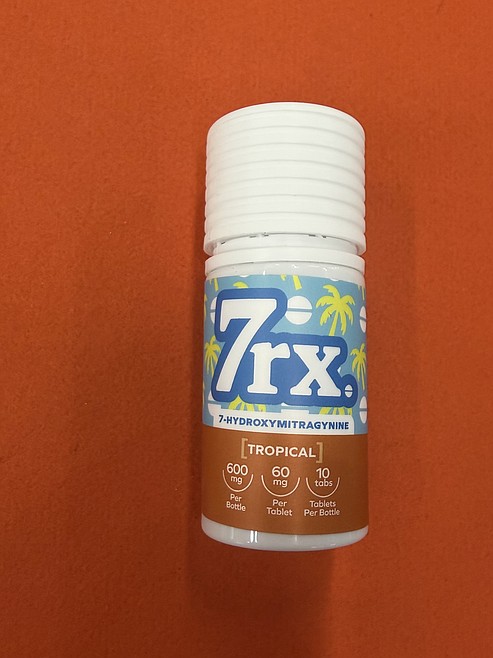
Kratom, a psychoactive substance derived from the leaves of the Southeast Asian tree, Mitragyna speciosa, has become widely available in recent years in forms such as powders, capsules, gummies and liquid shots. While it has traditionally been used in low-potency preparations, health officials say newer products, especially those concentrated with the compound 7-hydroxymitragynine, or 7-OH, pose increasing risks.
“Our big thing is that kratom has been around for centuries, but now what we’re seeing is that the effects can be stronger, and that no part of it is regulated by the FDA,” said Grant County Health District Public Information Officer Lexi Smith.
Smith said many modern kratom products contain elevated levels of 7-OH, a highly potent compound that interacts with opioid receptors in the brain.
“The products are claiming that they have more the 7-OH in them, meaning that they’re likely being manufactured in a way that’s adding different chemicals or going through a process that is still not regulated,” she said.
According to the resolution, the U.S. Food and Drug Administration has warned consumers against using products containing 7-OH due to risks including substance use disorder, liver toxicity, respiratory depression, seizures and, in rare cases, overdose and death.
The move follows a growing number of kratom-related incidents statewide and nationwide. Data from the National Poison Data System shows reports of kratom exposure increased roughly 1,200% between 2015 and 2025, rising from 258 cases to 3,434. Health officials say the increase coincides with the emergence of more potent formulations.
Locally, the Washington Poison Control Center has also reported a “significant increase” in kratom-related exposure calls, including incidents involving children and highly concentrated 7-OH products, according to the health district.
Smith said those trends, along with the substance’s availability in everyday retail settings, prompted action.
“It’s been a growing public health concern, and we’ve been seeing it marketed in convenience stores and places within Grant County,” she said. “And then with the Washington Poison Control announcing that they’ve seen an increase in calls, it prompted the resolution.”
The resolution does not ban kratom but encourages local jurisdictions to do so. It also reflects similar action already taken in parts of the Columbia Basin.
The Othello City Council earlier this year unanimously approved a ban on the sale, advertisement and distribution of kratom and 7-OH products. The decision came after city officials learned of a local case in which a resident was hospitalized after unknowingly consuming the substance.
“This is an up-and-coming new drug that is being sold in our convenience stores, easy to grab, right in front of the counter,” Othello Mayor Ken Johnson said at the time. “The thing about it is, there is no age limit on it. Your 14-year-old could go buy this.”
Warden soon followed, passing its own ban after City Council members raised concerns about the lack of regulation and potential risks to youth.
“We try to get things done and try to be ahead of them,” Councilwoman Emily Campos said. “It’s very important for us to be aware of this stuff.”
Grant County health officials say accessibility – especially among minors – is a key issue. In Washington, there is currently no statewide minimum age requirement to purchase kratom.
“Teens or youth that are purchasing may not know what kratom is, or that there are any risks associated with it,” Smith said. “Because it is marketed as a natural and safe substance, it gives teens a false sense of security.”
Kratom products are sometimes packaged to resemble candy or other sweets, increasing the likelihood of accidental consumption, particularly among children.
In addition to urging policy changes, the health district is encouraging parents and caregivers to talk with young people about the substance.
“We of course encourage parents and caregivers to have conversations with the teens and the youth in their life about all substances and the risks that come along with them,” Smith said. “Kratom being an emerging thing, parents may not know to add that to their list.”
The health district has also developed resources through its prevention programming to help families start those conversations.
Looking ahead, officials say education will remain a priority as policymakers consider broader regulation.
“We will continue to talk about kratom, along with other substances like tobacco and marijuana that we have prevention efforts around,” Smith said. “We’re committed to any follow-up or any news-related items that come out about kratom and sharing that with our community.”
For now, county health leaders say they hope the resolution encourages more local governments to act proactively.
“We’re definitely happy to see the conversations already happening in our cities,” Smith said. “The health district wants to support the cities and agencies that want to put restrictions on kratom as best as we can.”