


ML council discusses grant applications, unintended consequences
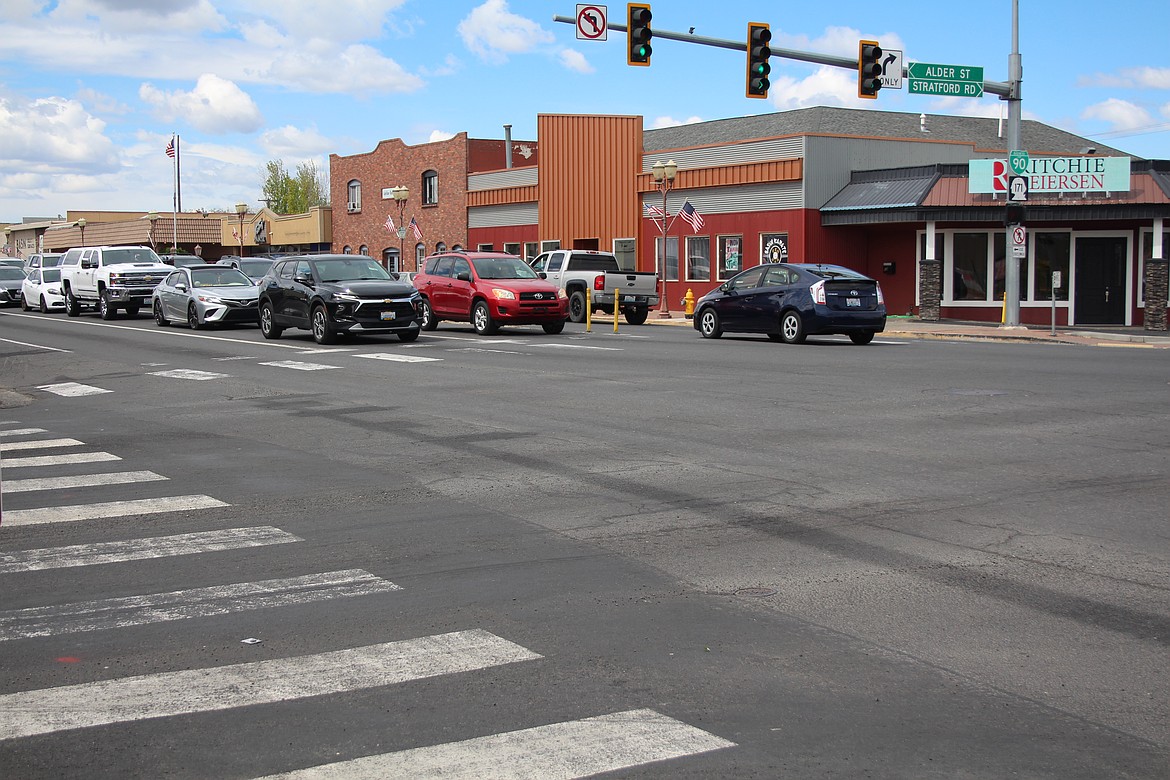
MOSES LAKE — A request to apply for a grant kicked off a discussion about road projects, how to pay for them and unintended consequences. The Moses Lake City Council voted to apply for the grant May 12, but not before a lengthy discussion about the impact of previous projects and how city officials and the council might shape future projects to fit the community.
The federal grant, said Levi Bisnett, project engineer for the city, would pay most of the cost of a traffic safety study and be the foundation of a road safety plan.
“What this allows us to do is receive some planning dollars to develop a comprehensive plan to address some of the safety concerns within the city tied to our roadways,” Bisnett said.
Part of the project would be assembling people and agencies who use the roads a lot to determine where they see the biggest areas of concern.
“Community feedback and (representation from) the schools, the hospital, emergency services – bring everyone together, the county, the state, everyone that utilizes the roads in Moses Lake,” Bisnett said.
Grant funds also can be used in certain circumstances for small demonstration projects. That could be a modular roundabout – or more than one – similar to the one at Road L Northeast and East Wheeler Road, or flashing beacons at a crosswalk, among other possibilities. Bisnett said some of the ideas tested with demonstration projects may not work out.
“Some of the criteria for this funding is that if it doesn’t work, you tear it out,” Bisnett said.
Grant County has already received this grant, Bisnett said, and one of the goals of Moses Lake’s plan would be to ensure the two complement each other. Grant County Public Works Director Andy Reed said in a separate interview that county officials are almost finished writing the safety plan, which is scheduled for release sometime this summer.
Council member Victor Lombardi said that while he was in favor of many of the components, he was skeptical about applying for a grant.
“What happens is, we find out two years later it’s not what we thought it was,” Lombardi said.
Council member Jeremy Davis cited the example of a 2025 project that chip-sealed large sections of Moses Lake’s downtown, sections of East Hill Avenue and East Wheeler Road.
“We don’t want to have our hands tied to a grant that’s going to dictate how we quote-unquote stripe or rearrange lane travel,” Davis said.
Among those who have questioned the restriping is Judy Madewell, former deputy mayor, who spoke during the public comment period about the configuration of the intersection at Alder Street and West Broadway Avenue.
“That’s not a place for a bike lane,” Madewell said. “It needs to go back to the way it was before the striping and everything took place.”
City Administrator Rob Karlinsey said the council would be laying down stipulations for any street project that came from the plan, and could decide not to apply for grants that didn’t meet their criteria.
“I will make sure that you are in full control of what goes into that safety plan,” he said. “I’m pretty sure you don’t want Seattle Second Avenue bike lanes in our city. We’ll be watching out for that stuff.”
If the city has a completed plan, it has a better chance of qualifying for additional federal highway funds, Bisnett said.
Karlinsey said council members all have a list of roads that need attention, but that the city needs money to fix them.
“To do that type of work, we need grants for that, right? We can’t raise that kind of money all by ourselves,” Karlinsey said.
Council member Mark Fancher said that council members had the option to reject possible grants or loans that came with stipulations that council members think are too onerous.
“We have to address these transportation issues,” he said.