Ephrata council considers park and transportation fees for new developments
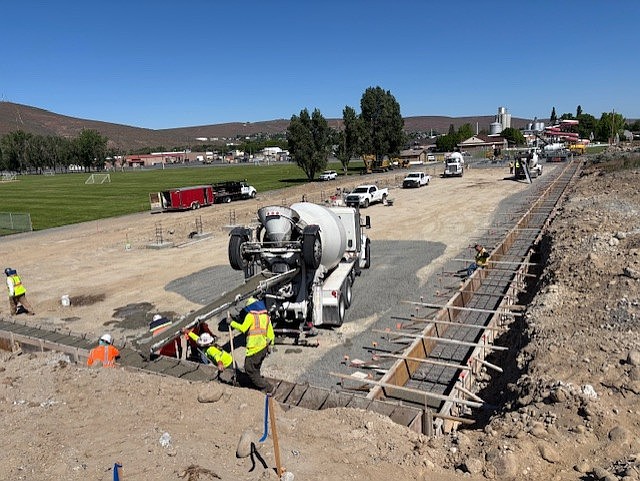
The City of Ephrata is considering park and transportation impact fees for new development to help offset the cost of growth without raising taxes. The Ephrata Sports Complex, now being renovated, is an example of a project that could be funded in part through impact fees.
COURTESY PHOTO/CITY OF EPHRATA/SHAWN O’BRIEN
EPHRATA — The Ephrata City Council continued discussions Wednesday on whether to adopt new park and transportation impact fees that would apply to future development, a move city officials say could help offset the cost of growth without raising taxes. No formal action was taken at the May 6 meeting.
Project manager Tim Wood, speaking to the council virtually, explained how such fees would be calculated under Washington law and how they could be implemented if the council chooses to move forward.
Impact fees are one-time charges imposed on developers of new development to help pay for infrastructure needed to serve growth. In Ephrata’s case, the proposed fees would support transportation improvements and park projects over the next 20 years.
Wood explained that impact fees are based on a relatively simple formula: eligible project costs divided by the amount of growth expected. State law limits fees to a “maximum defensible” amount tied directly to growth-related impacts.
For transportation, the analysis relies on projected vehicle trips during the weekday afternoon peak hour, considered the most congested period. Based on the city’s comprehensive plan, Ephrata is expected to see approximately 3,224 new in-city vehicle trips during the 4–6 p.m. peak over the next two decades, after excluding trips that merely pass through the city.
Those trips would be tied to a list of road projects developed by SCJ Alliance, including improvements to Division Avenue, Alder Street, Peachtree Drive, and multiple new north-south and east-west road connections. The total cost of the transportation project list is about $33.8 million, but after accounting for outside funding and limiting charges to the portion attributable to new growth, about $6.8 million would be eligible for transportation impact fees.
That results in a base transportation impact fee of approximately $1,969 per single-family home, based on typical trip generation rates published by the Institute of Transportation Engineers.
The proposed park impact fee follows a different approach, as most park demand is tied to residential growth rather than commercial activity. According to the city’s comprehensive plan, Ephrata’s population is projected to grow from 8,620 in 2022 to 10,809 by 2044, an increase of about 2,189 residents, or just over 1 percent annually.
The parks analysis reviews Ephrata’s existing inventory – including about 46.8 acres of parkland and 3.4 miles of trails – and compares it with future needs to maintain service levels as the population grows. The city’s long-range parks project list totals roughly $8.1 million, though about $1.4 million of that is expected to be funded through real estate excise taxes and other non-impact fee sources.
Depending on how “level of service” is measured, the analysis shows between $1.6 million and just under $2 million in park projects could legally be funded through impact fees tied to future growth. Using those figures, the maximum defensible park impact fee for a single-family home would be about $2,437.
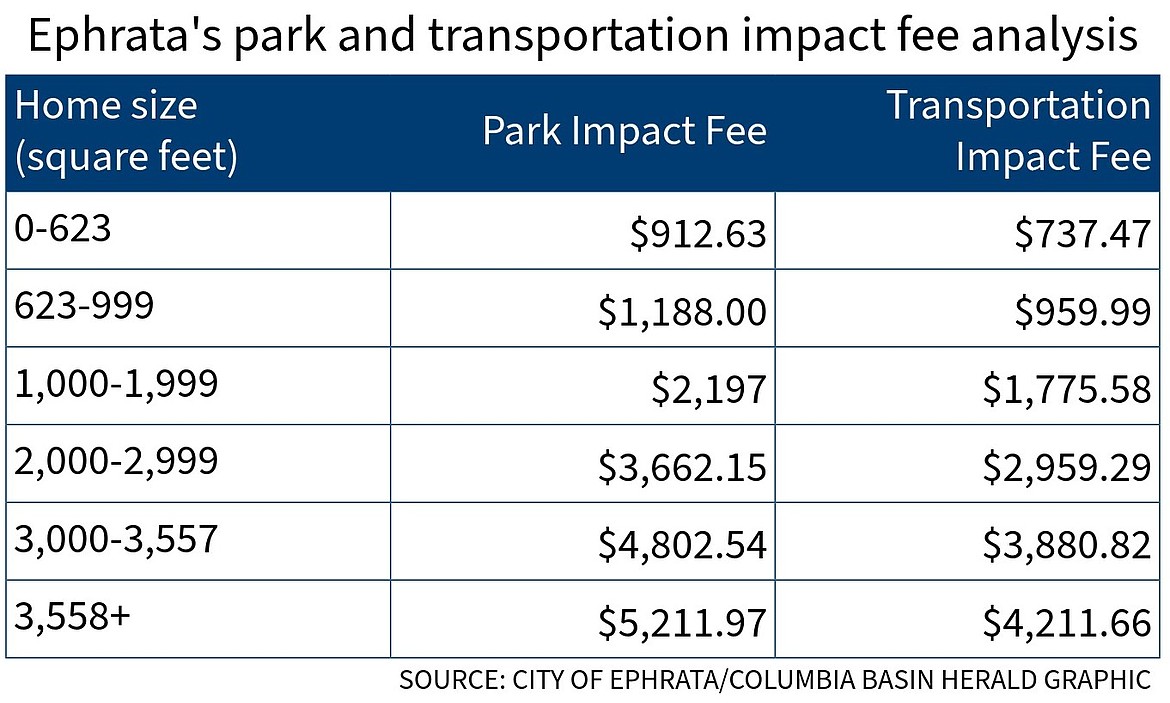
Wood also outlined a new state requirement that impact fees be scaled by the size of a home, reflecting data showing that larger homes tend to house more people and therefore generate greater demand for parks and transportation.
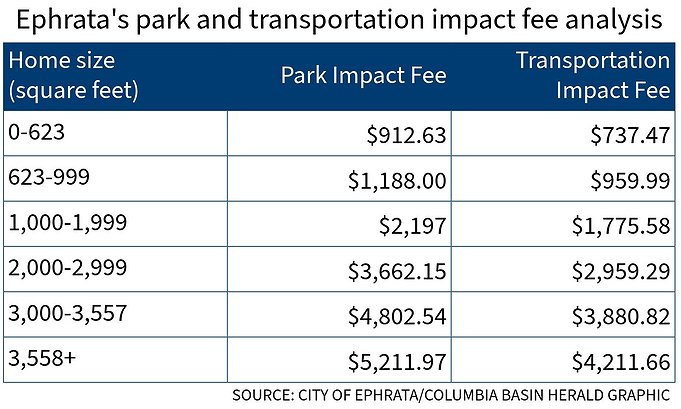
Under the proposed scaling model, fees would range widely. For example, the developer of homes smaller than 623 square feet would pay about $913 in park fees and $737 for transportation, while homes larger than 3,558 square feet could pay up to $5,212 for parks and $4,212 for transportation.
City Administrator Ray Towry asked Wood whether inflation was accounted for in the long-range projections. Wood recommended indexing any adopted fees to a construction cost index so they automatically adjust over time and do not lose purchasing power.
“If you don’t do that,” Wood said, “give it 10 years and the fee isn’t going to buy half of what it did when it was implemented.”
Council members asked no further questions during the presentation, and the discussion concluded without a decision. Any adoption of impact fees would require formal council action, including ordinances and updates to the city’s fee schedule.