‘Show up’

WARDEN — When Warden Mayor Rosaelia Martinez looked out over the audience at the April 28 Warden City Council meeting, she didn’t see empty seats. She saw neighbors.
“First of all, before we start, I want to say thank you to all those that came to the meeting tonight,” Martinez said. “I know we are all busy people, and I really appreciate your input. Your time is valuable and we appreciate you being here.”
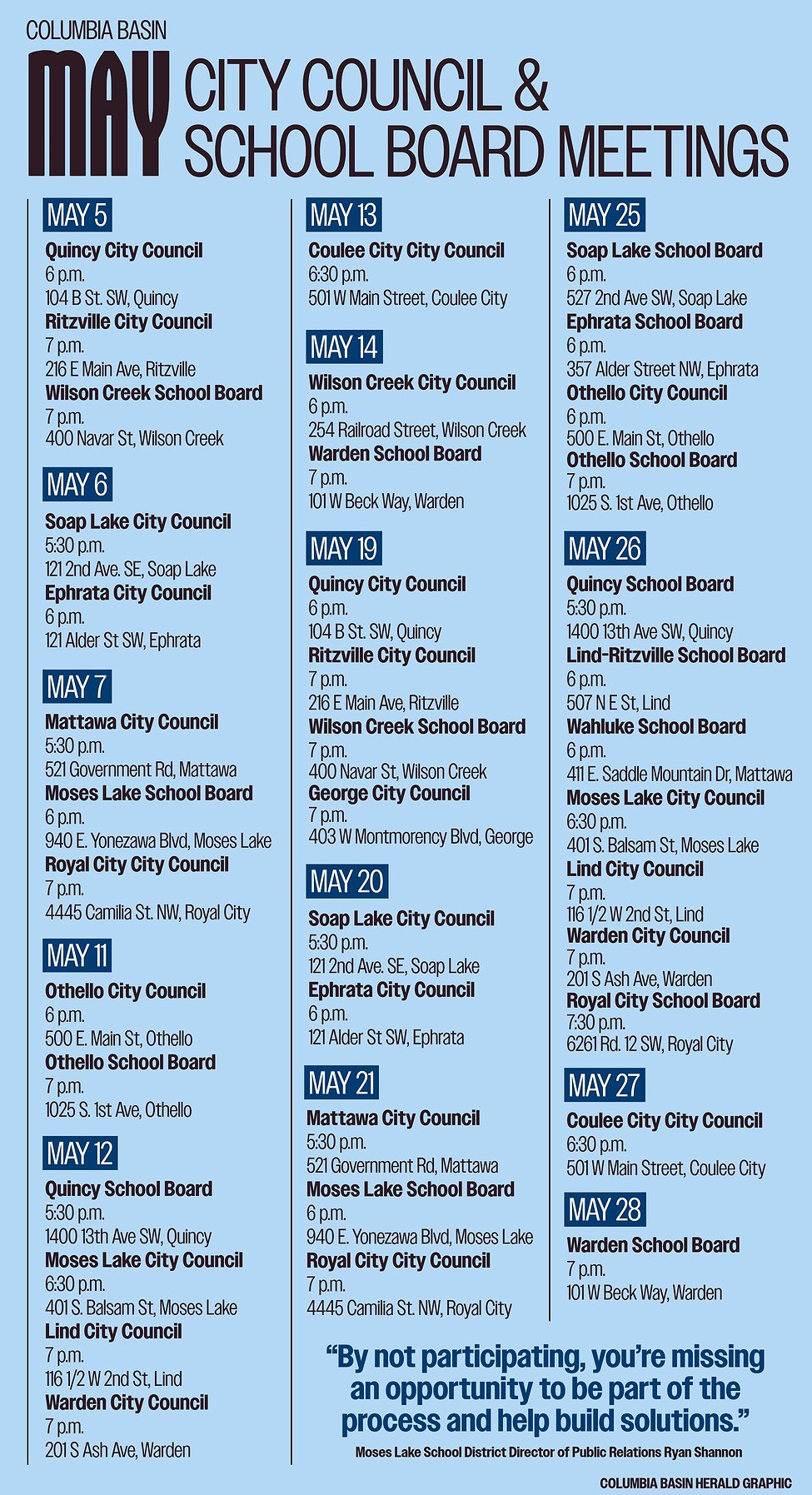
That message – that showing up matters – was echoed by city and school leaders across the Columbia Basin, many of whom say public participation directly shapes decision-making, transparency and long‑term planning.
‘You get the source’
For Moses Lake School District Director of Public Relations Ryan Shannon, the value of attending a board meeting starts with understanding how decisions are made.
“The community gets to see how decisions are actually made,” Shannon said. “They get a better insight into budgets, programs and policies.”
Shannon said hearing discussions firsthand gives residents information they can’t get from reading an agenda or hearing about it secondhand.
“Board meetings flat out give you the source,” he said. “They provide the context, the data and the reasoning behind decisions.”
Shannon said showing up also keeps misinformation in check.
“One of the things we constantly deal with is how quickly social media and word of mouth can change how people are thinking,” he said. “Being there allows people to hear what was actually said, not what someone thinks was said.”
‘Your participation generated the “why”’
During the April 29 Moses Lake City Council meeting, Council Member Victor Lombardi credited public engagement for pushing city leadership to explain its reasoning during the city’s recent fiscal sustainability planning process.
“You really, really got council and staff to explain why we’re doing certain things,” Lombardi said. “You had more of an impact than you think you did, because you forced the question of ‘why’ to be answered.”
Lombardi said that process created a clearer public record for future officials and residents.
“These are all recorded sessions,” he said. “Future council members will be able to look back five or 10 years and say, ‘Why did the city council make these choices?’ And they’ll be able to understand.”
Lombardi said that level of explanation is driven by public presence.
“That’s about as transparent as it can get,” he said.
‘Making decisions in a vacuum’
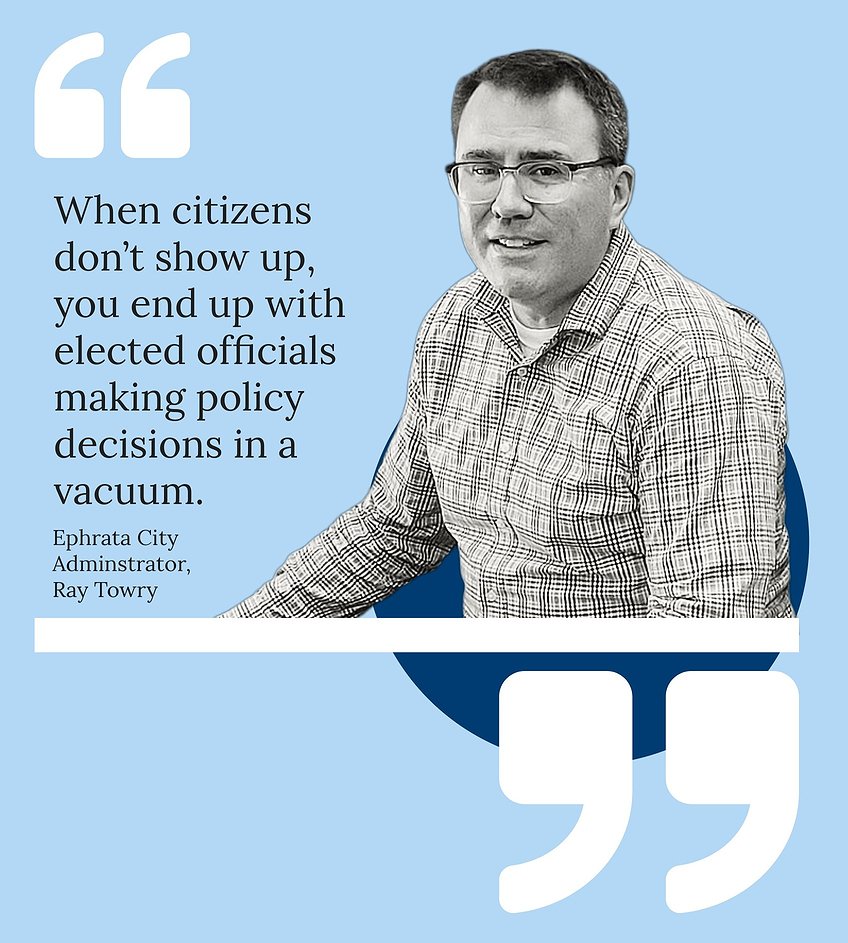
Ephrata City Administrator Ray Towry said when residents don’t attend meetings, public servants lose critical perspective.
“When citizens don’t show up, you end up with elected officials making policy decisions in a vacuum,” Towry said. “There has to be that give and take and that discussion.”
Towry said council chambers are one of the few places where that exchange happens.
“It’s impossible for elected officials to go knock on everyone’s door,” he said. “The public meeting is that opportunity.”
Towry recalled a case where residents showed up in force to oppose cost‑cutting changes at Ephrata’s cemetery.
“The community made it very clear that they would rather pay more to keep it the way it was,” he said. “Government followed.”
For Towry, that outcome illustrated the power of consistent engagement.
“Those people are shaping the future of the community,” he said.
‘One of the few places you can influence decisions’
At the school district level, Ephrata School District Director of Communications Sarah Morford said public meetings offer a direct line to decisionmakers.
“School board meetings are one of the few places where community members can directly influence decisions that affect students, staff and taxpayers,” Morford said.
Morford said public comment gives board members a better sense of how decisions will impact families.
“The more people speak up, the more informed the board becomes,” she said. “They may learn something they didn’t know before.”
Morford added that school board meetings are not limited to policy votes.
“It’s also a place to celebrate students and learn about what’s happening across the district,” she said. “People are often surprised by how much the board is responsible for.”
‘It makes us aware people are paying attention’
Othello Mayor Ken Johnson said public attendance changes the tone and direction of council meetings.
“It makes us aware that people are paying attention,” Johnson said.
Johnson pointed to Othello’s recent kratom ban as an example of public engagement shaping policy.
“Public input is what prompted us to continue the discussion and hear more before making a decision,” he said. “It’s better to hear concerns before a vote than after.”
Johnson encouraged residents to speak up, even if it’s brief.
“Sometimes the presence of being there makes a difference,” he said.
Johnson said engagement can also extend beyond meetings.
“A phone call, a visit, a comment – that’s how conversations start,” he said.
‘It matters to us’
Across jurisdictions, leaders said the most important step is participation – even without speaking.
“Show up,” Shannon said. “Even if it’s just to get informed.”
Shannon said attendance sends a clear message.
“Showing up signals that people are paying attention and expecting accountability,” he said.
For Martinez, the message was simpler.
“Your time matters,” she told residents. “And when you’re here, it matters to us.”