Examining how agriculture could switch to renewable energy
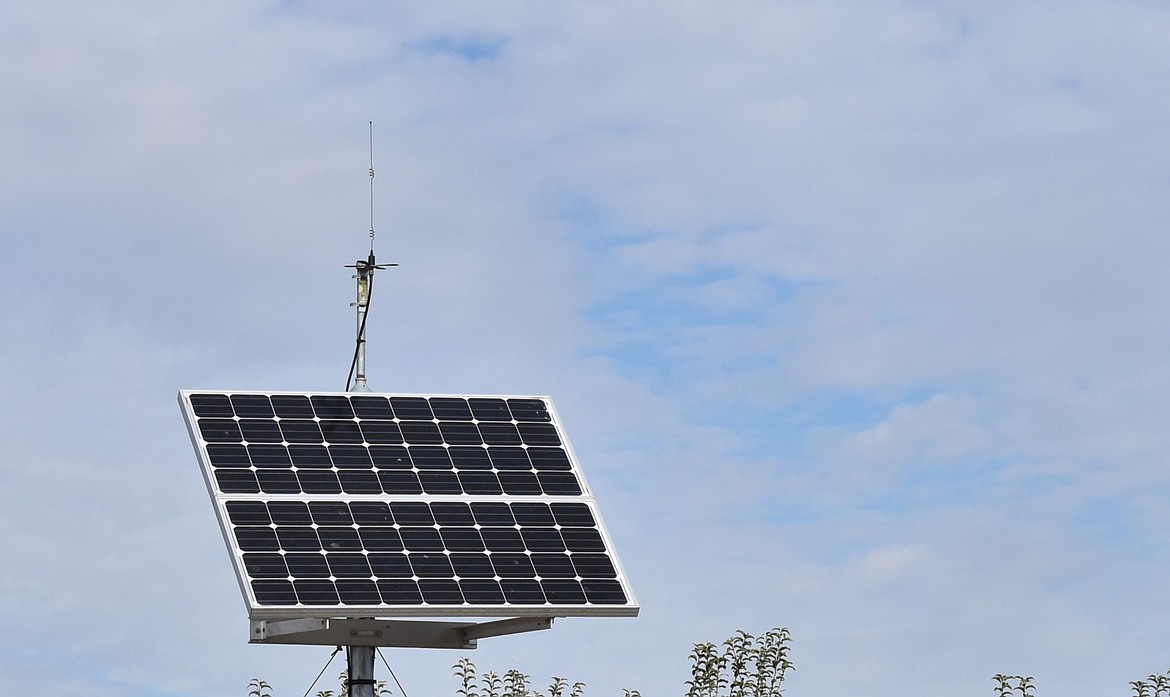
MOSES LAKE — The topic of energy production is something that has become something of increasing interest in recent years as new technology is developed. David Funk, President and Founder of Zero Emissions Northwest, said his goal is to inform people about green energy sources that can save long-term money.
“In certain scenarios we have to use what works today because we don’t have alternatives,” said Funk. “But for many technologies we have better alternatives today, it’s just this is the transition.”
Funk said there has been an energy transformation due to developments in renewable energy sources like solar, wind and hydropower that allow the option to shift away from traditional sources of energy.
These renewable energy sources are all readily available in Washington state, with hydropower being a predominant resource for decades. He said advances in technology allow for the storage of that energy when it’s not being used have allowed one of the cheapest options, solar, to become easier to utilize.
The shift toward more solar power has been on the rise on the eastern side of the state, with the most benefits going toward rural areas, said Funk.
“There’s a huge energy burden on rural people in general because they’re farther away from modern necessities of life,” he said. “Rural people just drive more than urban people, so it would be better for Washington to help electrify Eastern Washington than it is to help electrify King County.”
This renewable energy tech can already be utilized by farmers to help save money when it comes to taking advantage of cheap hydropower. Funk said a simple way agricultural farmers can do this is by making the switch to electric light-duty pickup trucks.
By using electricity from the hydropower that is currently in place or utilizing solar or wind power on the farm, a farmer can cut costs on refueling vehicles, he said.
“They use so much more energy than we all understand,” said Funk. “If you don’t work in agriculture, you don’t see our food system to the same extent, but it is impressive just how much power and fuel these farms use in order to keep everybody fed.”
The challenge when it comes to investing in renewable energy sources for farmers is that there are fewer opportunities to improve their systems, given how the industry operates, he said. Unlike other industries that use energy year-round, the farmer has high energy use within short periods of time.
“A Pepsi semi-truck, which is delivering soda every single day in a little distribution area drives a lot of miles and it will make sense for Pepsi, which is one of the largest fleets in the country to electrify that semi-truck and they will see the benefits of electrification in the bottom line,” said Funk. “But a grain farmer might use a semi-truck for one month out of the year.”
Because of this, he said the cost of investing in electric vehicles would be high for a farmer, especially during a time when input costs are already high. With systems in place for energy sources such as gasoline and diesel, making the switch at this point may not be beneficial for these farms.
This does not mean it is useless to make the switch to renewable energy sources. Zero Emissions NW and Washington Green Bank, which was formed in April 2023, have been working together to help ag professionals make informed decisions on the transition.
Eli Lieberman, the Executive Director at WA Green Bank said idea for the organization came from the WA Department of Commerce after seeing the success of Green Banks in the Midwest and Northeast regions of the U.S. The goal of these Green Banks is to lower energy costs through the use of more clean energy.
“It’s been widely successful since the idea kicked off (in 2009),” said Lieberman.
These banks are another resource for industries like agriculture that can benefit from transitioning to renewable energy sources. Lieberman said the Green Banks will step in and provide loans and design plans to help prove out ideas for renewable energy production in business.
“It would be, ‘How can we help farmers access capital in order to install more efficient technologies,’” he said.
The WA Green Bank and Zero Emissions NW have been collaborating to support each other’s efforts in helping communities access resources such as solar energy. Lieberman said Zero Emissions NW has already succeeded in assisting schools in Eastern Washington transition and the two organizations are helping other industries make the transition.
Leiberman said both he and Funk went on tours through different aspects of the farming industry such as a hops distillery, and potato and dairy farms across eastern Washington. This effort was to learn more about the agricultural community, what needs they have, and how they felt about clean energy.
“We want to be sure that the WA Green Bank represents all of Washington and not just another Puget Sound sort of institution,” said Lieberman.
Through their tours, WA Green Bank’s Executive Director said he has already seen how the hops industry has begun the shift to cut down on the use of natural gas and how fast the implementation of such systems can pay for itself over the years.
As technology in this sector, such as energy storage for solar, becomes more widespread, it will be easier to implement more efficient systems into the production line for agriculture, said Funk.
Zappy truck options
The change from gas or diesel to electric can add convenience for ag professionals. Pretty much every major car manufacturer has an electric or hybrid vehicle out, and all-electric has advantages.
If you’re looking for American-made, the Chevy Silverado EV and the Ford F-150 Lightning may be options for you. Both offer solid towing power, with the Silverado’s electric vehicle able to tow up to 12,500 lbs. It also has a range of about 478 miles, though just like with a gas or diesel vehicle, that can be reduced by heavy loads. The Lightning has a somewhat shorter range at 320 miles but still hits 60 mph in about four seconds.
Both the Chevy and Ford models offer additional utility. The Silverado EV has power ports that can be used to light your home or power tools. The Lightning offers the same, with the opportunity to plug in 120-volt tools like grinders, welders and similar into the vehicle’s power supply if you’re working out on the more remote parts of the farm.