
Q&A with Etosha Cave, co-founder of Twelve E-Jet fuel
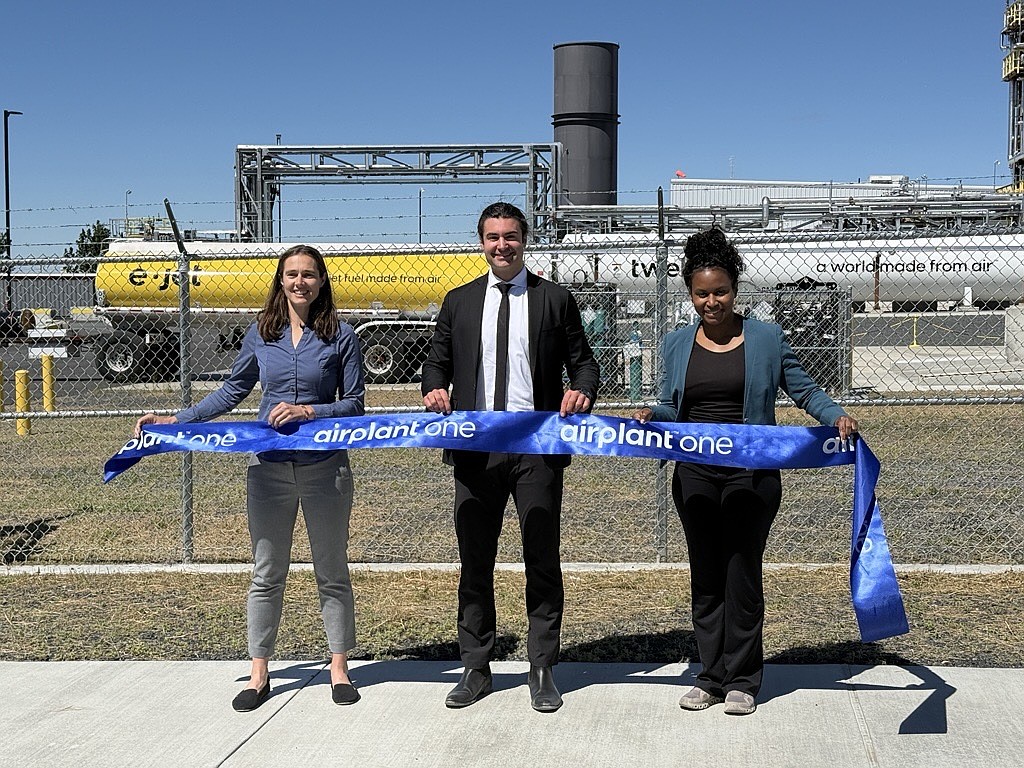
Twelve, which has its AirPlant One E-Jet fuel facility in Moses Lake, held a ribbon cutting ceremony on Wednesday, June 10, officially launching full operation of its jet fuel production. Etosha Cave is one of the three co-founders, along with Kendra Kuhl, and Nicholas Flanders, who is also the CEO. She spoke to the Columbia Basin Herald for a Q&A following the ribbon cutting ceremony and offered insight into the concept of the E-Jet fuel process and offered background in its beginnings.
CBH: You're a co-founder, and along with Nicholas and Kendra, how far back did you start with the concept?
CAVE: Kendra and I were in the same PhD laboratory together. We were working on the basic science side of this technology. We were writing papers and working with theory groups to understand how one can engineer a metal catalyst to convert carbon dioxide and water into one of 16 new molecules. Towards the end of my Ph.D., Kendra, had already graduated was at SLAC doing similar work; we started to ask the question, can we make something of this? Can we continue the research outside of the university, bring it to industry, and have an impact on manufacturing and carbon transformation? We teamed up with Nicholas, who was in the business school at Stanford University, and the three of us started applying for grants. We were housed at Lawrence Berkeley National Laboratory for about three years and built up a team and a prototype. We also started thinking about scalability and cost; the types of things you don't really think about as a grad student. Once we outgrew the lab at Lawrence Berkeley National Lab, we spun out into our own space in Berkeley and hired over a hundred scientists and engineers who would support us in developing this technology. Eventually, we realized that if we're going to do this, we need to go make these molecules; we need to make some fuel and products. So, we corralled the funds to build this plant, and it's truly 10+ years in the making. If you count our PhDs, it's a little bit longer than that. It's quite the life milestone to see it all come together.
CBH: Your mission statement in life started in college and follows through to your adulthood; that's kind of an unusual straight path.
CAVE: Yes, many people, especially in graduate school, are done with their research by the time they graduate. And the general sentiment is: ‘I don't want to think about this anymore. I wrote my papers; my thesis is turned in, but I was so passionate about the research, and I really wanted to see it come to life, so that passion, coupled with policy and being able to apply for grants on the federal level and then eventually on the state level, was really what brought us to this point.
CBH: Are we going to be like a billion-dollar company? I mean, is this going to be one of those breakthrough technologies?
CAVE: I certainly hope so — I hope we can reach a billion in annualized revenue in the next few years. That would be great. We have a contract with a European airline called IAG, which is the parent company of British Airways, for 984 million liters (785,000 tonnes or 260 million gallons). AirPlant Two, which we're starting to design, will be a direct result of that, and we're excited to have an impact by actually making fuel and products we can put out there.
CBH: Where's AirPlant Two going to be?
CAVE: There are conversations happening at some sites in the Midwest and the South that we're looking at. It's still in the works, but we basically look for a place where there's low-cost, carbon-free electricity, and so the Midwest is where it's at.
CBH: Which brings me to the question of Moses Lake. How did you end up choosing this site?
CAVE: In a lot of ways, the site was just so ideal for us. There was already low-cost hydropower, and it already had the substations there. It was a brownfield site. It was a sugar beet plant that had gone out of business, so it had a lot of industrial access and prior permitting. It has a local economy that's built around industrial development, so you could get the talent here to run the plant, which we've been able to do both on the construction side and also now operating it. It had a very welcoming set of state and local policies that wanted to see this developed, and that's really helpful when you're working through all the permitting and all the details of building something like this that’s new. Ultimately, we want to find sites that reduce the friction at least as much as possible while you're getting everything signed off. So that's been really helpful to have all those things lined up. Washington also has a history of aerospace, so it's been really lovely to be a part of that history. I hope that in the same way people associate Washington with Boeing that they will associate Washington as the birthplace of Twelve and look back at these moments and say, ‘wow, we were here when this industry got started.’”
CBH: Maybe, down the road we will see an IPO for the company.
CAVE: Certainly, we need to capitalize more of these AirPlants, so funding from the public markets would be welcomed when it makes sense. We want to make sure that we are ready and prove ourselves. It's hard to ignore all the activity in the public markets, but building AirPlant Two is our current focus.