


Wednesday, July 29, 2026
63.0°F

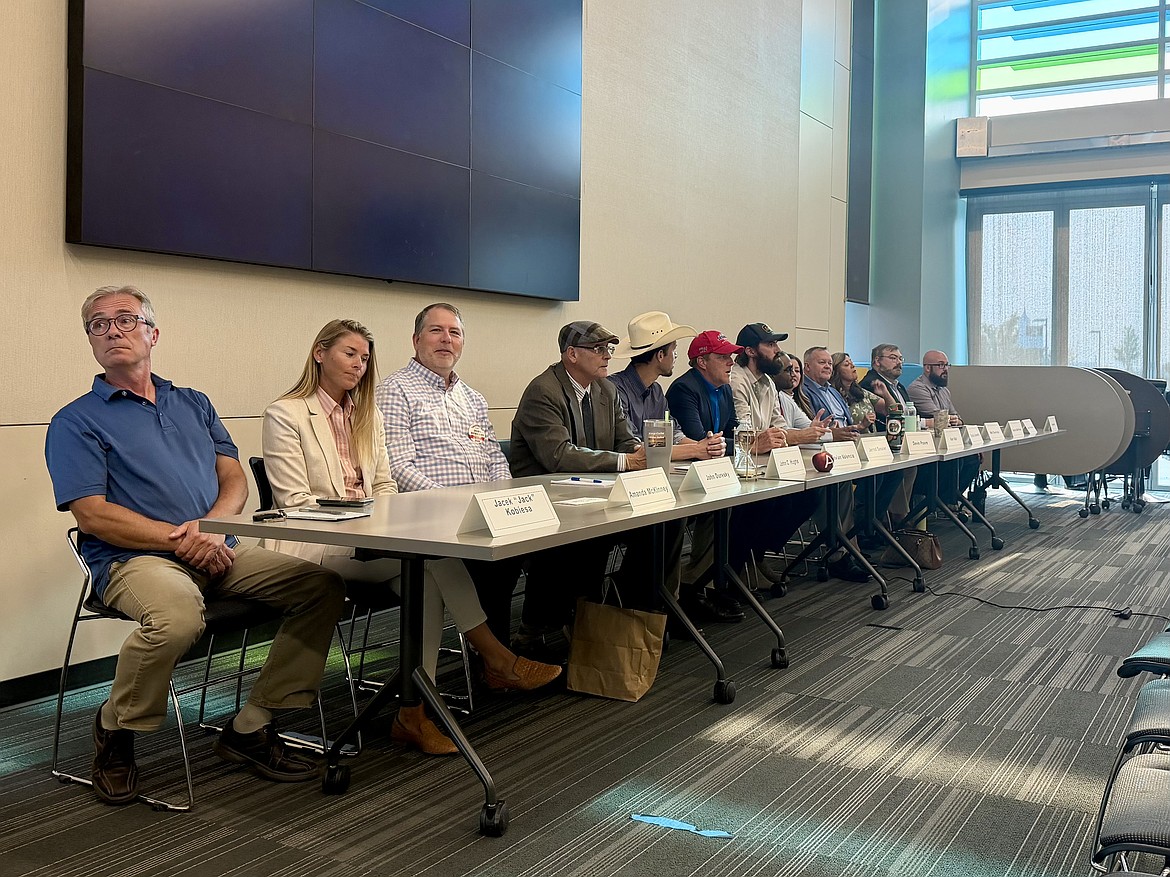
10 congressional candidates outline priorities at Moses Lake forum
by NANCE BESTON
Staff Writer | July 29, 2026 2:00 AM

MOSES LAKE — Ten of the 11 candidates running for Washington's 4th Congressional District appeared at a candidate forum in Moses Lake, offering voters a wide range of perspectives on economic development, agriculture, government spending, water policy, immigration, health care and political reform ahead of the primary election. Zac Rossi, no party preference, was not in attendance.  

Candidates were given opening statements before answering questions on topics ranging from federal accountability to the future of Columbia Basin water resources. 

The full forum video is available on the Columbia Basin Herald Facebook page at bit.ly/PrimaryCandidateForum.  


Jacek "Jack" Kobiesa 

Republican candidate Jacek "Jack" Kobiesa, an immigrant from Poland who now lives in the Tri-Cities, framed his candidacy around concerns that America is becoming increasingly divided and ineffective. 

Kobiesa said Republicans and Democrats spend too much time fighting rather than solving problems. Drawing on his experience growing up under communism, he warned against what he described as growing socialist influences in the United States. 

"We're racing to the bottom," Kobiesa said during his opening remarks. 

When asked about economic competitiveness, Kobiesa argued the United States is falling behind countries such as China and called for federal programs that would provide low-interest or no-interest loans to small businesses to spur domestic manufacturing and innovation. 

Addressing water issues, Kobiesa said water rights should remain tied to the property to which they were originally assigned. He also proposed exploring ways to recover and reuse waste heat and water associated with power generation, particularly from the Columbia Generating Station. 


Amanda McKinney 

Yakima County Commissioner Amanda McKinney highlighted her agricultural background, banking career and local government experience as qualifications for Congress. 

McKinney emphasized water policy as one of the district's most critical issues, calling water storage expansion and infrastructure investment essential for the region's future. 

"We live in a desert and we grow beautiful things," McKinney said. 

She pointed to her experience helping establish Yakima County's water bank and working on regional water planning efforts. McKinney argued federal investments made decades ago transformed Central Washington and said Congress must continue supporting irrigation infrastructure. 

On government accountability, McKinney criticized layers of federal bureaucracy that separate taxpayers from decision-making. She cited her work auditing COVID-19 assistance programs in Yakima County, where she said officials identified 228 fraudulent applications worth approximately $6.8 million. 

McKinney repeatedly advocated for greater local control, arguing county and municipal governments are better positioned than federal agencies to determine community priorities. 


John Duresky 

Democratic candidate John Duresky, a retired Air Force veteran and former federal employee, said his campaign was motivated by concerns over federal workforce reductions and what he called the erosion of services Americans rely on. 

Duresky warned that cuts to government agencies could have long-term public impacts, including food safety oversight and other federal functions. 

His campaign platform emphasized affordability, labor protections, health care access and ethics reforms. Duresky endorsed efforts to impose congressional term limits, prohibit stock trading by members of Congress, restrict lobbying activities, overturn the Citizens United decision and establish an enforceable code of ethics for the U.S. Supreme Court. 

Asked how he would appeal to a predominantly Republican district, Duresky pointed to his military service and constitutional oath. 

"My oath is not to a party. It is not to a man. It is to the Constitution," he said. 

On water policy, Duresky acknowledged he is not a water expert but said he would rely on stakeholder input and experienced staff to navigate the district's complex water challenges. 


John C. Hughes 

Independent candidate John C. Hughes emphasized his educational and legal background, noting his membership in the U.S. Supreme Court Bar and the U.S. Patent and Trademark Office. 

Hughes told attendees the nation faces major challenges, including national debt, artificial intelligence, family instability and economic inequality. He advocated decentralization, homesteading opportunities and renewed focus on strengthening families and rural communities. 

When asked about bipartisan cooperation, Hughes cited workforce development and youth opportunities as areas where Republicans and Democrats could find common ground. He specifically referenced programs similar to the Civilian Conservation Corps. 

Regarding water policy, Hughes argued agriculture should remain the priority while balancing environmental protection and future growth. 

"We have the water. We have the resources. We have the best land in the United States," Hughes said. 


Favian Valencia 

Yakima attorney and independent candidate Favian Valencia focused much of his message on political independence and constituent-driven representation. 

Valencia, a civil rights attorney and small business owner, said he is not beholden to either major party because he does not rely on party organizations or large political action committees. 

"As an independent, I don't answer to the Republicans or the Democrats. I answer to you," Valencia said. 

Valencia said his campaign has been shaped by conversations with residents across the district, including farmers concerned about labor, water and economic stability. 

On water policy, Valencia praised portions of incumbent Rep. Dan Newhouse's record, particularly on water-related issues, while saying he would seek improvements where necessary. He stressed the importance of building consensus among farmers, tribal governments, local communities and other stakeholders. 

Valencia repeatedly referenced George Washington's warnings about political factionalism, arguing independent leadership can help reduce division. 


Jerrod Sessler 

Republican candidate Jerrod Sessler focused his remarks on government spending, economic affordability and federal program reform. 

Sessler said one of the biggest challenges facing families today is the rising cost of homeownership. He contrasted housing affordability across generations and argued policymakers need to restore opportunities for younger Americans. 

When asked about federal programs, Sessler singled out FEMA for reform. He criticized aspects of federal disaster response policy and called for revisions to the Stafford Act, which governs federal disaster assistance. 

During his answer, Sessler referenced the Confederated Tribes of the Colville Reservation, stating that after a previous wildfire the tribe received a $30 million FEMA payment and suggesting current incentives can encourage dependency on federal assistance. He also said tribal governments did not bear the same taxation burden as other residents. 

Those comments drew a public response from the Confederated Tribes of the Colville Reservation after the forum. 

In a statement released July 24, tribal officials disputed Sessler's claims, stating that tribal members pay federal income taxes and that FEMA wildfire reimbursements are subject to documented expenses and cost-sharing requirements. The tribe reported receiving approximately $11.7 million in FEMA reimbursements since 2020 for roughly $13.2 million in wildfire recovery costs and stated it had never received a $30 million FEMA wildfire payment. 

The tribe also rejected Sessler's suggestion that there was any incentive for additional wildfires, noting that more than 1 million acres of the reservation have burned since 2015 and that wildfire losses have damaged timber revenues critical to tribal government operations. 

Two days later, Sessler issued a public response acknowledging errors in his remarks. 

"The Colville Tribes is correct in their statement correcting my comments in regard to funds paid to them by FEMA," Sessler wrote. 

Sessler called his comments "ill-informed and incorrect," accepted responsibility for failing to verify information and apologized to tribal members. 

"I take responsibility for the mistake," Sessler stated. 

Sessler said his criticism was intended to focus on what he sees as flawed federal incentives within FEMA and the Stafford Act, not to question the character or integrity of tribal members. He added that he plans to seek forgiveness directly from tribal leadership. 

On water policy, Sessler advocated completion of the Columbia Basin Project and reducing regulations he believes limit agricultural production. He argued the district has sufficient water resources but faces excessive regulatory barriers. 


Devin Poore 

Cascade Party candidate Devin Poore presented himself as an alternative to the traditional two-party system and repeatedly focused on political reform. 

Poore argued that money has become too influential in federal politics and called for reforms including congressional term limits, stock trading bans and campaign finance changes. 

"It is a coin-operated system," Poore said of Washington, D.C. 

An engineer by profession, Poore also emphasized agricultural challenges, wildfire concerns and infrastructure investments. He noted that roughly 1,400 farms have disappeared in the district over the past 15 years and said Congress must prioritize agriculture. 

On water policy, Poore stressed conservation and future planning despite the region's abundance of water. He advocated replacing open canals with enclosed pipe systems where practical and suggested installing solar panels over canals to reduce evaporation while generating electricity. 


Ken Vaz 

Republican candidate Ken Vaz, an engineer and technology professional, emphasized fiscal responsibility, national debt reduction and government efficiency. 

Vaz said growing federal spending and inflation are placing significant burdens on American families. He pledged to support efforts to reduce waste and audit Pentagon spending. 

Asked about representing a diverse district, Vaz pointed to his experience working with people from different backgrounds throughout his engineering education and technology career. 

On water issues, Vaz focused heavily on protecting consumers from costs associated with industrial projects, particularly energy-intensive and water-intensive data centers. 

"If a company decides to build an AI data center and pollute all the water, then there'll be none left for this district to use," Vaz said. 

He proposed requiring large-scale industrial users to contribute financially to communities affected by their projects and supported modernization of dams and fish passage systems. 


Elpidia Saavedra 

Toppenish Mayor Elpidia Saavedra shared a deeply personal introduction, recounting her upbringing in a single-parent household, her decision to leave high school after becoming pregnant and her eventual return to education, culminating in an MBA. 

Saavedra highlighted her experience as a city council member and mayor, saying those roles taught her firsthand about local government challenges. 

She identified labor, immigration and water access as major concerns for farmers. 

"We need some immigration reform," Saavedra said, arguing that employers and agricultural producers should have greater input in shaping labor policies. 

Regarding water, Saavedra discussed infrastructure funding challenges faced by local governments pursuing major projects. She cited a $20 million wastewater treatment project in Toppenish and highlighted the proposed W20 project associated with the Port of Moses Lake. 

Saavedra said municipalities often must compete for limited federal dollars and pledged to advocate aggressively for local infrastructure funding in Congress. 


Matt Boehnke 

State Sen. Matt Boehnke highlighted his legislative experience throughout the forum, describing himself as the only congressional candidate with recent experience advancing major legislation. 

Boehnke emphasized economic development opportunities tied to data centers, advanced nuclear energy, manufacturing and emerging technology industries. 

"Moses Lake is primed to be a leader," Boehnke said. 

The Tri-Cities Republican argued Congress should ensure federal investments create lasting local jobs through direct support for local communities rather than through multiple layers of bureaucracy. 

On water issues, Boehnke focused on infrastructure financing, groundwater replacement projects, and water treatment improvements. He referenced state investments already approved for regional projects, including the W20 initiative and Odessa-area groundwater programs. 

Boehnke said the challenge is ensuring critical infrastructure can be built without imposing excessive costs on local ratepayers. 

He also framed water as a national security issue and said he would seek assignments to congressional committees dealing with water and natural resources if elected. 


    Republican Jacek “Jack" Kobiesa
 
 
    Republican Amanda McKinney
 
 
    Democrat John Duresky
 
 
    Republican John C. Hughs
 
 
    Independent Favian Valencia
 
 
    Republican Jerrod Sessler


    Cascade Party Devin Poore
 
 
    Republican Ken Vaz
 
 
    Republican Ken Vaz
 
 
    Republican Matt Boehnke