


Farm Wives and Cowbelles: Women Who Built Grant County
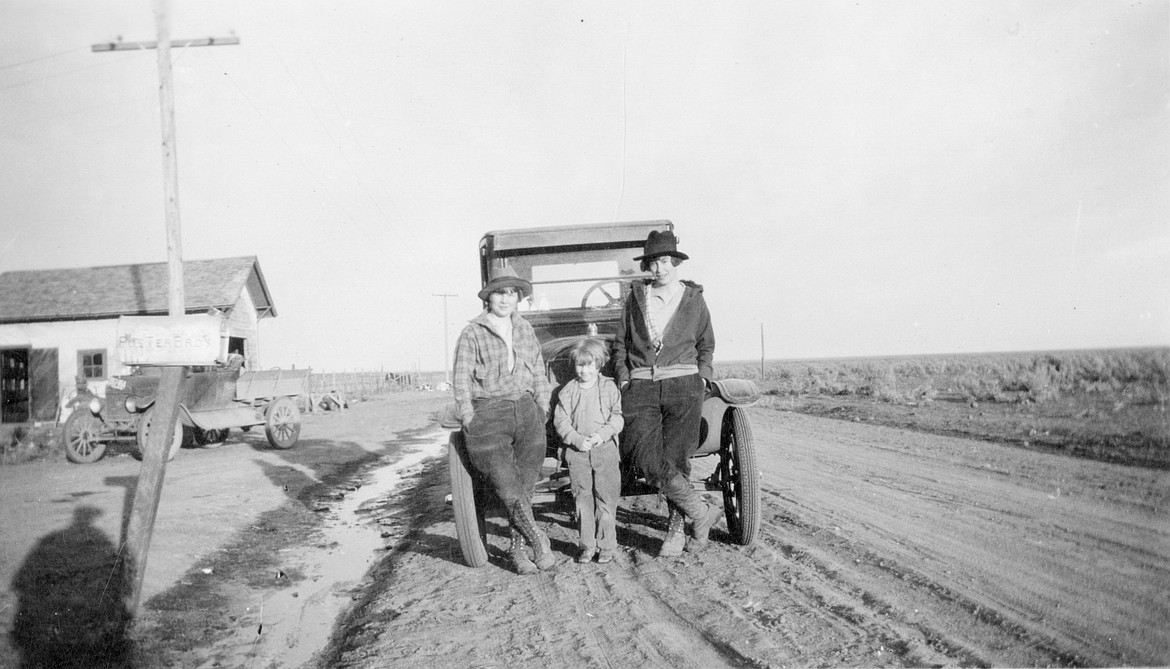
A photo from the 1920s showing Bertha Eccles (left), Ruth Power (right) and Marjorie Goodwin (front). Eccles was the assistant postmistress in Moses Lake when the Grant Hotel burned down in 1939. She ran into the building to save the post office equipment.
PHOTO FROM THE MOSES LAKE MUSEUM & ART CENTER COLLECTION
From the Neppel days to now, women have worked hard to build a life here and shape the broader community. In the early days they worked as business owners, in commercial fishing, farming, ranching, homesteading, and a host of other jobs. Early 20th-century photographs of the area in Moses Lake Museum & Art Center’s collection show women working alongside men in huge threshing operations up near Steamboat Rock.
Later photographs show women working in farm fields, in processing plants, at Larson Air Base, and in agriscience. When the town’s population exploded after the Columbia Basin Project and there was work for everyone, old-fashioned notions of what women could and could not do did not seem to hold much sway here.
They were business owners like Roxy Thorson, who owned Soap Lake Products and developed an efficient evaporation system that allowed her to extract and ship Soap Lake Salts all over the world. Those who swore by “the cure” wrote letters praising her for making their lives better when they couldn’t be here to take the water.
They were politicians like Maggie Waltho, who was Mayor of Soap Lake from 1946 to1950. Her life’s journey took her from Ireland to Ellis Island to the shrub-steppe. As mayor, she stood up for nudists’ rights and stripped the town marshal of his gun and badge when he got a little too rowdy at a town bar.
There were undeniable heroes like Assistant Postmistress Bertha Eccles, who ran into the burning Grant Hotel in April of 1939 to save the post office equipment, mail, money, and stamps. Her actions preserved one of tiny little Neppel’s only links to the wider world.
May Miller Wegner led what might have been the last cattle drive down Broadway in 1952. She was president of the Grant County Cowbelles, and a member of the Cattlemen’s Association. A photo in our collection shows her leading the herd past brand-new shops and restaurants, an image that perfectly captures the old way of life in Moses Lake giving way to modernity.
The stories of women like May, Roxy, Bertha and Maggie are rich and entertaining, but no less important than the day-to-day work of the women of our community. Every farming family knows that farming is a group occupation. Only the smallest and infirm are exempt from hard work.
In an oral history, self-described “farm wife” Wanda Hansen described the breadth of work she did on their property. Irrigation, cutting potatoes for seed, getting in harvests, feeding farm hands, and more were part of her routine. In the understatement of the century, she said it was “just a busy time.”
The women’s club movement in the U.S. started in the 19th century as more women gained access to higher education and public life. Societal and economic changes meant some women had time to commit to club life, as a way to participate in their community and fill needs unmet by local government and others.
The Moses Lake Woman’s Club is the oldest women’s service organization in Moses Lake. It was formed in 1914, and in 1938 it founded the first Moses Lake Library, which it ran until the city took responsibility in 1955.
The Nisei Women’s Club was active in town for 42 years, only disbanding in 2008. They were well known for their annual Sukiyaki Dinner and for raising money for scholarships and equipment for Samaritan Hospital, among other causes.
True Moses Lakers are familiar with the work of the modern-day Lioness Club, which sells Space Burgers at the Grant County Fair and on very special occasions. This small-town club not only preserves a piece of Seattle World’s Fair history, but has also raised over $1 million selling historical burgers since 1964. Space Burger sales fund everything from scholarships to cancer research.
Too often I hear nostalgia for a “Mayberry” type of past where women had a certain role and men another. Historical research affirms that that past never really existed. The reality of carving out a life in the shrub-steppe fell on men and women, and I can safely say that Grant County women have more than pulled their weight.
Dollie Boyd is the Cultural Services Superintendent for the City of Moses Lake. She has an MA in Public History from Middle Tennessee State University and specializes in researching local history’s little-known stories.
"Back in the Day" will appear bi-weekly and will look at the rich and sometimes little-known history of the Columbia Basin.