


Wildfire glossary of equipment and common terms
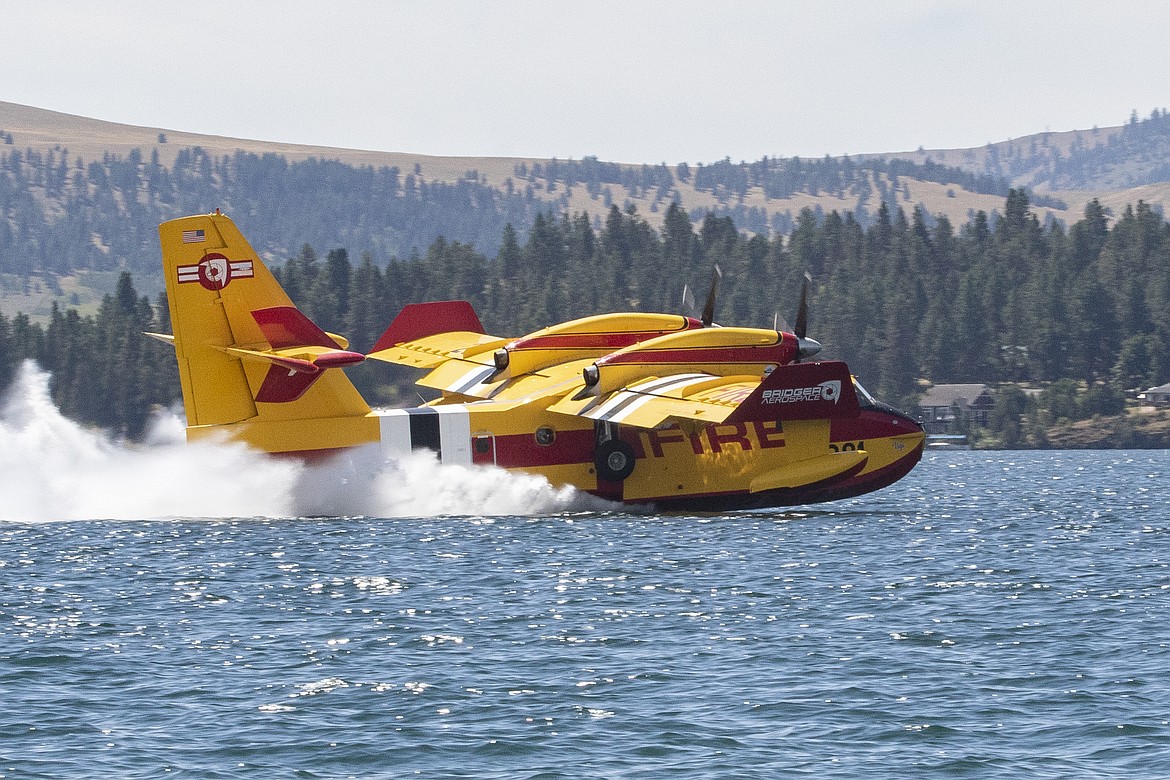
A scooper plan dips into Flathead Lake while providing water drops for the Elmo 2 Fire on the Flathead Reservation. (Rob Zolman/Lake County Leader)
Air Tanker: Fixed-wing aircraft that drops water or fire retardant.
Crown Fire: Fire that spreads through the tree canopy rather than the forest floor.
Dozer: Heavy machinery used to create wide firelines.
Drip Torch: A handheld device that drips flaming fuel to ignite controlled burns or backfires.
Fire Front: The part of the fire with the greatest flame length, typically spreading the fastest.
Fireline: A cleared strip of land used to stop or slow a wildfire.
Fuel: Any burnable material, such as grass, shrubs, trees, and dead leaves.
Helitack: Helicopter-based crew and equipment used for rapid wildfire response.
Hotshot Crew: Elite wildland firefighters used in high-risk areas.
Ladder Fuels: Vegetation that allows fire to climb from the ground into tree canopies.
Mobile Command Center: A vehicle outfitted with communication and coordination tools.
Perimeter: The boundary of an area that has been burned by a wildfire.
Pulaski: A combo tool with an axe on one side and a grub hoe on the other that is used to dig fireline.
Red Flag Warning: A weather alert indicating critical fire weather conditions.
Skidder: Used to move logs and adapted for wildfire work.
Smokejumper: A firefighter who parachutes into remote wildfire locations.
Spot Fire: A fire ignited outside the main fire area by wind-blown embers.
Type 1 Incident Management Team: The highest-level team assigned to manage the most complex and large-scale wildfires
Unmanned Aerial Systems: Provide real-time imagery, thermal scanning, and mapping.
Water Tender: A truck that carries water to support firefighting crews.
Wildland-Urban Interface (WUI): Areas where human development meets undeveloped wildland, often at high wildfire risk.