


New federal agency unifies wildland fire programs
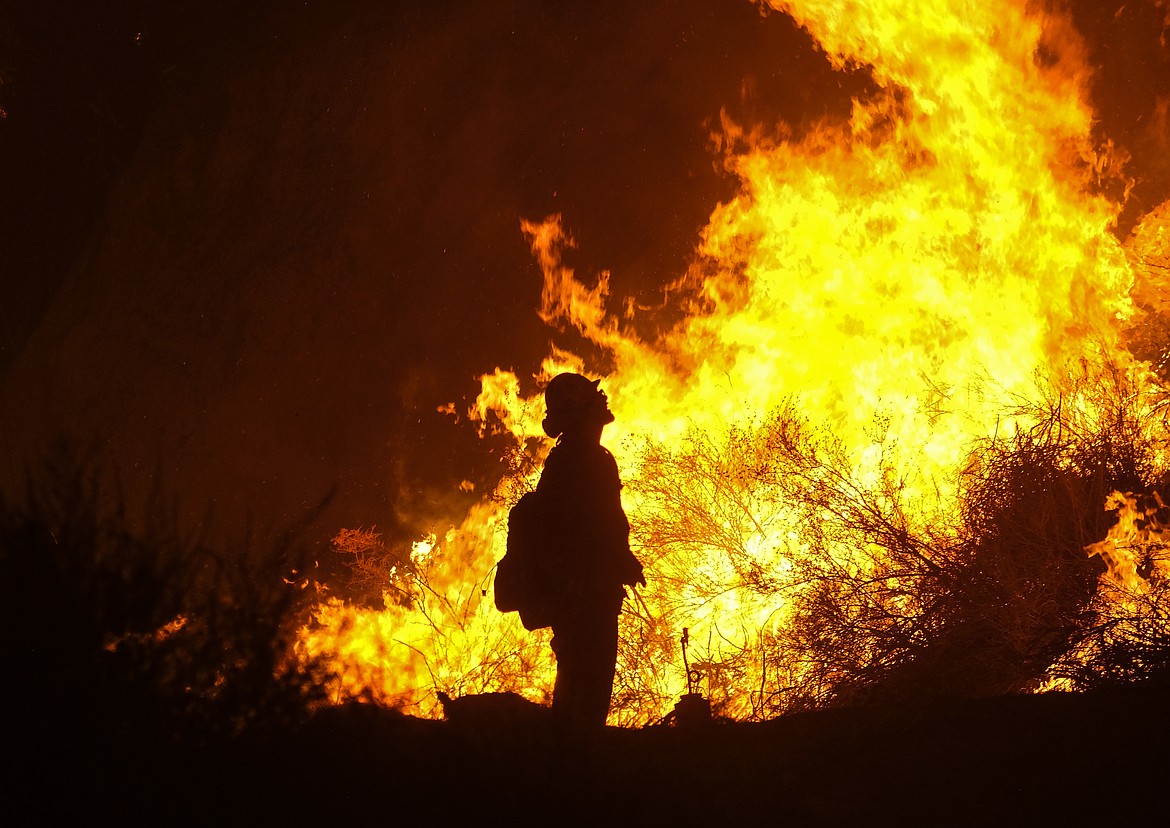
In this Aug. 9, 2018, file photo, a firefighter keeps watch as a wildfire burns in the Cleveland National Forest in Corona, Calif. (AP Photo/Ringo H.W. Chiu, file)
In January of 2026 the U.S. Department of the Interior officially launched the U.S. Wildland Fire Service.
The formation of the new federal organization represents a significant reorganization aimed at streamlining wildland fire management across federal and state agencies.
This new service consolidates firefighting, prevention and recovery efforts previously scattered among several DOI bureaus and state agencies. This marks one of the most notable shifts in federal wildfire policy in several years.
“This isn’t going to make a huge improvement necessarily on the ground in that initial attack phase. I think this is going to save money and make things much more efficient at the higher levels,” said Bobbie Scopa, a 45-year firefighting veteran and current vice president of the Grassroots Wildland Firefighters.
The establishment of the USWFS comes from Executive Order 14308, “Empowering Commonsense Wildfire Prevention and Response,” issued under President Donald Trump and Secretary of the Interior Doug Burgum.
“Because this is coming during a particular administration, people will automatically think it's bad,” Scopa said. “It’s the right thing, it should have been done 20-30 years ago.”
Burgum signed the order on Jan. 12, formalizing the agency. It unifies wildland fire programs from the Bureau of Land Management, National Park Service, U.S. Fish and Wildlife Service, the Bureau of Indian Affairs, the office of Aviation Services and the Office of Wildland Fire.
“It takes so much work and effort to get something through the bureaucracy,” said Scopa.
Fire Chief Brain Fennessy, from the Orange County Fire Authority in California, was selected to lead the new service.
The USWFS is now responsible for wildland fire management on more than 500 million acres of public and tribal lands and employs around 5,700 personnel; it also supports around 900 tribal personnel.
The agency aims to improve efficiency by reducing fragmentation and bureaucracy, enabling faster decision-making and better resource allocation during the increasingly severe wildfire seasons.
“We will have one representative to go along with the states and the locals,” said Scopa. ““I’m envisioning communities that have Fish and Wildlife on one side and BLM on the other, they’re going to be dealing with one less person and they’ll have one less agreement. For the locals I don’t see there being a big negative on this.”
Before the USWFS’ creation, qualifications varied between agencies. Now federal firefighting agencies operate under the same helm, and now therefore will have the same job requirements and certifications.