


Drought prospects looking dire this year, experts say
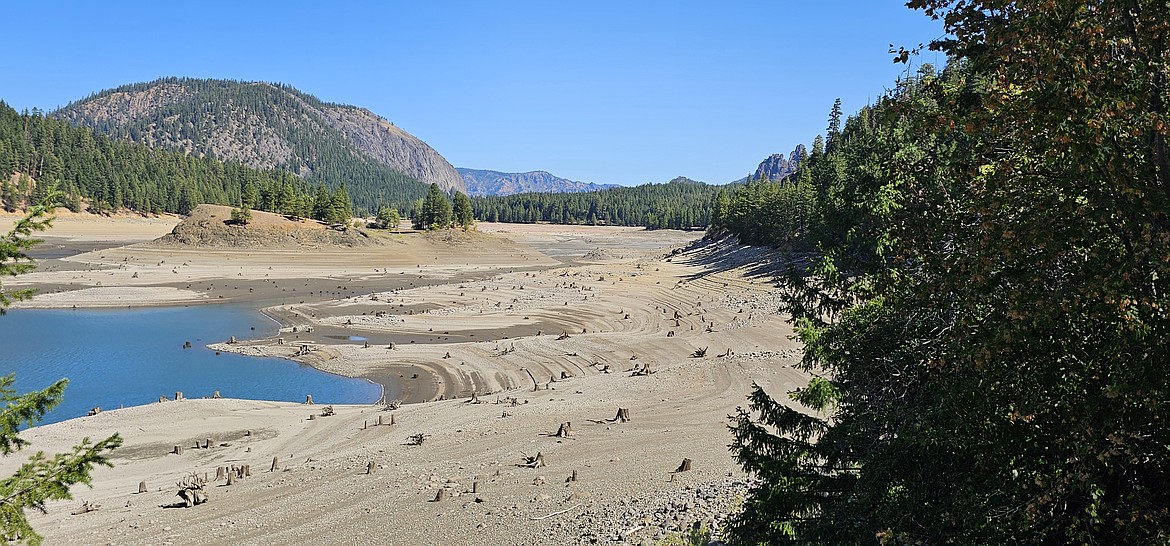
Drought conditions leave Rimrock Lake, a Cascades reservoir, nearly dry in 2025. Warm temperatures over the winter led to a scant snowpack in the Cascades and Rockies, which in turn will lead to an even more severe drought this summer, according to the experts. (Washington State Department of Ecology photo)
The question isn’t whether we’ll have a drought in the Inland Northwest this summer, according to regional experts. It’s just a question of how bad it will get.
“For the last, about two years, we've had extremely high temperatures compared to a normal two-year period,” said Idaho State Climatologist Russell Qualls.
Those temperatures have been above the 98th percentile, Qualls explained, meaning that temperatures in the last two years have been hotter than 98% of previous two-year periods.
“That can lead to a multi-year drought situation,” Qualls said.
The same thing applies to Washington, said Washington State Climatologist Karin Bumbaco.
“This year was unusual in that … our temperatures were so warm, it was the third-warmest December on record averaged over Washington state,” Bumbaco said.
The snowpack in the Rockies and the Cascades has been unusually scant, both Qualls and Bumbaco said. The problem isn’t so much that there was a lack of precipitation; Washington, Idaho and Montana were all drenched in rain in December 2025. The problem is that precipitation wasn’t staying in the mountains as snow, instead rolling down and flooding the lower elevations.
“The highest elevations did OK,” Qualls said.” They were cool enough that a fair amount of snow accumulated, but those locations were elevations above about 7,500 feet.”
A few parts of the North Cascades also retained a good bit of snow, Bumbaco said.
Some of Montana fared better than the rest of the Northwest in terms of snowpack, said LeeAnn Allegretto, a hydrologist with the National Weather Service stationed in Missoula.
“In western Montana, we’ve had the most snow this winter compared to Washington, Oregon and Idaho,” Allegretto said. “Our deficit was not as great as the other (states), and we did OK with soil moisture. So, we’re sitting pretty good west of the (Continental) Divide. But then you get down into the Beaverhead (in southwestern Montana) and into north central Montana, and it’s pretty bad.”
Those areas missed out on the atmospheric river that brought heavy rainfall farther west, Allegretto said, so the soil moisture is poor as well. In addition, western Montana has had a wetter spring than some other areas because of cool air coming down out of Canada.
“Unfortunately, eastern Montana did not,” Allegretto said.” Portions of Idaho and Washington also did not, and those are the areas that have the worst drought conditions currently.”
The snowpack in British Columbia was still healthy, Bumbaco said. For that reason, the Columbia River is likely to have a normal water supply, and that means irrigators in the Columbia Basin Project won’t have to worry about running dry come summer. The Yakima Valley and other regions that rely on water from the Cascades won’t be so fortunate, especially those growers who hold junior, or lower-precedence, water rights.
“This is the fourth consecutive year that they’ve had drought issues, and their junior water users are expected to only receive about half of their normal water allotments,” Bumbaco said. “I would expect to see more drought impacts there.”
A drought isn’t just a one-time thing, Qualls and Allegretto said. When one dry year is followed by another and then another, the effects multiply.
“In Montana and portions of Idaho, we have seen a three-year compounded drought problem,” Allegretto said. “It doesn't help that we had a winter that had such below-normal values for snow. Some places just didn't make up any ground over this winter, so it's just compounded even further on the preexisting drought conditions that were there”
Those effects ripple out into many areas of the environment and the economy,” Qualls said.
“When you have drought years stacked one after another, each successive drought summer things are worse than if we just had that one drought year isolated by itself,” he said. “Each year the starting point for soil moisture and stream flow is a little bit lower for farming. The soil doesn't get replenished as much, so you begin each year with a little bit more of a deficit. (That creates) other ecological impacts: when you have less snowpack, you get stream temperatures warming, which affects fish species that rely on very cold stream temperatures.
“It affects rafting; the big flows come out in March or a little bit later (when) not many people are rafting, so if you're at historic lows by May or a little bit later, that's really going to impact the recreation industry.”
Don’t expect the situation to improve in the coming years, the experts said.
“What we've seen over the last roughly 20 years is a gradual trend of warming,” Qualls said. “That doesn't mean that every single year is warmer than the previous year, because there are fluctuations, but the general trend (is that) the temperatures have been warming.”
“It's certainly expected with our climate change projections that the way that drought develops this year, where we had normal winter precipitation but below normal snowpack, that is really the key of what we expect to see more of in the future,” Bambuco said. “Our Cascade Mountains aren't going to get any taller, temperatures (will be) warm (and) we're going to see more rain. (That means) more flooding in the winter, and then less snow, so then less water when we need it in the spring and summer.”