
MLSD outlines proposal for new elementary
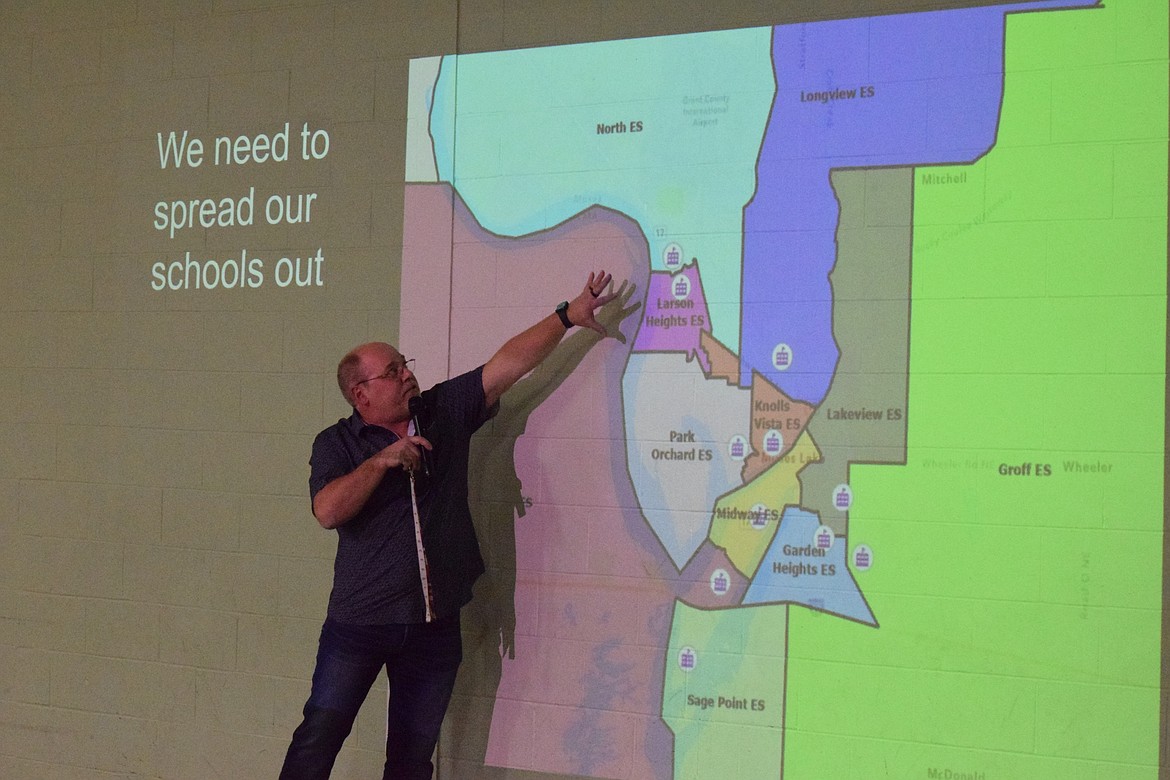
MOSES LAKE — The Moses Lake School District’s Facility Advisory Committee is recommending the district replace North Elementary and Larson Heights Elementary with a single new elementary school in north Moses Lake. This decision, committee members say, is driven by aging infrastructure, long‑term cost savings and the opportunity to leverage millions in state construction funds.
“This is just step one,” committee member Chuck Sutton said during the district’s presentation Monday night. “Most of our elementary schools are pretty poor in condition … these buildings are long past their time.”
North Elementary, built in 1951, with a building score of 52; and Larson Heights, built in 1956, with a building score of 48, are among the oldest and lowest‑rated facilities in the district.
Sutton presented photos of decaying flat roofs, failing piping and outdated electrical systems that he said no longer support the technological demands of modern classrooms.
“Up on the roof … the design just doesn’t work very well for the weather we have here,” he said. “To try and upgrade these schools is very, very difficult.”
The committee’s analysis concludes that replacing the two schools with one new campus is not only the most cost‑effective option, but also the one will stretch remaining bond dollars the furthest.
The district still retains about $54.7 million from the 2017 bond, which originally totaled $135 million. Constructing a new elementary school is expected to cost $40.2 million regardless of whether it is a replacement school or built on a new site. But the financial outcomes diverge depending on the location.
If the district builds a separate, standalone elementary school without replacing an existing one, it will not qualify for the state’s School Construction Assistance Program. Without SCAP, the project would leave roughly $14.5 million in remaining bond funds. The district would need to tap into Materials, Supplies and Operating Costs funding for around $6.8 million to complete other needed repairs around the district.
However, if the new school replaces North and Larson Heights, the district becomes eligible for nearly $20.9 million in SCAP funding. It also avoids an estimated $1.6 million in repairs, and the Larson Heights property could potentially be sold for another $3 million. With no need to pull from MSOC funds for aging buildings, the district would retain approximately $38.4 million for future district‑wide upgrades — a difference Sutton emphasized as a benefit.
“From a taxpayer’s standpoint, this looks much better to me,” Sutton said. “This option brings in state support and leaves more money for repairs across the district.”
Beyond the finances, the committee said demographic data strongly support building on the north end. Sutton said a professional demographer hired by the district analyzed growth patterns, housing development and birth rates to determine where future enrollment pressure is most likely to occur.
“Data shows future growth pressure on the north end,” he said.
He added that the existing North Elementary site already includes key infrastructure such as roads, utilities and emergency access, reducing both risk and cost.
The committee also addressed why the district is not considering building the next school in Mae Valley, an option frequently raised in public discussions.
Sutton said while Mae Valley represents “future potential,” its infrastructure “does not currently support a school,” and city plans do not include near‑term upgrades.
He said building a new school there would also eliminate the district’s eligibility for SCAP funding, significantly reducing remaining bond capacity.
“The net gain to the district by building at North is about $38 million,” he said.
Under the recommendation, the new school would be built on the North Elementary property and be designed for up to 650 students — enough space to serve the combined populations of North and Larson Heights.
Moses Lake School Board Vice Chair Paul Hill, who also serves on the advisory committee, said this would set the district up for around 10 years. Despite that, further growth may be needed, but he said it’s hard to predict far out. He said he fully supports this plan.
“I love it,” Hill said. “I think it’s the right move. The Base deserves it.”
The existing North Elementary gym would be retained as part of the new facility, allowing the campus to operate with two gym spaces. The Larson Heights site could be used for district maintenance, held for future construction, or sold, depending on district needs.
Sutton said the plan fits into a longer‑term facilities strategy the district is working to develop.
“We’re not always just coming back each year with a blank piece of paper trying to say, ‘What’s next?’” he said. “This work is about setting a long‑term vision for our buildings.”
If the district proceeds, planning would begin in spring 2026, with design phases extending through 2027. Construction would take place from late 2027 through spring 2029, and the new school would open to students in fall 2029.
Superintendent Carol Lewis said the recommendation marks the beginning of a multi‑year decision‑making process, which will continue to include community input.
“We’re involving lots of people in all of our work,” she said. “This is the first step.”
Additional community meetings are expected as the district develops more detailed designs and long‑term facilities plans.