
Washington lawmakers resurrect bill to lower legal alcohol limit for drivers
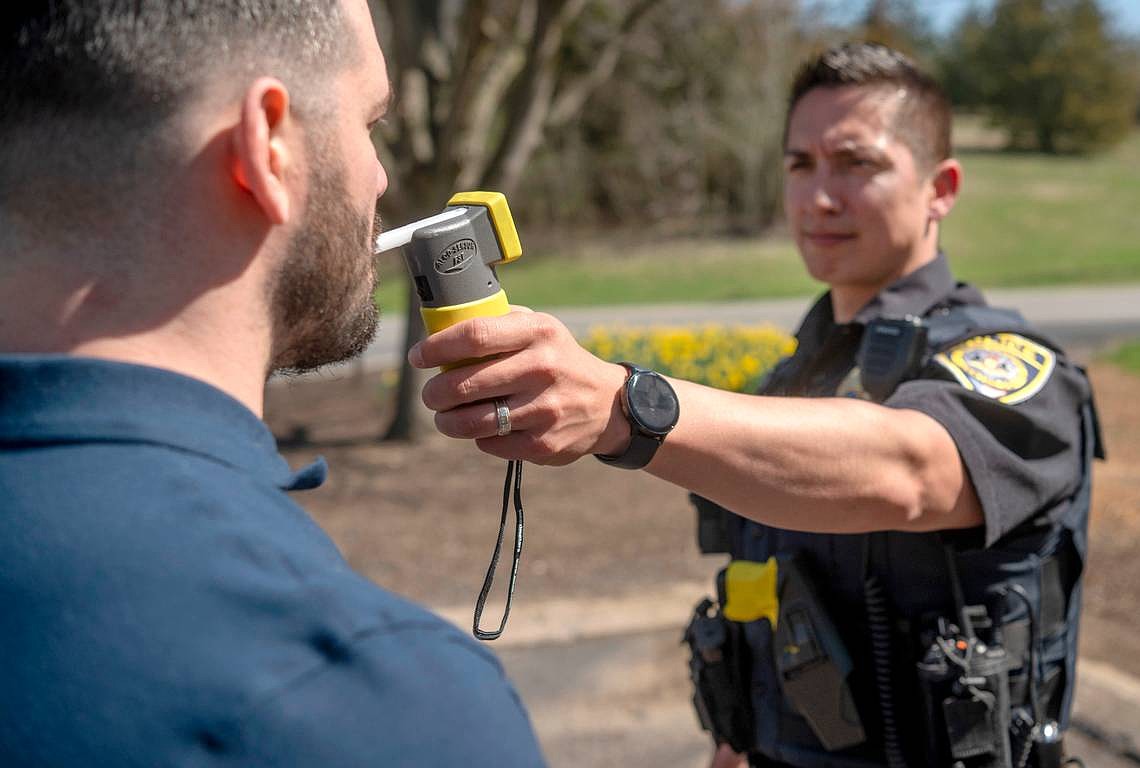
A police officer and intern demonstrate a breathalyzer test. A bill currently under consideration by the Washington Legislature would reduce the legal limit for driving under the influence cases.
ABBY DREY/TNS
OLYMPIA — Stacy Gammons-Ankerfelt just completed her first year as a fifth-grade teacher at Scenic Hills Elementary School in Kent when she was struck and killed by a drunk driver. Now, more than 13 years later, her family is still fighting to ensure no one else loses a loved one to drunk driving.
Ashley Bonus, Terri Gammons and Kayson Bonus – sister, mother and nephew of Gammons-Ankerfelt – testified Thursday in support of a bill that would reduce the legal alcohol limit for impaired driving offenses.
“Impaired driving is not an accident,” Gammons said in a public hearing. “It is the choice that is 100% preventable. No family should ever have to stand where I am standing today.”
House Bill 2362, sponsored by Rep. Brandy Donaghy, D-Mill Creek, aims to lower the legal per se breath or blood alcohol concentration threshold from 0.08% to 0.05% as evidence used to determine the offenses of Driving Under the Influence and Actual Physical Control of a Motor Vehicle While Under the Influence.
“We know that when we have a few drinks, we probably feel like we’re fine,” Donaghy said in testimony. “Data shows us that we are not, that our reactions are slower, that our judgment is flawed.”
If passed, the Washington Traffic Safety Commission would be directed to implement a statewide public information campaign relating to the reduction, including advertisements in county newspapers across multiple non-English languages and in collaboration with the hospitality industry.
The bill also requires the Washington State Institute for Public Policy to submit a report by March 2028 evaluating the policy’s impact on serious and fatal traffic crashes, arrest and adjudications for impaired driving offenses, and business effects on the hospitality industry, including breweries, wineries, and distilleries.
The bill follows Utah, the only state to lower its legal alcohol limit to 0.05% in the United States, and other global countries such as Australia and Germany. According to Utah’s Department of Public Safety Highway Safety, the state saw a 19.8% reduction in the fatal crash rates between 2016 and 2019.
The Washington Traffic Safety Commission finds that driving performance declines by 25% to 50% at a BAC level of 0.05% and that drivers between BAC levels of 0.05 - 0.079% BAC are nearly five times more likely to be involved in fatal crashes compared to those with no alcohol in their system.
In 2024, 102 of 342 impaired drivers involved in fatal car crashes were over the legal 0.08% BAC limit, with 85 involving alcohol combined with other drugs.
Opponents of the bill argued it would unfairly burden businesses while criminalizing drivers who are not actually impaired.
Sean DeWitz of the Washington Hospitality Association testified in opposition, arguing that reducing the legal BAC limit would increase liability risks for establishments serving alcohol.
“This bill imposes new restrictions on responsible consumers and adds liability on small businesses like breweries by expecting staff to identify when a customer has reached a 0.05% BAC when there is no training or practical means to do so,” DeWitz said.
Josh McDonald, executive director of The Washington Wine Institute, added that there are no dedicated funds, resources, or implementation plans to support education or training for servers to identify impairment.
Karlie Valdez from the Washington Association of Criminal Defense Lawyers and the Washington Defenders Association also argued that the bill would subject drivers to DUI convictions without actual impairment.
“This would mislead Washington drivers by creating a near-zero tolerance standard that is more stringent than the legal definition of being under the influence,” Valdez said.
Those who testified in support, including Amy Freedheim, prosecuting attorney with the King County Prosecuting Office, countered that lowering the BAC would further educate the public about the risks of impaired driving.
“When our state moved from 0.1 to 0.08 – and I was there for it – we heard the same arguments from the hospitality industry,” Freedheim said. “We did not see the effects that they complained about, but we did see a six percent decrease in fatalities. We are going to see this same kind of decrease and we’ve seen that in all the other countries.”
Washington lowered its legal BAC to 0.08 in 1999 and the number of drivers in fatal crashes with BACs higher than 0.15% declined by 20% by 2013, according to the Washington Traffic Safety Commission.
Additionally, in a 2017 meta-analysis, researchers found a 11.1% decline in fatal alcohol-related crashes from lowering the BAC to 0.05% or lower, estimating that 1,790 lives could be saved each year if all states adopted a 0.05 limit.
Other residents also testified in support, sharing personal stories of loss, including Robin Sparks, who lost her brother in Sept. 2024.
“Grief is a lifetime of work,” Sparks said. “Holding on to grief and anger isn’t productive, but solutions are.”
Grant County’s Sheriff, Joe Kriete, said that any legislation that changes impaired driving laws must be looked at carefully to ensure its practicality, fairness, and effectiveness to prevent dangerous behavior.
“Keeping the public and the deputies who enforce these laws safe is always my top priority,” said Kriete. “As this bill moves forward, I want to hear from community members and partners, review the facts, and understand how the proposed changes could impact traffic safety and law enforcement across Washington state.”
Donaghy resurrected the bill after previous efforts by Sen. John Lovick, D-Mill Creek, in 2025 and 2023 failed to advance.
HB 2362 is now scheduled for an executive session at the House Community Safety Committee on Jan. 22.