Monday, January 19, 2026
30.0°F

Ephrata Schools bond – Ephrata High School
by NANCE BESTON
Staff Writer | January 19, 2026 3:15 AM

EPHRATA — As the Ephrata School District prepares to bring a $75 million bond proposal to voters in February 2026, one of the components is a plan to renovate Ephrata High School. The proposal aims to address aging infrastructure, scattered campus layout and growing instructional needs.  

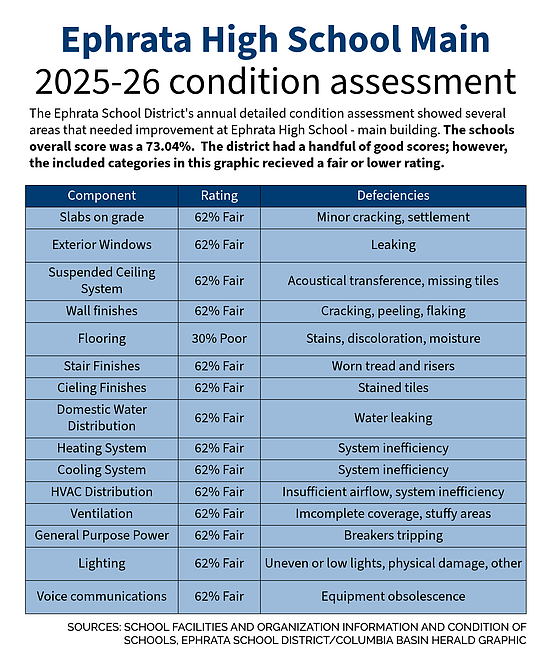
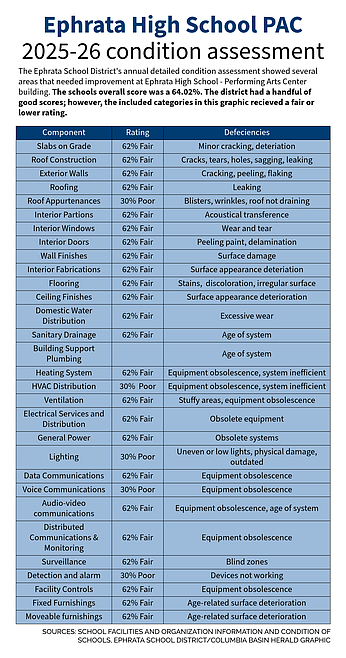
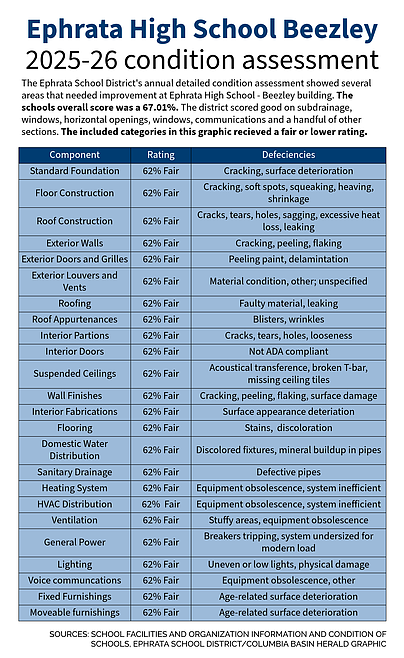
The bond would replace both Grant Elementary and Parkway Intermediate Schools and begin the renovation of Ephrata High School. Ephrata High School – built in 1985 alongside older adjacent facilities – received a 73.54% condition rating in the district’s most recent building assessment. While not the lowest-scoring building in the district, several systems show signs of age, wear, or inefficiency, and the Performing Arts Center and the 1937 Beezley Annex scored significantly lower. 

“If we don’t start the renovations soon, students who are in Kindergarten now wouldn’t see any of the benefits,” Superintendent Ken Murray said.  

Aging components 

Although the high school’s overall condition is considered adequate, the assessment identifies several areas of concern. Flooring in the main building scored 30%, noting stains, discoloration, and moisture-related deterioration. Wall and ceiling finishes show cracking, peeling, worn surfaces and stained tiles. HVAC systems — including heating, cooling, ventilation and airflow distribution — were rated in the 62% fair range, reflecting aging equipment and inefficient performance. Electrical systems also show limitations tied to modern teaching and technology needs. Breakers trip under current loads, and lighting fixtures are described as outdated, mismatched and energy-inefficient. Voice communications, including phone and intercom systems, also received a 62% rating, with incomplete coverage reported. 

Although the high school itself dates to 1985, many of its associated facilities — including the PAC and Beezley building — are older and contribute to overall campus challenges. 

Architect Ned Warnick noted that the high school’s condition reflects a typical depreciation curve “about the time to start talking about what would come next.” 

Divided campus 

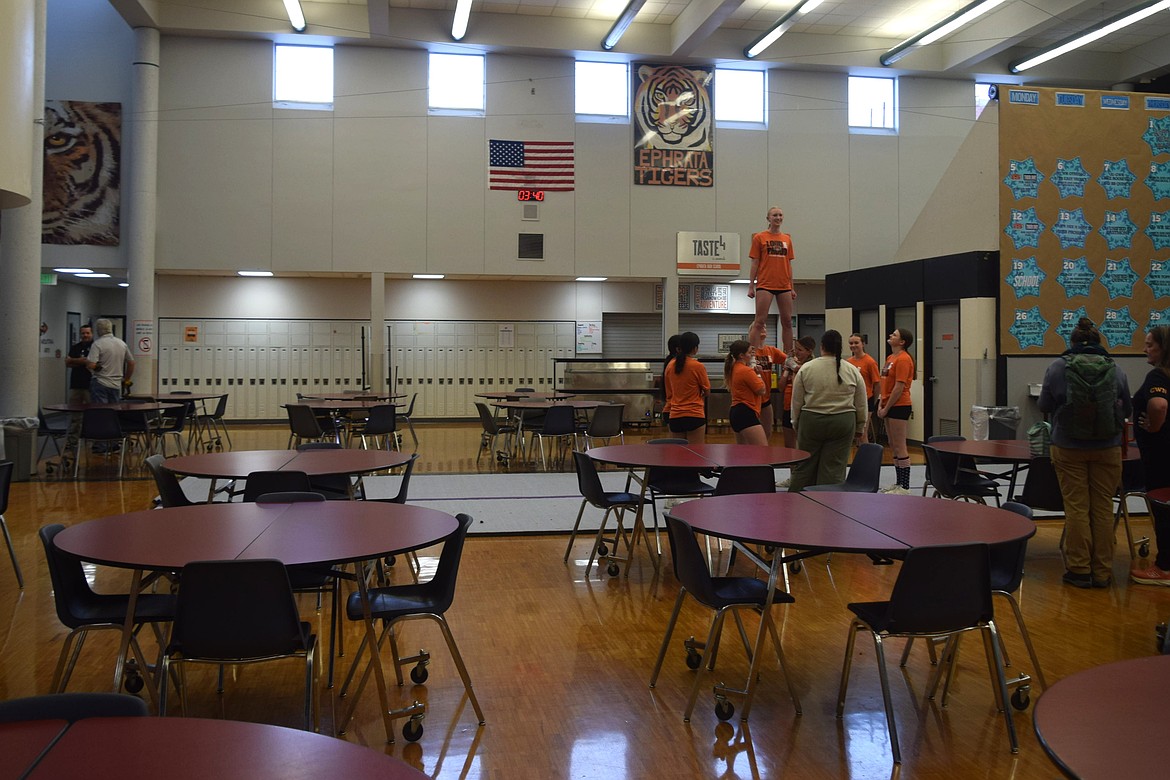
The district describes the current high school campus as fragmented, consisting of separate buildings constructed over multiple decades: the main 1985 building, the Performing Arts Center and the older Beezley structure. Movement between buildings requires students to cross exterior areas, creating supervision, security and weather-related challenges. 

Warnick said the long-term goal is a fully consolidated high school. 

“The long-range goal expressed by the committee is to end up with a high school that is a consolidated, closed campus… You would be able to keep them controlled and secure,” he said.  

Although this is the ultimate goal, it will not be achieved solely with the proposed 2026 bond. District officials have stated that there will likely be another bond in the future to complete the high school's renovation. The current proposal would be a start, though.  

Some classrooms today are located in spaces not originally designed for instruction, such as former locker rooms or storage areas. A teacher currently instructs students on the PAC stage, a space not intended as a classroom but repurposed due to enrollment pressure. 

Murray said the high school was originally built for about 600 students but now serves over 900.  

“You’ve got to find every space … we’re out of space,” Murray said.  

Alongside the space issues inside the school, there are also problems with the roads outside the building.  

“Parents line up on these skinny roads, kids are walking across busy roads, this location is just not set up to handle the traffic we see,” Murray said.  

PAC limits 

The Performing Arts Center — scoring 64.02%, one of the lowest ratings in the district — shows multiple deficiencies. Roof drains fail to function properly, roof materials show sagging, leaks, and deterioration and ventilation systems were rated 30% poor, with “stuffy areas” and inadequate distribution. Sightlines and seating capacity also limit the space for productions and community events. During walkthroughs, staff described how the auditorium feels overcrowded when hosting events like Cabaret. 

“For cabaret, we stand up for about 325 to make sure every seat has a full view … We just don’t have the space to house everyone safely,” Murray said.  

New construction would include a fully modernized auditorium designed to meet current and future program needs. 

EHS bond upgrades 

If approved by at least 60% of voters, the bond would fund approximately $21 million in high school improvements, including a new performing arts auditorium to replace the PAC, a new main office relocated to the front of the campus, six new classrooms, creation of a single secure entry point and expansion to support a closed high school campus. 

The new Parkway Intermediate school would be built behind the high school and the Grant Elementary building would be demolished after the high school construction is finished. The space where Grant sits would become expanded parking for parents and students. There is also the potential for added sports fields. Murray also mentioned adding a bus loop to connect the two schools in the future.  

First step

District leaders said that without beginning the high school work now, future improvements could be delayed 25-30 years. Fire Chief Jeremy Burns noted the committee’s concern.  

“If we didn’t start working on the high school, it would push the project out by 25 to 30 years.” 

During the committee's work sessions, they had to decide whether or not to propose just the replacement of Grant and Parkway or to add the renovations to the high school into the mix. The group decided the high school couldn’t wait.  

The bond funding strategy includes an estimated increase of $1.07 per $1,000 of assessed property value, with up to $27 million in state matching funds available to support eligible portions of the total project. According to the district, this would be a fiscal impact of nearly $392 annually for a home valued at $300,000.  

The total estimated cost of the three projects is $102 million, with around $75 million coming from local dollars. The Ephrata High School project is estimated to cost nearly $21 million, with around $14.5 million coming from local dollars.   

“This proposal reflects both the realities of our facilities and a shared commitment to providing equitable, high‑quality learning spaces for every Ephrata student,” Murray said.  

Next steps 

If the measure passes, design work for high school improvements would begin in spring 2026, with construction sequencing determined to minimize disruption to students. If it fails, Murray said the district will continue operating but will need to “come back together as a community group” to determine the next steps. 

While discussions about the aging elementary schools have drawn much attention, Murray said the high school upgrades are essential for long-term safety, efficiency and student experience. 

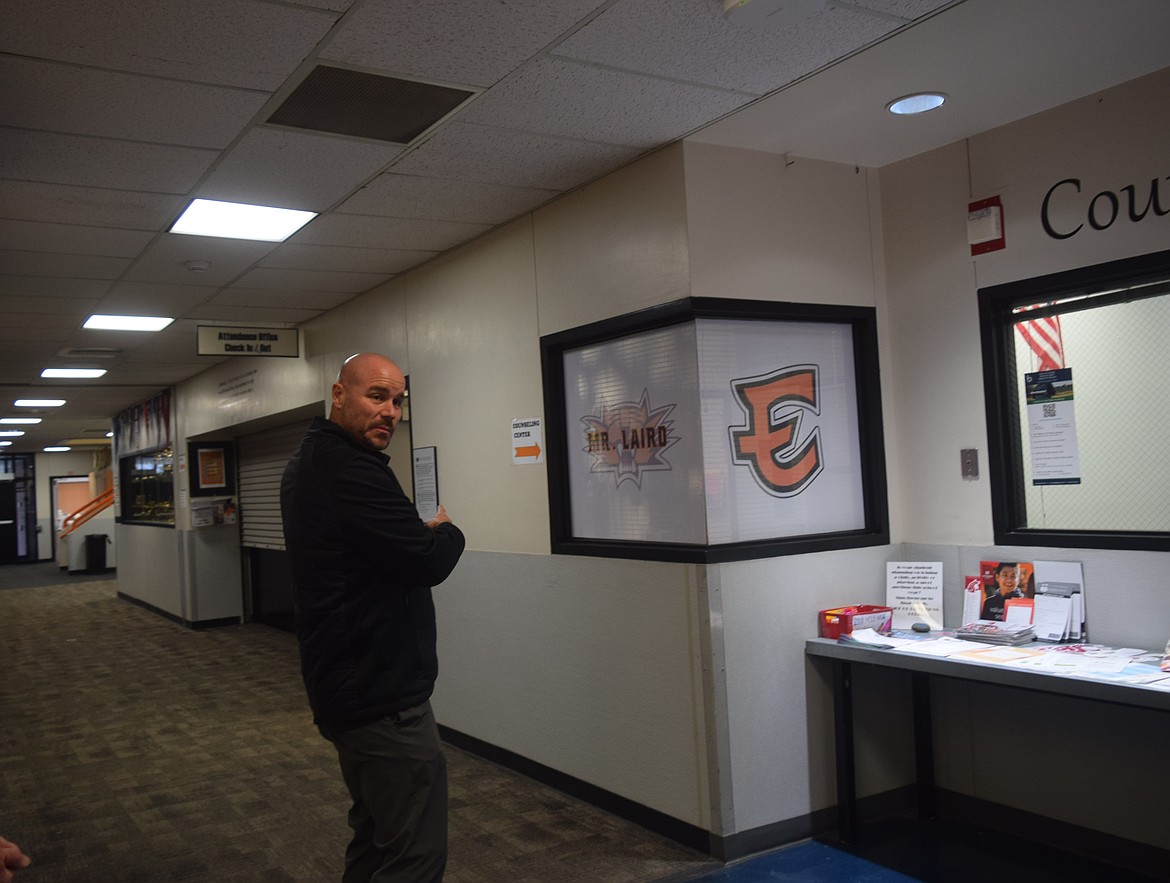
    Superintendent Ken Murray stands next to the Ephrata High School main office. Currently, people talk to a camera outside of the building to be let in. If the 2026 bond is approved by voters, the school would build a secure front office for visitors. On the second floor, above the office, new classrooms would be built.