
Construction workers rally in support of behavioral health in Olympia
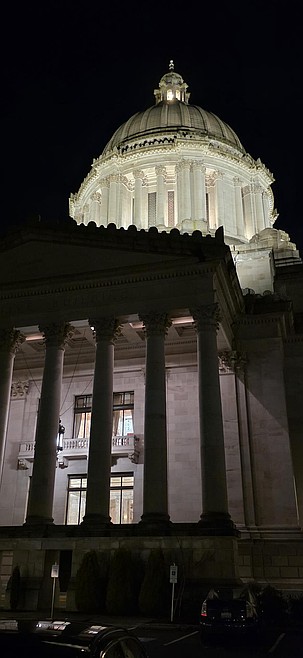
Construction workers from throughout Washington rallied at the state Capitol this week in support of policies and legislation that supports mental health care access statewide. Pictured is a view of the Capitol last Thursday evening.
R. HANS MILLER/COLUMBIA BASIN HERALD
OLYMPIA — Bright orange hardhats and yellow reflective vests engulfed the steps of Washington’s Capitol Feb. 17 as construction workers, apprentices, labor leaders from across the state joined members of the Legislature to call attention to the behavioral health crisis impacting one of the most physically demanding and high-risk industries.
Construction and trades workers rallied to support behavioral health following the passage of House Bill 2492 through the House Floor that would require behavioral health and wellness training in state-registered apprenticeship programs. The training would include destigmatizing behavioral health, supporting wellness, recognizing signs of distress, suicide prevention, and connecting to resources.
The legislation was introduced by the Washington State Building and Construction Trades Council and sponsored by Rep. Greg Nance, D-Bainbridge Island, aiming to alleviate the behavioral health crisis across the construction workforce.
“A lot of times when folks are trying to address behavioral health needs, the focus is maybe more on the access to services or the health care coverage but our union workforce has a very strong health care coverage,” Erin Fraiser, deputy secretary of WSBCTC, said. “It's more about the stability of having a job and income, having the respect that goes with being employed, and being able to provide for your family.”
Rep. Mari Leavitt, D-Steilacoom, also sponsored and signed House Resolution 4677, which recognizes the urgent need to strengthen behavioral health awareness and reaffirms the state's commitment to supporting the construction workforce. According to Fraiser, the resolution served not only as an acknowledgment but to let those who may be struggling know that they are not alone.
“Building a healthier Washington means making behavioral health a true priority in every corner of our state,” Leavitt said at the rally.
According to the WSBTC, in 2023, there were 982 fatal construction jobsite injuries nationwide, compared to 15,910 overdose deaths and 5,095 suicides among construction workers. Additionally, while construction workers make up about 8% of the U.S. workforce, they account for roughly 17% of overdose deaths among working people, with male construction workers nearly twice as likely to die by suicide as other working men.
Mandi Horton, director of safety at the Associated General Contractors of America, explained that the industry’s physical demand coupled with societal pressure on men to not show vulnerability and cyclical employment makes construction uniquely challenging.
“We have some seasons where we are working gangbusters and they can get all the hours they possibly could work. And then other seasons where it might be slower or leaner times, and there's advantages and disadvantages to both,” Horton said.
Between Dec. 2024 and Dec. 2025, Washington lost 11,600 construction jobs, a decline of 5.2%, according to a press release from the Associated General Contractors of America. The WSBTC also found that across 14 different union construction workforces in the state, more than 10,000 workers are out of work with many of them for more than two years.
According to Fraiser, the state budget deficit, along with federal funding cuts to public works has significantly contributed to the employment downturn.
“None of our jobs are permanent,” Fraiser said. “Our workforce’s career is going from one job placement to another.”
Horton added that increased regulation and inflation in material prices have made the work cumbersome with certain employers and project owners canceling or pausing their projects due the state's economic climate. .
The state is currently facing another $2.3 billion operating budget deficit this biennium with budget makers proposing to redirect more dollars from the Public Works Assistance Account, a program that provides loans to local government infrastructure projects, to help balance the general fund in their recent supplemental budget proposal.
House Bill 2492 passed through the Senate Labor and Commerce Committee, joining other mental health legislation such as House Bill 2619 sponsored by Rep. Tom Dent, R-Moses Lake, that aims to reduce the regulatory stress in agriculture, and Senate Bill 1634 that would strengthen public schools’ support for student behavioral health.
“We've got to get upstream of the problem,” Horton said. “We've got to start talking to people before they get into crisis, before they get established in the industry, and remind them that, you as a human being, add value to this world.”
If you are experiencing a mental health crisis, you can visit https://www.agc.org/mental-health-suicide-prevention or contanct the 988 Suicide and Crisis Lifeline.