
WA lawmakers push for state to embrace nuclear energy
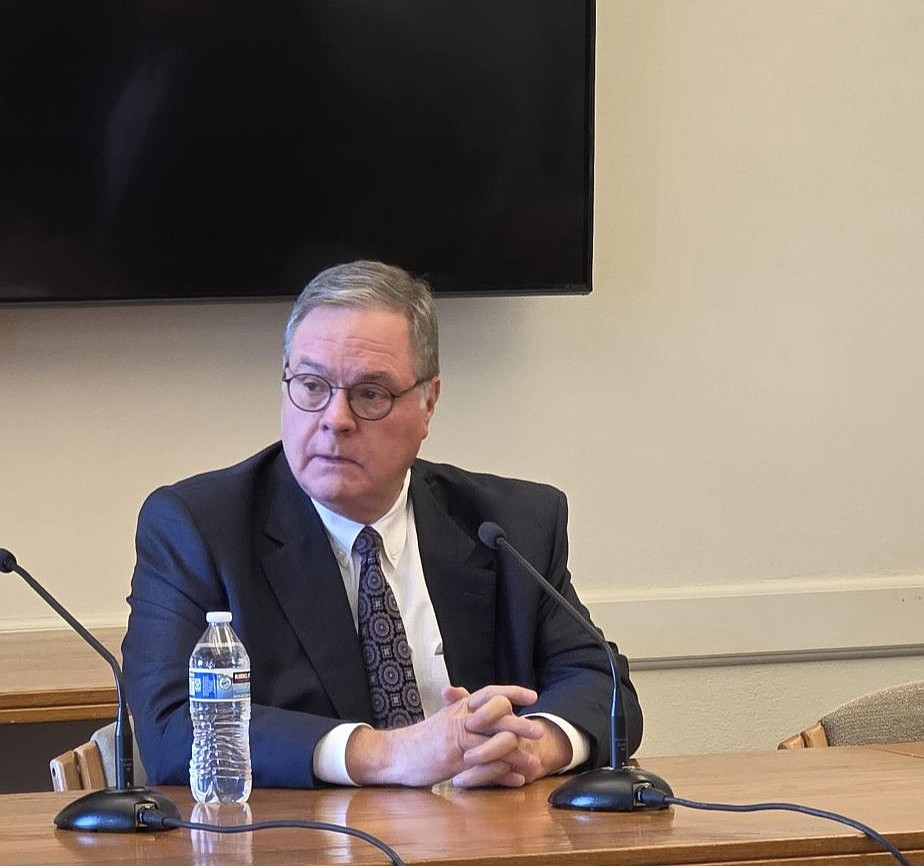
Washington Lieutenant Governor Denny Heck speaks with journalists during a briefing last Thursday in Olympia. Heck said he thinks people will change their minds about nuclear energy when they flip a switch but don't get light because of an energy shortage.
R. HANS MILLER/COLUMBIA BASIN HERALD
OLYMPIA — “The United States Department of Energy is looking for a home for a new Nuclear Lifecycle Innovation Campus, and Washington is the perfect place to put that,” Rep. Stephanie Barnard, R-Pasco, said in an interview.
Many nuclear energy-related bills introduced in Washington’s Legislature this session have not made it out of committee, including HB 2090, HB 1249, and HB 1481.
HB 2090 would integrate nuclear energy into the state strategy, HB 1249 would create the commercial liftoff for energy from the advanced nuclear advisory commission, and HB 1481 would commission a state study on the benefits and feasibility of expanding nuclear energy in Washington.
Barnard and Rep. Mark Klicker, R- Walla Walla, introduced House Joint Memorial (HJM) 4016 on Feb. 14. The joint memorial requests Gov. Bob Ferguson to respond to the DOE’s request for information (RFI) and convey Washington’s interest in hosting one or more nuclear lifecycle innovation campuses. It would also require Washington to work with local officials and other stakeholders to develop a plan to ensure it aligns with Washington's economic, energy, and workforce goals.
HJM 4016 has been referred to the House Environment and Energy Committee.
NLIC’s are intended to strengthen America’s advanced nuclear energy strategy.
“The proposed campuses could support activities across the full nuclear fuel lifecycle, including fuel fabrication, enrichment, reprocessing used nuclear fuel, and disposition of waste.,” according to the DOE website. “Depending on state priorities and regional capabilities, the sites could also host advanced reactor deployment, power generation, advanced manufacturing, and co-located data centers.”
Nuclear energy is a point of contention in the Washington Legislature. Most Republicans are pro-nuclear energy, while majority Democrats are more wary.
Nuclear plants emit no carbon and produce an extremely high amount of energy because they are almost always operating at full capacity, according to MIT Climate Portal. Compared to wind and solar energy, nuclear plants take up less land to produce the same amount of electricity, and operate at almost three times the capacity of a wind or solar energy plant.
NLIC’s would provide a major opportunity for economic development in Washington, create family wage jobs, and solidify the Tri-Cities region as the clean energy capital of the world, Barnard said.
Opponents of nuclear energy are concerned about nuclear waste and how it would be dealt with, according to Barnard.
Barnard said many people are uneducated about nuclear energy, and associate it with disastrous incidents such as the Chernobyl nuclear meltdown.
“The waste that people think about when they think about nuclear waste is kind of what you see on The Simpsons –- the big green boom that's bubbling out of those barrels, and it's terrifying,” Barnard said. “But that’s the degree to which they understand it, and they see it as something to fear.”
When asked about his stance on Washington turning to nuclear energy, Lt. Gov. Denny Heck said Washington is not producing energy at the pace needed to meet the increasing demand. He warned that Washington is heading towards a serious shortage if it does not expand generation capacity.
“We’re headed towards a real problem,” Heck said. “Nuclear absolutely has to be a part of our conversation about how we meet our own energy needs.”
Heck said regulatory and permitting barriers have slowed Washington’s ability to expand energy production, including potential nuclear power.
“I know exactly the moment in time when the dynamic is going to change,” Heck said. “That moment in time is when large numbers of people reach for the light switch, and they flip it, and they don’t get any light because of a brownout.”
Nuclear energy is increasingly viewed by experts as critical to meeting long-term climate goals.
“Nuclear is now recognized by experts around the world as a necessity to reaching net zero by 2050,” said Scott Montgomery, a geoscientist at the Jackson School of International Studies at the University of Washington.
Investing in nuclear energy comes with significant upfront costs and long construction timelines.
“Nuclear is more expensive… particularly on a megawatt hour or kilowatt hour basis,” Montgomery said, adding that reactors require substantial initial investment but operate for decades once built.
Montgomery added that nuclear expansion in Washington could move forward regardless of legislative action, pointing to Amazon’s partnership with X-energy, a start-up company, to develop small modular reactors near the Columbia Generating Station, a nuclear power plant in Benton County. Those projects could add significant electricity to the grid beyond what Amazon’s data centers require.
The Washington State Journal is a nonprofit news website operated by the WNPA Foundation. To learn more, go to wastatejournal.org.