
Media Day at the Capitol reveals ongoing budget debate
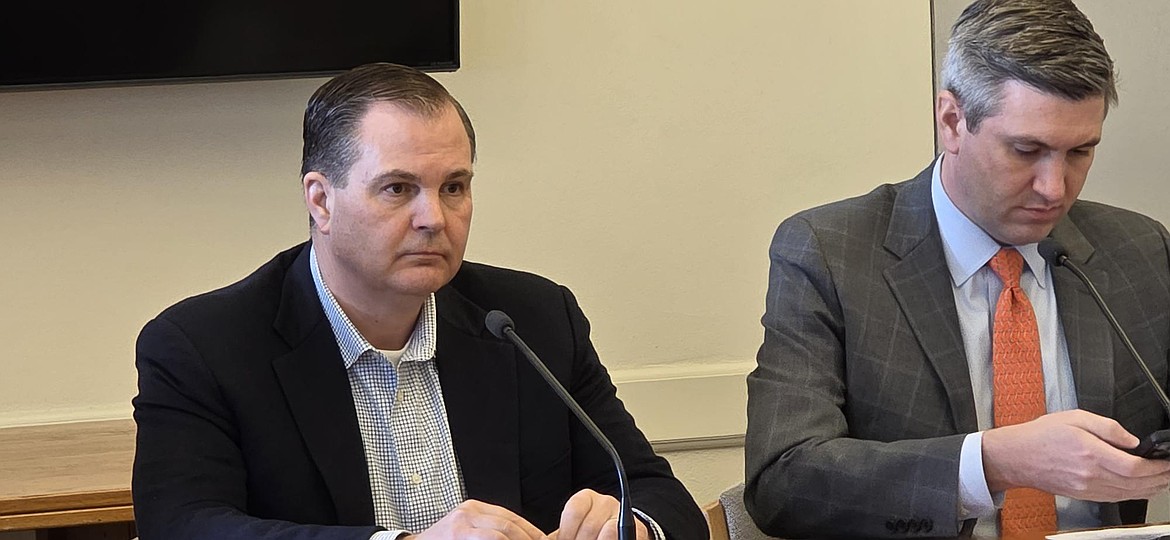
Senate Republican Leader John Braun, R-Centralia, on the left, and House Republican Leader Drew Stokesbary, R-Auburn, participate in a panel regarding the ongoing negotiations to adjust the state's biennial budget during the 2026 Washington Legislative Session while attending Media Day at the state Capitol.
R. HANS MILLER/COLUMBIA BASIN HERALD
OLYMPIA — Media outlets from throughout Washington congregated at the Senate John A. Cherberg building Thursday, Feb. 19, for the Capitol’s annual Media Day hosted by the Washington Newspaper Publishers Association.
Reporters heard from the Transportation Committee, caucus leaders in both chambers of the Legislature, budget makers and other elected officials, including Lt. Gov. Denny Heck, to discuss the state’s supplemental budget, affordability crisis, and the controversial proposed income tax known as the “millionaires tax.”
The Transportation Committee and budget writers opened the series of panels, announcing both chambers’ supplemental budget proposals that will be released to the public over the weekend, with a public hearing scheduled at the fiscal committees on Monday, an executive session Wednesday, followed by a floor vote Saturday, Feb. 28.
The state is currently facing a $2.3 billion budget shortfall as lawmakers work from Gov. Bob Ferguson’s budget proposal that was announced in December.
Earlier in the week, the state’s Economic and Revenue Forecast Council revealed that revenue collections are predicted to increase by more than $1.8 billion by 2029 compared to the Nov. 2025 forecast. The forecast placed the total revenue at $75.3 billion this biennium, an increase of $827.5 million from November.
In light of the rosy news, Republican budget writers argue against the majority’s push for tax increases in pending budget policies, including Senate Bill 6346, which would tax households earning more than $1 million by 9.9%.
“We talk a lot about regressive taxes and all of the regressive nature of our state budget, but right now, it seems like the thirst for new and additional taxes and fees in Olympia is just never-ending,” Sen. Chris Gildon, R-Puyallup, ranking member of the Senate Ways and Means Committee, said.
Gildon pointed to a series of bills moving through the legislature that he claimed to contradict the Democratic majority’s goal of restructuring the regressive tax code, including a bill that would increase tax on nicotine products, a bill that would remove a tax exemption for the warehousing and reselling of prescription drugs, and a bill that removes the tax exemption for replacement equipment for data centers.
“I can't reconcile the two,” Gildon said.
Caucus leaders then took the floor to discuss their uphill battle against the state’s affordability crisis, centering the conversation back on the income tax.
House Speaker Laurie Jinkins, D-Tacoma, said the chamber has passed 190 bills so far, with more than 80% having bipartisan support, focusing on affordability and protecting Washingtonians from the “malevolent” federal administration.
Legislation requiring employers to notify workers if the federal Immigration and Customs Enforcement officers inspect businesses advanced through the House. Lawmakers also passed a bill that would make impersonating a law enforcement officer a gross misdemeanor and prohibit facial coverings worn by law enforcement officers. Additionally, they passed a series of bills aimed to increase affordability, such as legislation that would increase access to preventive services without co-pays, one that would decrease medical debt interest to a maximum of 1%, and a bill that would help establish and support publicly owned grocery stores.
Members of both parties acknowledged that affordability is a distinct problem in Washington on a variety of fronts, from housing to fuel to groceries. Disagreements arose on how the issue should be addressed.
Republican caucus leaders shared their concern for the growing affordability struggles; however, they asserted that an income tax would only put them in the “wrong” direction.
“We're top five for gas, groceries, housing and childcare,” House Republican Leader Drew Stokesbary, R-Auburn, said. “It doesn't matter if some rich guy in value has to pay more taxes. It matters if you can balance your own budget, and if we're not going to give a tax reduction to those people that can barely balance their budget, what are we doing here?”
Stokesbery and Senate Republican Leader Sen. John Braun, R-Centralia, highlighted that the income tax could result in capital flight with businesses leaning away from locating in the state, while posing a possibility for the tax to spread to all Washingtonians. There was also a concern that wealthy individuals and businesses might also leave Washington due to the added tax burden on those in their income brackets.
Primary sponsor Senate Majority Leader Jamie Pedersen, D-Seattle, asserted many times throughout the session that there are no plans to lower the income threshold and that the tax reduction attached to the bill will be expected to grow to between 25% and 40%, including tax relief from the business and occupation tax and sales tax exemption for hygiene products.
More elected officials spoke, including the superintendent of public Instruction, the commissioner of public lands, and the secretary of state, with Lt. Gov. Denny Heck closing the event. Heck discussed the legislature’s declining press corps and overall health of democracy amid increasing political polarization and violence, referring to the assassination of former Minnesota House Speaker Melissa Hortman.
Other political violence incidents, including the assassination of Turning Point USA founder and political commentator Charlie Kirk, have occurred in the last few years.
Heck said the overall decline in the number of professional journalists nationwide created a problem because, without dependable news sources, people tend to fill in the gaps of knowledge with hearsay and rumor.
“I think there's plenty of evidence, plenty of data, to suggest that the decline of local journalism is unhealthy for democracy, and there are plenty of forces degrading the health of democracy today,” Heck said.
In 2019, Heck formed the Project for Civil Health in partnership with Henry M. Jackson Foundation, the University of Washington Evans School, and The William D. Ruckelshaus Center, which established the Joint Select Committee on Civic Health at the legislature. The project aims to train officials how to engage and work across differences while seeking common ground.
“How is it that we think that norms and mores are developed and are adopted and are internalized?” Heck said. "It's by continuing to hold them up such that they become habits of the heart and treating one another respectfully, even when we disagree, is a habit of the heart that is necessary to sustain a healthy democracy.”
As the income tax proves to be the most politically divisive piece of legislation this session, lawmakers have less than three weeks to work through that bill and numerous others ahead of adjournment set for March 12.