Monday, February 23, 2026
37.0°F

Ephrata sets plan to address floodplain challenges

by NANCE BESTON
Staff Writer | February 23, 2026 3:00 AM

EPHRATA — The City of Ephrata is beginning a long process to repair and improve the Dry Creek Flood Diversion Channel, a system meant to protect the community from major flooding. During the Feb. 18 City Council meeting, Project Engineer Dave Bren gave an explanation of why Ephrata is still in a federally established floodplain and what must be done to change that. 

Bren opened by addressing a question city staff say they hear often: “Why are we in a floodplain?”  

He explained that even though Ephrata is in a desert climate, Dry Creek still produces seasonal floods.  

“Right now, we are not getting any credit at all for our flood diversion,” he said.  

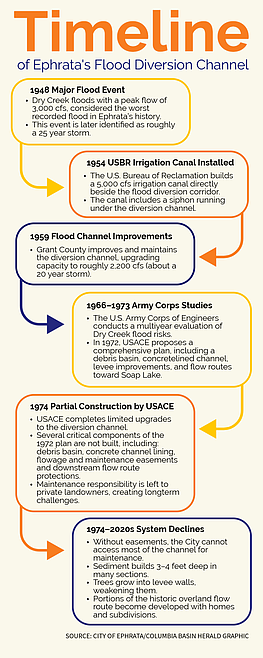
The channel above the city, built in stages since the 1940s, acts as Ephrata’s “shield” from floodwater, but it’s no longer functioning as designed. 

Challenged channel

According to Bren, lack of maintenance over several decades has left the channel clogged and weakened.  

“It’s filled about three to four feet with bed load or sand, ground rocks,” he told the council. He also pointed out that the levee is deteriorating. “The levee itself has trees growing in it, which is weakening it… it is in very bad shape.” 

He showed drone footage illustrating how some areas have narrowed, and how past construction by the Bureau of Reclamation has pushed material into the channel. 

“We’ve been losing capacity,” he said. 

Bren told council members that the channel likely could not even handle a moderate flood today.  

“If we get hit with (a 25‑year storm), right now, I don’t think our flood diversion channel could handle it,” he said. 

Why the system isn’t big enough  

Much of the problem dates back to unfinished federal work. Bren explained that in the early 1970s, the U.S. Army Corps of Engineers created a complete plan to protect the city from 100‑year floods, but “that didn’t happen.”  

Instead, the city received a smaller project in 1974 that lacked several key parts. 

“One of the options in the report was the 1972 plan. That’s not what we got. We got the worst of the six options,” Bren said. 

Critical pieces were never built, including: an upstream debris basin; a larger, concrete‑lined channel; proper levee construction; flowage easements downstream so water could move safely; and maintenance easements so the city could legally access the channel.  

“Something happened where they walked away,” Bren said.  

Property owner responsibility 

Because no maintenance easements were created, much of the channel lies on private land.  

“The private property owners are completely unaware that they have a responsibility to maintain the portion of the channel,” Bren said.  

He noted that this includes clearing trees, sediment, rocks, and brush to maintain the original capacity. 

He added that under state law, “the flood is a common enemy,” meaning property owners must not block or reduce the channel’s ability to carry floodwater. 

A three‑phase plan 

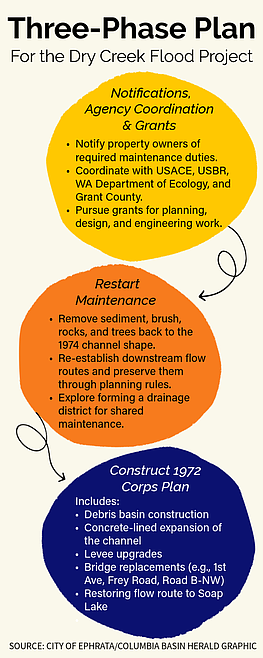
Bren outlined a long‑term, three‑phase approach, which he said could take a decade or more.  

Phase one includes notification and planning. Bren said this step will inform property owners of responsibilities, coordinate with federal and state agencies, and pursue grants.  

“Phase one is coordination with other agencies to let them know, hey, we need your help,” Bren said. 

Phase two will restart maintenance. Bren said this step will begin the process to clear the channel back to its 1974 condition and work with the county and USBR to stop activities that reduce capacity. 

“We’ve got to get it back to at least the 1974 (design),” Bren said.   

This phase would also explore creating a drainage district so property owners can share maintenance costs. 

Phase three will build the full 1974 plan outlined by USACE. Bren said this step will construct the debris basin, upgrade crossings and bridges, concrete‑line the channel, and re‑establish flow routes north toward Soap Lake.  

“We need to be able to move 5,000 CFS… that’s the 100‑year storm,” Bren said. 

Long process 

Bren told the council that while the task is large, the city now has a roadmap and better public information tools.  

“There is a path,” he said. “And I can see why those before me haven’t attempted it. But this is absolutely fascinating, and I can’t believe our community has been damaged by this for five decades.” 

He encouraged residents with questions to visit the city’s website, where a new Floodplain Management section includes maps, history and videos which can be accessed at bit.ly/EphFlood.  

“Whenever anyone asks you this question, show them that we now have a dedicated page,” he told councilmembers. 

The next steps include agency coordination, grant applications, and outreach to property owners. Bren also emphasized the importance of preparing plans ahead of any major flood event.  

“If we do have a major flood… we need to be in position,” he said. 

Editor's Note: Ephrata sees multiple challenges associated with being in a designated flood plain throughout most of downtown. As noted by city administration, former and current council members and business owners in conversations I've had with them, this has presented a significant problem for developing and improving the downtown business core of the city. The expenses associated with flood insurance not only negatively impact homeowners and renters, but the businesses that would add convenience, quality of life and economic opportunities to Ephratans and those living nearby. As such, the Columbia Basin Herald is dedicated to covering this issue as the city moves forward with plans to address the issue. This issue appears to be the result of neglect on the part of prior administrations over decades and it is important to current and future residents that flooding is proactively addressed.