
Grant Co. solar projects moving forward
COULEE CITY — A new solar electrical generation facility near Coulee City has received a conditional use permit from Grant County officials. When it goes into operation, Dry Falls Solar is projected to generate up to 400 megawatts of electricity, said Grant County Planning Director Jim Anderson-Cook.
“There was overwhelming support at the public hearing for that project,” Anderson-Cook said. “There was support from local labor unions. And there was quite a bit of public support in favor of that project, which I hadn’t seen in the past.”
The project’s owners, NextEra Energy Resources, are building on 5,715 acres near Coulee City. Battery storage is also planned, according to previous Columbia Basin Herald coverage.
Dry Falls Solar, Anderson-Cook said, is negotiating a contract with the Bonneville Power Administration to sell the electricity generated to BPA. Two solar electrical generation facilities in Grant County are under construction, with five more, including Dry Falls Solar, in the planning stages.
Appledale Solar, northwest of Quincy near Trinidad, also has received a conditional use permit.
“It has received approval for a 300-megawatt facility,” he said.
But that’s not a guarantee of construction.
“Sometimes they don’t get built because they either fall short on financing, or they never receive approval to connect to the electrical grid,” he said.
Susan Manville, vice-president of strategy and development for the Grant County Public Utility District, said solar projects that want to hook up to the PUD system are evaluated on a case-by-case basis.
“We have a generation interconnection process. We have a procedure and an agreement once we get to that point,” Manville said.
Manville said the PUD has to answer requests from potential customers, whether they want to buy power or, as in the case of a solar generation facility, sell it. Some potential customers have a third party that wants to buy the power, but they need PUD facilities for delivery.
“We have to determine what the requirements would be for them to interconnect to our system, so we would conduct studies,” Manville said. “My group does handle those transmission planning studies to determine what the impact is to our transmission system, and if there's any mitigation needed, what that would be.”
The PUD analysis has to look at the impact on the entire system in light of the customer’s request, whatever it is.
“It doesn't matter if you're a large load or you're a generation interconnection project. We still study them to understand the impact and determine what equipment is needed,” she said.
Customers are asked to pay for those upgrades, she said.
“That's really the responsibility of the customer. If we need to build a new substation or a new switch yard to accommodate connecting a large generator to our system, they typically pay for that construction up front,” Manville said.
The PUD does have a lot of people waiting for power, or to sell power, so customers that want to hook up to its system have to take that into account.
“What we say is, ‘What does a realistic timeline look like?’ We have so much work on our system that a lot of entities might have plans, and they want to come in or connect to our system,” she said. “And they say, ‘I want to be energized by 2028.’ We'll address these – we have a queue that we maintain that has all of this work in it. It's really more a conversation about timing and where that project falls in our list of work, and what's the realistic timing for the project. And our schedule – it's pretty full.”
Anderson-Cook said one of the two projects under construction is Quincy Valley Solar, near Winchester. Developers of two more projects, in addition to Appledale Solar and QV Solar, have applied for construction permits near Quincy.
Record Energy Center is owned by the same company developing Appledale Solar, Anderson-Cook said. It would be located north of Winchester, next to the QV Solar project that’s under construction.
“They are working through cultural resource concerns and habitat shrub steppe concerns that (Washington Department of Fish and Wildlife) has brought forward,” Anderson-Cook said. “We expect that we’re going to pause the SEPA review and give them 90 days to work through these, these concerns that have been brought forward, and see if they can work through that.”
The fourth Quincy project is Cascade Solar; it’s at the start of the permitting process, with the initial application submitted in December.
Royal Slope Solar is further along, Anderson-Cook said. It’s south of the Vantage Bridge and State Route 26 and is designed to generate 260 megawatts.
“They've been working on this one since, since 2022. We are sending it for a second round of review to the (state and federal) agencies, tribal agencies included. We anticipate that we'll take that one to hearing in April, if all goes well in the second round of review,” Anderson-Cook said. “If we can make a hearing date in April that would be great and probably afford (the owners) the opportunity to begin construction in midsummer. In doing so, they would fall within the federal timelines to allow them to qualify for the tax credits that are expiring. That's their goal.”
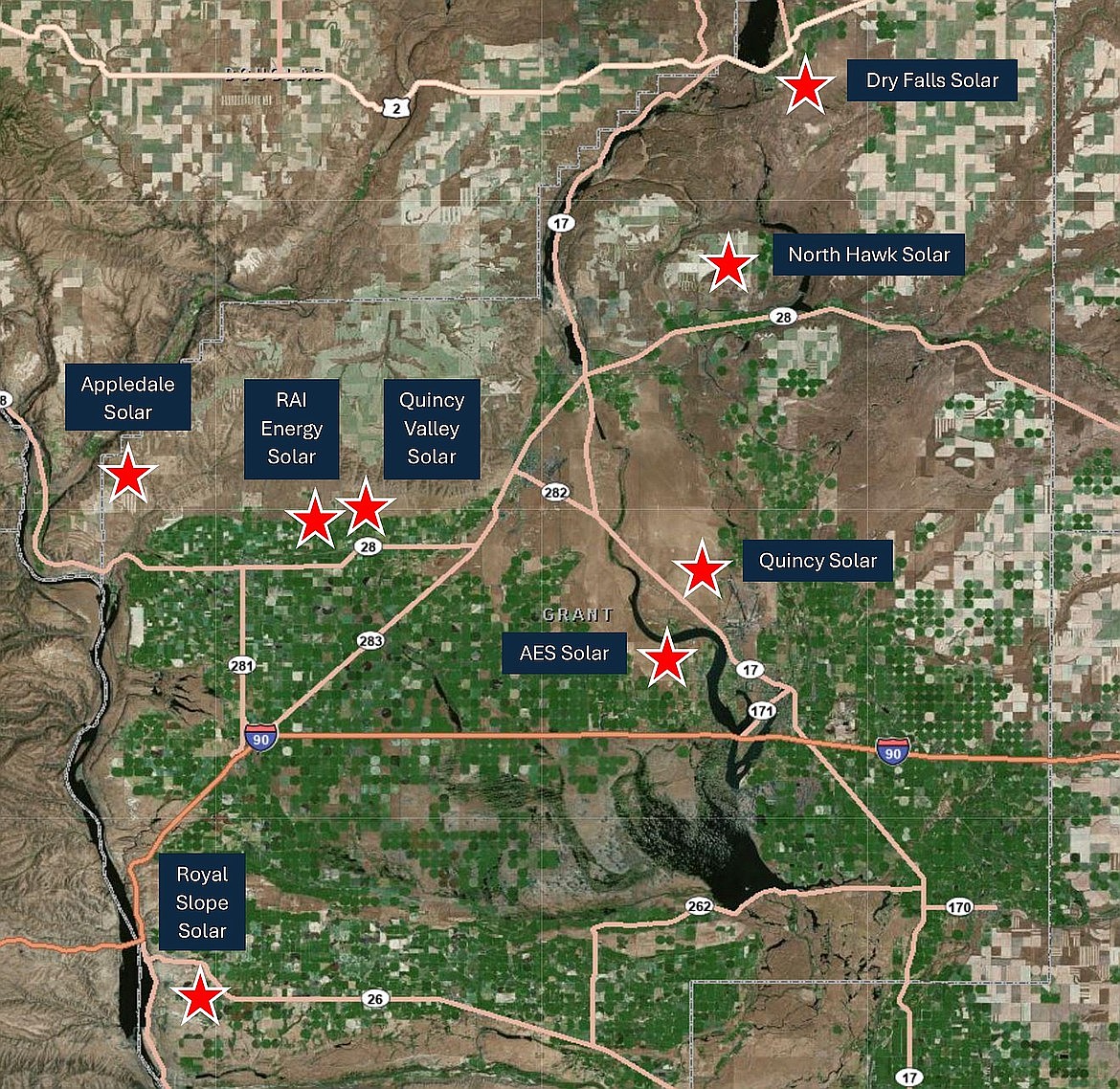
 The solar projects under construction or in development are peppered throughout Grant County.