
Ferguson remains unsatisfied with millionaire’s tax proposal
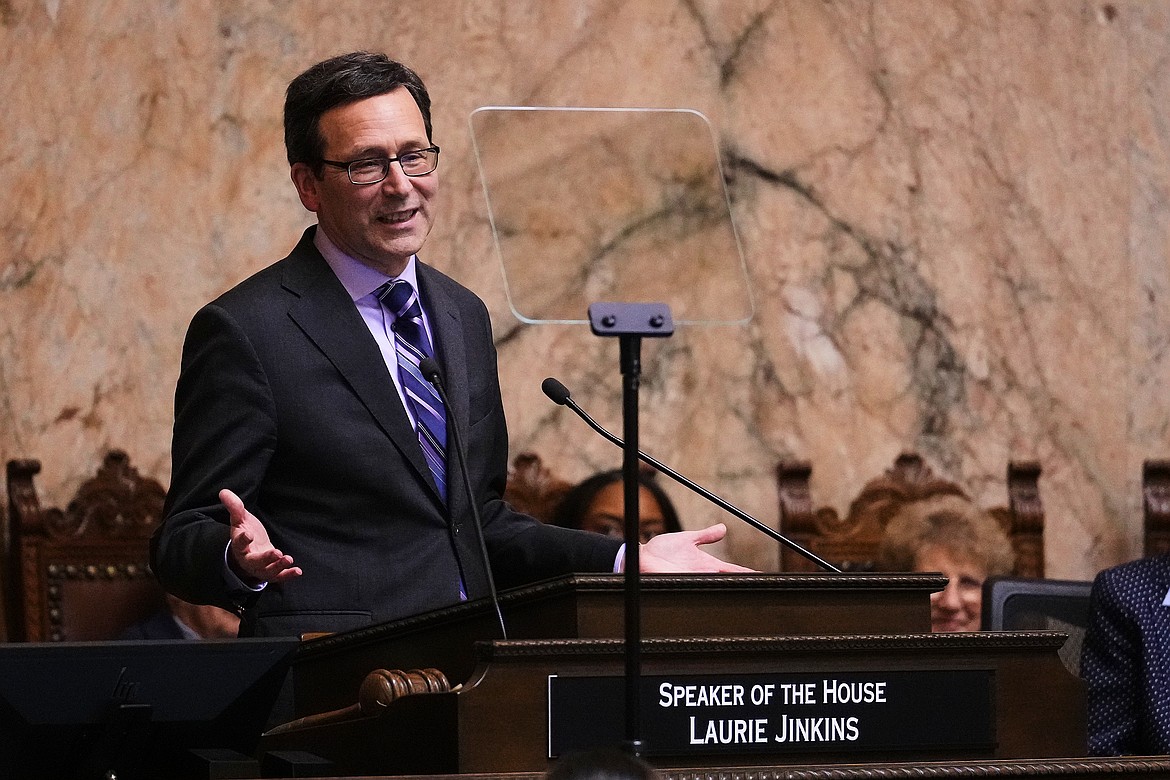
Washington Gov. Bob Ferguson delivers his State of the State address during a joint legislative session at the Washington State Capitol, Tuesday, Jan. 13, 2026, in Olympia, Wash.
AP Photo/Lindsey Wasson
OLYMPIA — Washington lawmakers advanced a tax on millionaires through the Senate earlier this week, yet Gov. Bob Ferguson said there is still much more work to do.
In a news conference Tuesday, Ferguson said Senate Bill 6346, in its current form, does not provide enough tax relief for small businesses and Washingtonians despite recent changes in committee and on the Senate floor.
“I've said multiple times that any bill I sign must send a significant percentage of the revenue back to Washington families and small business owners,” Ferguson said. “We are not there yet, and we are still not close to being there.”
The bill cleared the floor Monday afternoon by Washington lawmakers with a 27-22 vote, defeating the latest hurdle in the bill's long battle before reaching the governor’s desk. Ferguson previously pushed back on the Democrats’ initial proposal last month based on similar grounds, asserting more revenue must be allocated to make the state more affordable for residents.
In its current form, the bill, sponsored by Senate Majority Leader Jamie Pedersen, D-Seattle, would place a 9.9% tax on annual adjusted gross income for households who make more than $1 million, including married couples whose combined income exceeds that threshold. The tax would begin Jan. 1, 2028, with first payments due in April 2029, estimated to generate $2.5 billion in fiscal year 2029 and $3.4 billion in fiscal year 2030. The funds will go to providing tax relief and public services.
The bill also includes a sales exemption on grooming and personal hygiene products such as shampoo and toothpaste, exempts small businesses who gross less than $300,000 from the business and occupation tax, and provides tax relief for businesses grossing up to $600,000 a year.
Additionally, the bill expands the Working Families Tax Credit program to those over 18, offering sales tax rebates to lower- and moderate-income households, and allocates 7% to local city and county public defense services with the rest funneling into the state’s general fund where it could be spent in other areas, including education and childcare.
According to Ferguson, the legislation must go further.
“My proposal puts all the revenue that has come in from millionaires tax at about $1.9 billion directly back in the pockets of Washingtonians,” Ferguson said. “It’s over half of the total revenue generated.”
The governor proposed utilizing $1 billion of the tax revenue to increase the small business tax credits, resulting in more than 170,000 small businesses in the state no longer paying the business and occupation tax with another 30,000 businesses seeing reduced B&O taxes.
The governor said, if adopted, the tax credit would save businesses an average of about $5,000 annually.
Moreover, the governor also proposed expanding both eligibility for the Working Families Tax Credit program and how much money families receive. He recommended opening eligibility to families who meet or make below the Washington Department of Social and Health Services needs-standard, an estimate utilized by different assistance agencies of how much a household needs to maintain a basic standard of living. As well, Ferguson recommended increasing the amount of rebate by 30%, ultimately opening eligibility to nearly 500,000 households and costing about $380 million for the state to implement.
On top of the current sales tax exemptions, Ferguson proposed creating a sales tax holiday, where for a limited time households can purchase certain items without a sales tax. If enacted, the legislation would follow 18 other states including Alabama, Florida, and Texas, that host tax holidays for back-to-school season.
He also urged to extend the sales tax exemption beyond hygiene items to diapers and baby products, an initiative that was struck down in a floor amendment the day before.
Ferguson expressed support for an amendment sponsored by Sen. Markus Liias, D-Edmonds, that rolls back the extended retail sales tax on services that was passed last session. The amendment was adopted, meaning all retail sales tax on services, except digital advertising, would be repealed if the entire legislation gets passed.
The governor doubled down in support of the provision requiring households that make a combined income of over a million dollars are subject to the tax, including married couples and registered domestic partners who make $500,000 or more each.
Sen. Judy Warnick, R-Moses Lake, proposed an amendment that raises the $1 million standard deduction to $2 million for joint filers, aiming to remove the Republican-labeled “marriage penalty.”
“I wanted to see my grandchildren get married,” Warnick said during the floor debate. “I also want to see them do well but if they do too well then their taxes are going to go up.”
The amendment was ultimately not adopted with Pedersen asserting the legislation follows the structure of the capital gains tax that considers married couples a combined entity.
Republicans continue to slam the proposal arguing it will soon creep down, becoming an income tax on all Washingtonians.
Sen. Mark Schoesler, R-Ritzville, argued that promises that the bill will sufficiently fund education and health care services are misleading.
“People out there actually are being told if you pass this income tax, you're going to get health care funded and you're going to get education funded. Nowhere in this bill does any section dedicate one penny to those causes that many people are very, very supportive of. It just isn't there,” Schoesler said.
Sen. Chris Gildon, R-Puyallup, echoed similar concern, contending that the bill directs no dollars to support education but simply funnels money into the general fund that could be used for anything.
“This bill offers the false hope of reform…” Gildon said. “It's laughable at how low this level of direct tax-relief is… This is not tax reform, this is just tax layering.”
If passed, the bill would be exempt from the bipartisan Initiative 2111, passed in 2024, that prohibited the state and local jurisdictions from levying personal income taxes.
The bill was passed by a majority vote with three Democrats siding with Republicans against the legislation, including Sen. Adrian Cortes, D-Battle Ground, Sen. Drew Hansen, D-Bainbridge Island, and Sen. Deborah Krishandasan, D-Gig Harbor.
The bill now heads to the House for further consideration where more changes are expected to be made ahead of the last day of session on March 12.