
Standalone energy project eyed for Quincy
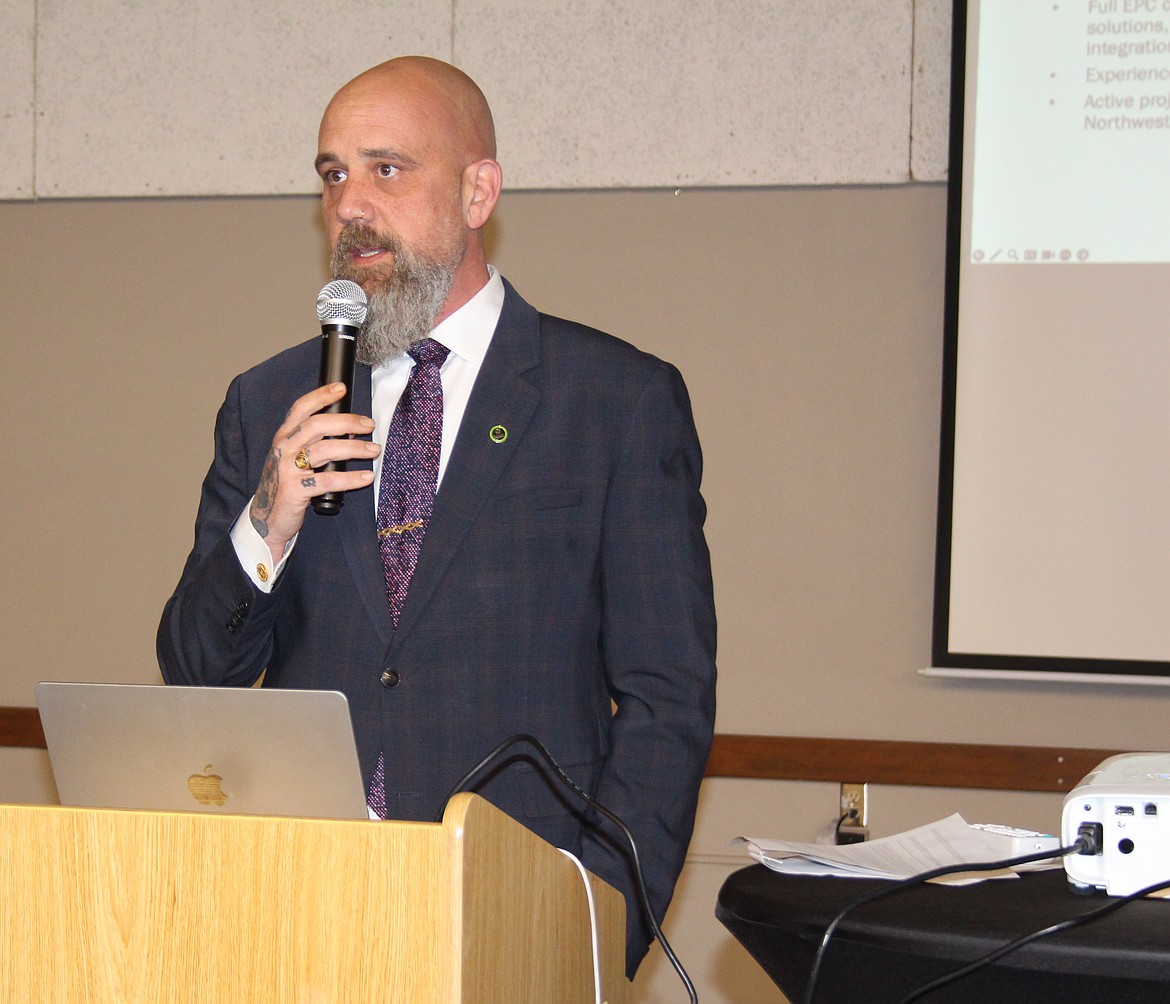
Ken Ahmann of Colusa Indian Energy explains its project in conjunction with the Port of Quincy.
CHERYL SCHWEIZER/COLUMBIA BASIN HERALD
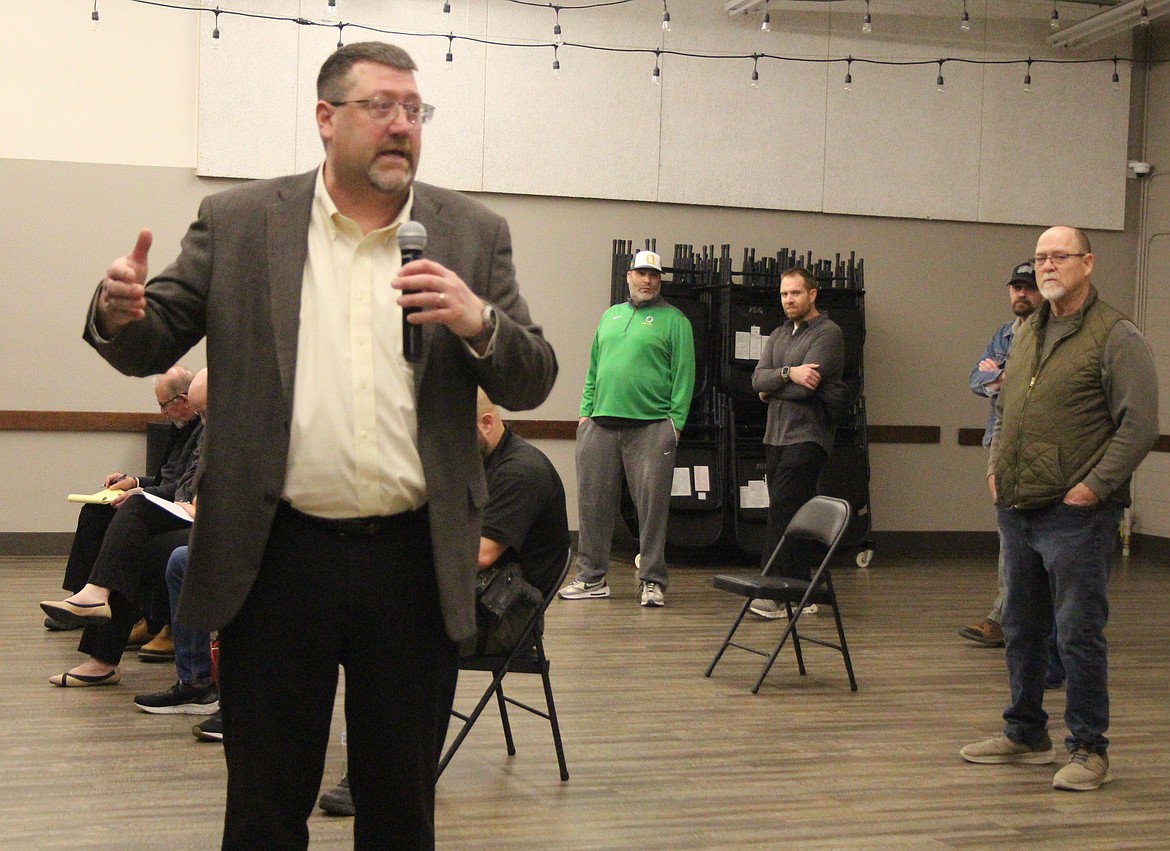
Kevin Blaser answers a question about workforce development during a community meeting to introduce the project Colusa Indian Energy is working on with the Port of Quincy. Blaser is the company’s vice president of business development
QUINCY — While it’s only in the beginning stages, the Port of Quincy and a California Indigenous tribe will be working on a project to bring a standalone energy project to Quincy. Ken Ahmann, chief operating officer of Colusa Indian Energy, said the project would help the Quincy area in the search for a diversified – and robust – economy.
“Growth is happening. Whether it’s load growth or economic growth, we’re continuing to expand and not having this infrastructure in place creates an economic loss. It’s the companies that can’t come here, or that come here and say, ‘I need 50 megawatts and 50 acres,’ and the acres are there, the rest of the infrastructure is there, but without the power. So those opportunities pass by,” Ahman said.
Ahmann gave an overview of the project at a community meeting Thursday. The facility would be located along M Street Northeast on port-owned property in the section of Quincy zoned for industrial uses. Ahman said there’s no construction timeline yet, since the project is in its beginning stages.
“We’ve got a rough idea. I think our best guess right now is some time between three to five years,” Ahmann said. “We would love to target the end of 2029, and that’s what we’ve told the regulatory agencies.”
Kevin Blaser, vice president of business development, said the goal is to generate up to 3.5 gigawatts of electricity.
Port commission chair Curt Morris said some businesses want to locate in and around Quincy, and port officials want to make sure the things businesses need are available.
“We’ve got to do something, because there’s no alternative power,” Morris said.
The facility would use natural gas for its generators, Ahmann said, but would be supplemented with other kinds of generation as it became available.
“You’ve got a base load generation could be gas-fired, could be geothermal, could be nuclear, could be all kinds of different supplementary power generation coming from these renewable assets like solar,” he said. “Then all that funnels into a control center. You have energy storage in conjunction with that. All those energy assets are tying into a single point.”
Using a variety of generation sources improves reliability, he said.
The state of Washington has stringent requirements for carbon emissions, and Ahmann said the company will be using technology that will reduce carbon both before and after the natural gas is burned.
The regulatory process is near the beginning, he said; company officials have met with the Washington Department of Ecology, the Washington Department of Commerce and representatives of Gov. Bob Ferguson. They’re also working with the Grant County Public Utility District, he said.
“Where we are lacking explicit support, I think we do not have explicit opposition,” he said.
The customers would be companies located in the service area, Ahmann said, and they would pay for the energy. Blaser said the company can’t compete with hydropower, but the company’s rates will be competitive.
“Ten to 15 cents a kilowatt hour is what we’re modeling,” Blaser said
Colusa Indian Energy got its start when tribal leaders decided to build a separate energy source to power its reservation. That was in 2004, Ahmann said, and since then, the tribe has used its energy expertise to form a private company.
 Kevin Blaser answers a question about workforce development during a community meeting to introduce the project Colusa Indian Energy is working on with the Port of Quincy. Blaser is the company’s vice president of business development