
Ephrata leaders push for local control, infrastructure protections in Olympia
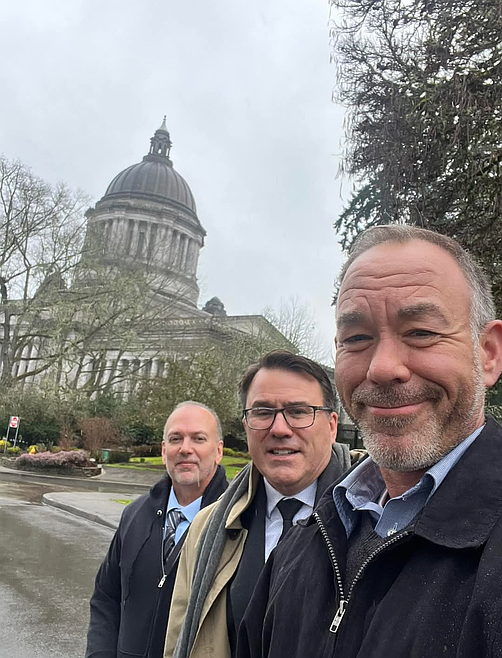
From left to right, Ephrata Mayor Steve Oliver, City Administrator Ray Towry and Mayor Pro Tem Matt Moore stand inside the Washington State Capitol during their two‑day visit to Olympia last week. The three met with legislators to advocate for local control, oppose certain homelessness and zoning bills, and defend key infrastructure funding sources such as the Public Works Trust Fund.
COURTESY PHOTO/MATT MOORE
EPHRATA — Three Ephrata city leaders spent two days in Olympia last week meeting with state lawmakers on a wide range of bills affecting homelessness policy, housing, public safety and funding for local infrastructure. Their message throughout the trip, they said, centered on protecting local authority and ensuring small cities like Ephrata are not left behind in statewide policy debates.
Mayor Steve Oliver, City Administrator Ray Towry and Mayor Pro Tem Matt Moore traveled to the Capitol on Monday and Tuesday, meeting with local legislators as well as lawmakers from across the state. The visit coincided with the Legislature’s short session, which typically sees high volumes of bill activity in compressed timelines.
“We took a trip to meet with our senators and anyone else we could find to discuss either how we were for [a bill], or we had questions about it, or we thought that this would be detrimental,” Oliver said. “We’re going to do whatever we can to help them help us succeed around here.”
Towry, who helped coordinate the visit, said the city is working to strengthen its regional engagement and make sure Ephrata is represented in discussions that carry statewide consequences.
“The city has recognized the need to be more regionally active,” he said. “We’re working with regional partners to help ensure we’re in line with the needs of our community and advocating for the needs of our community.”
The delegation began its meetings early Monday with local legislators before arranging additional conversations as they reviewed which bills were moving through committees.
“Yesterday, we met with six additional representatives and senators,” Towry said of the second day. “We particularly were looking at support in economic development and growth for our community.”
Protecting the Public Works Trust Fund
Among the delegation’s top concerns was a proposal to sweep the Public Works Trust Fund, a revolving loan account cities rely on for sewer, water and road improvements. The fund offers low‑interest loans that cities pay back, allowing the program to sustain itself over time.
“That is the model of how government should work,” Towry said. “Small communities particularly utilize that account to finance their infrastructure projects. You borrow from this fund at a low interest rate, you pay it back, and then it’s a self‑regenerating fund.”
Towry said using the account to plug budget gaps at the state level would be harmful.
“We advocated very hard against sweeping that because it’s been so vital to us and to all the small communities around us,” he said.
Opposition to bills limiting local authority on homelessness
A recurring theme for Ephrata officials was frustration with legislation they say would restrict cities’ ability to manage homelessness within public spaces. They cited House Bill 2489, which would prohibit cities from enforcing ordinances limiting “life‑sustaining activities” on public property unless they can prove “adequate alternative shelter space” is available nearby.
“To simply allow people to live on public property is just not feasible,” Towry said.
He noted that Ephrata does not currently have a homeless shelter, meaning the city would be unable to legally remove someone camping in a park or sports field.
Moore described the situation in more vivid terms.
“It’s always been concerning — their efforts to try and make it where public parks are free domain for the homeless,” he said. “It’s a huge public safety hazard, and it’s not what the public intended for these spaces.”
He said the consequences could extend to youth sports and family events.
“You can have them take over a soccer complex, and that can … end your soccer league,” Moore said. “You can’t legally kick (the homeless) off. That’s not right.”
Officials also opposed HB 2266 and SB 6069, which would allow transitional or supportive housing facilities in nearly all zoning districts. Towry said the legislation removes cities’ ability to use operating agreements, a tool to ensure such sites mitigate impacts on surrounding neighborhoods.
Preserving zoning authority
Zoning emerged as another major focus. Both Moore and Towry said several bills under consideration would reduce cities’ ability to regulate development in ways that reflect their communities’ needs.
“We’re trying really, really hard to just have them not meddle with city and municipal zoning,” Moore said. “Every city is different, and they each have their own issues, and they’ve got to figure out how to handle that locally.”
The city opposes SB 5729, which would automatically deem certain building permit applications complete or approved under strict timelines. Towry said the measure creates safety concerns, particularly when engineers or developers need more than three review cycles to meet code requirements.
“There’s all kinds of levers and buttons and push and pull that has to be a part of it,” he said of the permitting process. “Sometimes it’s a very pleasant process … but [this bill] takes away some of the ability for local control.”
The city also supports HB 2316, which would remove shrub‑steppe environmental restrictions inside urban growth areas. Towry said developers in the port district often face expensive studies based solely on aerial photos showing sagebrush.
“It’s already designated for growth,” he said. “This just adds to the cost of housing and commercial development.”
Public safety, interlocal efficiencies
The delegation expressed support for several public‑safety‑related bills, including HB 2349, which expands notification requirements when a sexually violent predator is released.
“We definitely supported that,” Towry said.
Ephrata also supports HB 2209, which adds sentencing enhancements for high‑value theft.
“There has to be some kind of repercussions for people who break the law,” Towry said. “For the average community member, that’s a significant loss.”
Towry praised HB 1529, which would make it easier for counties to stripe or pave city streets under interlocal agreements.
“It saves everybody money,” he said. “It’s an efficiency and a cost savings for the taxpayer.”
The city also supports eliminating a lodging‑tax reporting requirement under HB 2120 / SB 5879, calling it redundant because the State Auditor already reviews those funds annually.
Productive meetings
Oliver, who was visiting the Capitol for the first time, described the environment as “its own machine.”
“You can imagine this building that makes you feel just like a tiny little ant,” he said. But he praised the staff and lawmakers for their approachability. “Everybody was there, friendly … they answer every question you have without hesitation or without trying to sugarcoat anything.”
Moore said the delegation complemented one another well.
“Ray is just indispensable in terms of his knowledge of the law and policy,” he said. “The mayor brings a level of humanity and I’m bringing a degree of salesmanship and charm. Between the three of us, we made a pretty good team.”
Towry encouraged residents to review the bill list and follow legislative updates, noting that bill language can change rapidly.
“Sometimes when a bill dies, that’s not a terrible thing,” he said. “Most of the time, a bill has to circulate … a couple of sessions before everybody can be in agreement.”