


Tapping into the sun
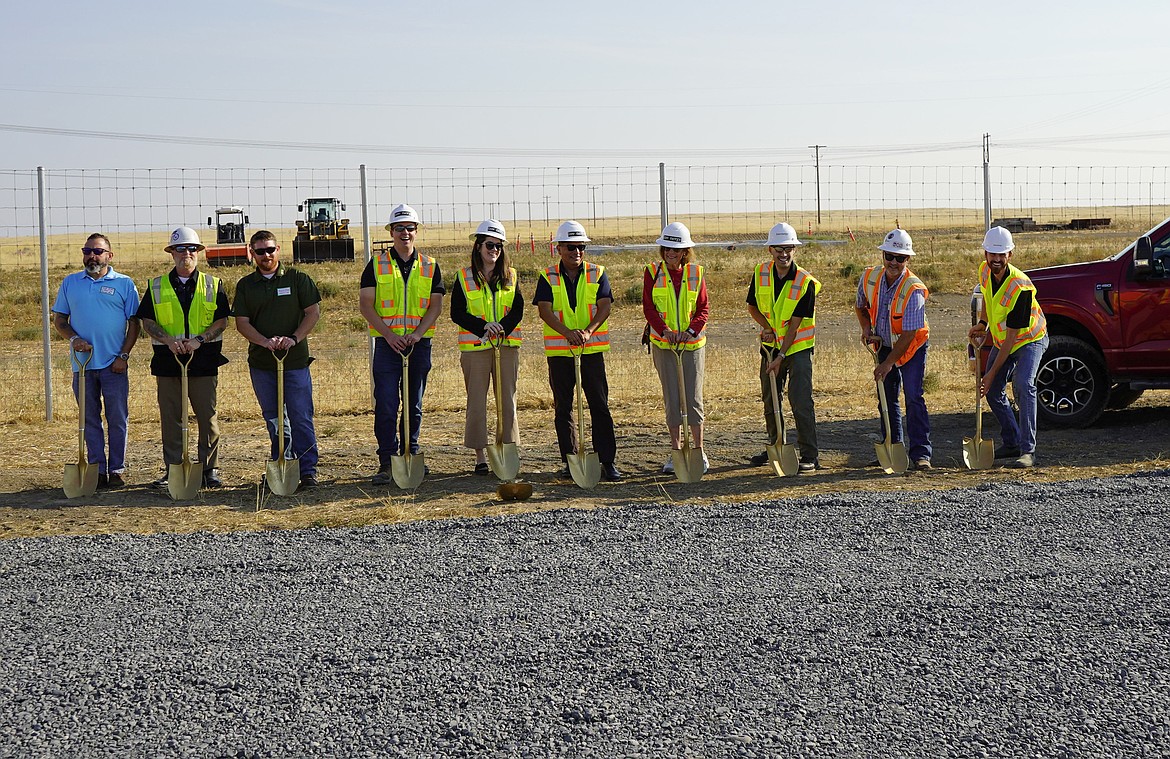
Invenergy, elected leaders, and labor representatives prepare to wield their golden shovels at the groundbreaking of the Quincy Solar Energy Center Tuesday. From left: Russell Walker, IUOE Local 302; Nate Mack, LiUNA Local 348; Jeremy Chase, IBEW Local 191; John O'Connell, Invenergy; Chandler Cornwell, Invenergy; Washington State Representative Alex Ybarra; Washington State Senator Judy Warnick; Mateo Gomez, Invenergy; Bob Allen, IBEW Local 191; and Bly Rougier, Invenergy.
COURTESY PHOTO/INVENERGY
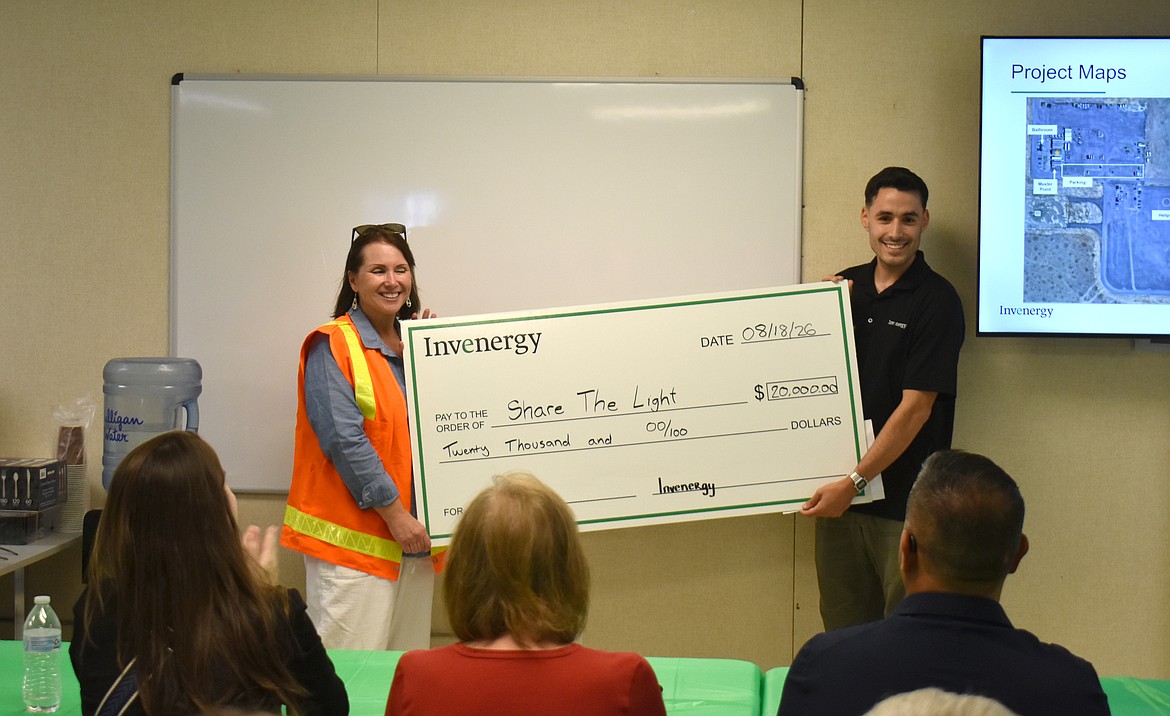
Grant PUD Community Relations Coordinator Annette Lovitt accepts a donation of $20,000 from Invenergy Lead Developer Mateo Gomez at the groundbreaking of the Quincy Solar Energy project Tuesday. The money will go to the PUD’s Share the Light program to help low-income residents meet their power bills.
JOEL MARTIN/COLUMBIA BASIN HERALD
MOSES LAKE — The Quincy Solar Energy Center, Grant County’s first solar energy facility, broke ground Tuesday, with a ceremony attended by local officials, Grant PUD representatives and officials from Invenergy, the company building the site.
"As this project hits peak construction, we're going to have over 200 union construction workers on this site from the local areas,” said Lead Developer Mateo Gomez. “This project is going to deliver over $27 million in economic investment in a community; that's across tax payments, across landowner lease payments, local spending, everything else that goes into a project actually getting built.”
The project will have a capacity of 120 megawatts, Gomez said, enough power to service about 25,000 homes in Washington. That power will be sold to the Grant PUD, which will pass it on to consumers in the county.
“Particularly in this Pacific Northwest region, we're seeing very large energy demand, and we need to build more energy generation to meet it and ensure we're able to have reliable power, affordable power, and safe power for everyone,” Gomez said. “This project is a small piece of that bigger puzzle that we're all trying to solve.”
The name Quincy Solar is a bit of a misnomer. The project is actually located a few miles northwest of Big Bend Community College, off Road 10 Northeast.
“I live in Quincy, and I heard that Quincy Solar was coming, and I’ve been watching for it,” said Grant PUD Commissioner Larry Schaapman. “I didn’t realize it was so far from home, and I don’t think I’m going to be able to see it from my place.”
Solar power is an important step in complying with Washington’s Clean Energy Transformation Act, state Rep. Alex Ybarra said. The law, passed in 2019, mandates that all electric utilities be greenhouse gas-neutral by 2030, meaning any carbon emissions must be offset by renewable energy, energy efficiency, carbon reduction project investments, or payments funding low-income assistance, according to the Washington Utilities and Transportation Commission’s website. By 2045, all electrical power must be generated from renewable or zero-carbon resources.
“We do want clean air,” Ybarra said. “But how do you get there without getting rid of the reliability of the grid? Right now, we have a 2045 requirement to go zero-carbon, and without wind and without solar and without firm energy, we're not going to get there.”
“(Reliability) is a key factor … that you never think about, and then as soon as you don't have it, it's all you can think about,” Gomez said. “You go through a blackout for more than one hour, and that's extremely uncomfortable. Your food starts getting bad, and it’s worse if you have medical devices that need constant power. Then it becomes a life-and-death situation.”
Chicago-based Invenergy, the company building the Quincy Solar Energy site, has more than 230 power generation projects either in operation, under construction or contracted worldwide, according to its website. Of those, 65 are solar power, generating more than 9,000 megawatts. The company also operates wind, natural gas and geothermal power generation projects.
At the conclusion of the presentation, Gomez presented a check for $20,000 to the PUD’s Share the Light program, which helps income-eligible seniors, families and others pay their electric bills.
“This is neighbors helping neighbors,” said PUD Community Relations Coordinator Annette Lovitt as she accepted the donation. “This is companies helping neighbors. And this will help over 600 families keep the lights on.”
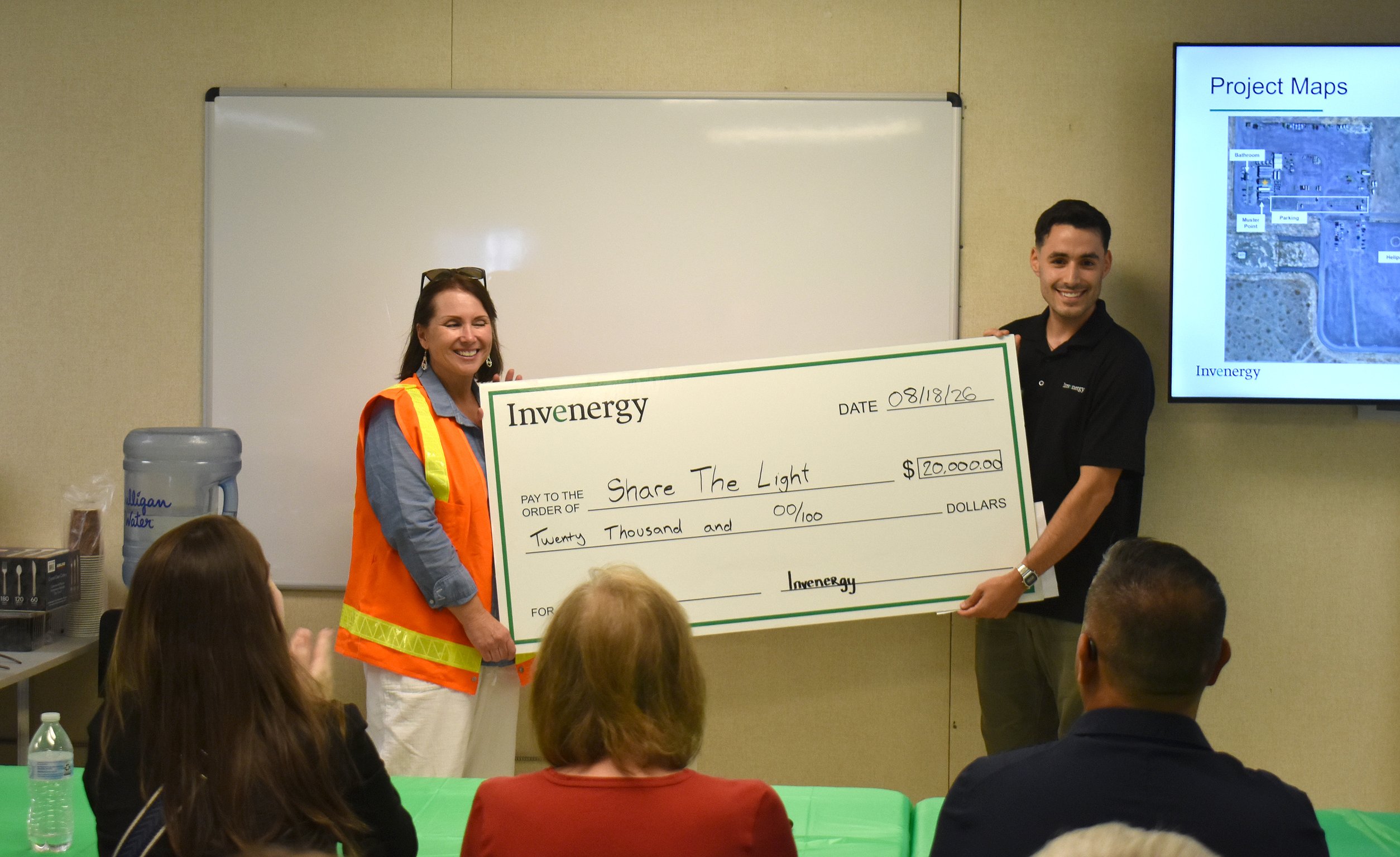 Grant PUD Community Relations Coordinator Annette Lovitt accepts a donation of $20,000 from Invenergy Lead Developer Mateo Gomez at the groundbreaking of the Quincy Solar Energy project Tuesday. The money will go to the PUD’s Share the Light program to help low-income residents meet their power bills.
An earlier version of this story incorrectly stated that Invenergy's donation to Share the Light would help 200 families. The correct figure is 600. It has been corrected above.