

Sila Nanotechnologies looking at possible Moses Lake expansion
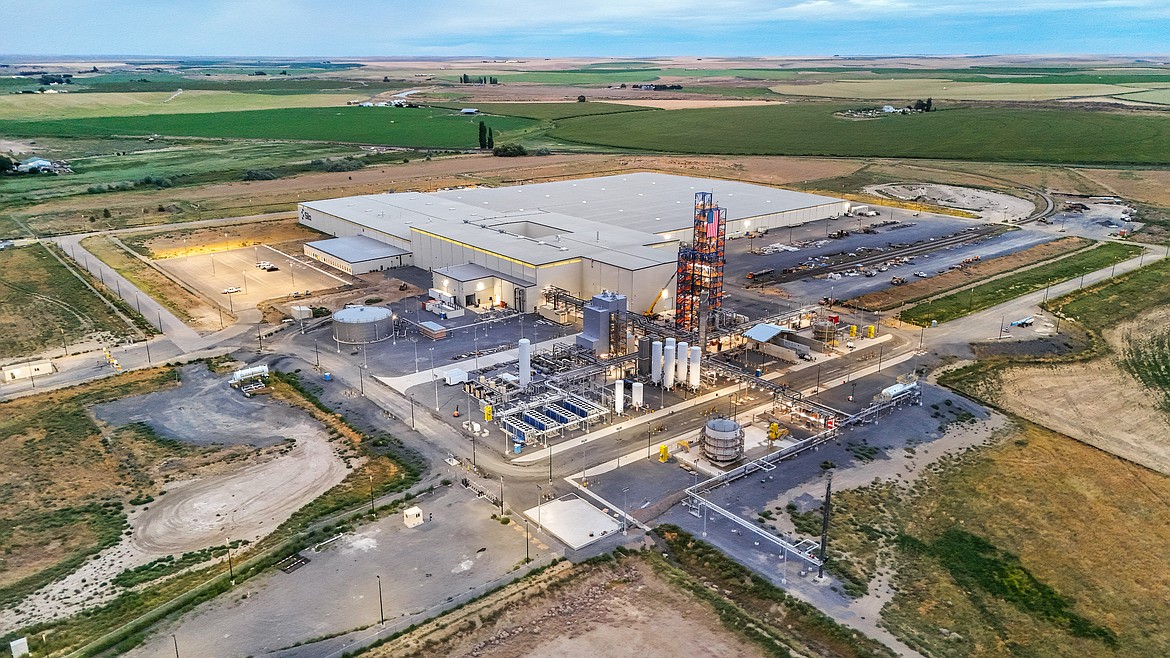
Sila Nanotechnologies has obtained loans and funding that could lead to major expansion of the company’s Moses Lake facility.
FILE PHOTO
Sila Nanotechnologies is considering expansion of its Moses Lake facility following the announcement of a $1.4 billion loan from the U.S. Department of Defense earlier this month. The company also received about $300 million in funding in July, said co-founder and chief executive officer Gene Berdichevsky.
“We haven’t announced a date (to start expansion),” Berdichevsky said.
When expansion starts, it eventually could mean substantial growth at the company’s facility on Road N Northeast.
“This should add a few hundred jobs in Moses Lake, and these are sort of high-tech jobs in maybe the world's most advanced production plants,” he said.
Sila’s facility on Road N will be manufacturing battery components that Berdichevsky said are designed to solve some of the challenges that have hampered development of more reliable batteries.
“We do make a new technology, we make silicon anodes,” he said. “One of the really big advantages of silicon anodes is they can replace graphite anodes. (Silicon anodes) are about five times lighter and two times smaller than graphite anodes in lithium-ion batteries.”
Producing those components in the U.S. will help solve a critical supply issue which, Berdichevsky said, was one of the attractions for the Department of Defense.
“Graphite anodes come almost entirely from China, and certainly entirely from outside the U.S. We are going to be replacing those imported goods with domestically produced silicon anodes, so imported graphite anodes with domestically produced silicon anodes,” he said.
In terms of battery performance, silicon has an advantage over graphite, he said.
“It makes the batteries much better. The places that really want much better batteries are things like drones, satellites, robotics, consumer electronics, and electric cars,” Berdichevsky said.
A lot of modern technology incorporates materials that are either not produced in the U.S. or are hard to find. Graphite anodes are one example, but not the only one.
“If our war fighters can't get batteries with the latest and greatest technology, that's a huge disadvantage on the battlefield, especially in a world of drones. So that's very clear,” he said. “However, that's a fairly small market. But though that's a small market, if you don't have an industrial base to support the broader industrial markets, you're not going to have the latest technology even for sort of small markets.”
Berdichevsky said the civilian and military markets are tied together.
“So, it's really important for the U.S. to have a broad industrial base for civilian applications in critical technologies and that's why the Department of Defense has been investing in rare earth metals, but also in batteries,” he said. “In particular in batteries, anode materials are incredibly concentrated in their production in China. The U.S. is almost entirely dependent on the rest of the world for its anode production.”
The market for better batteries is only expected to grow over time, he said.
“The world, this year, will buy about 2,000 gigawatt hours' worth of batteries globally, and each one of those batteries has a graphite anode,” he said.
Sila’s Moses Lake facility will produce anodes that will help generate about 1.5 gigawatt hours in its first phase, Berdichevsky said. The Department of Defense financing will allow the company to ramp that up to the 10 gigawatt-hour range to start with, and possibly more over time.
“That'll still be sort of a fraction of what the world needs,” he said. “It'll be a decent fraction of what the U.S. needs, but still small, you know, maybe 10% of what the U.S. needs. This technology needs to grow into the existing market, and the existing market is going to double in the next five years, from 2000 gigawatt hours to 4000 gigawatt hours. So, you know, we have to grow at quite a pace to catch up.”
But the company does face one pressing challenge -- getting adequate electricity.
“We’re working very closely with the (Grant County) PUD,” Berdichevsky said. “We’re working with others in the area to make sure we can get the power we need. We have some of what we need, but we do need the community to support building out the power infrastructure.”
An earlier version of this story gave the Sila Nanotechnologies plant's location incorrectly. It has been corrected above.