
Desert Green Turf in Moses Lake installs logo for Mariners 50th Anniversary
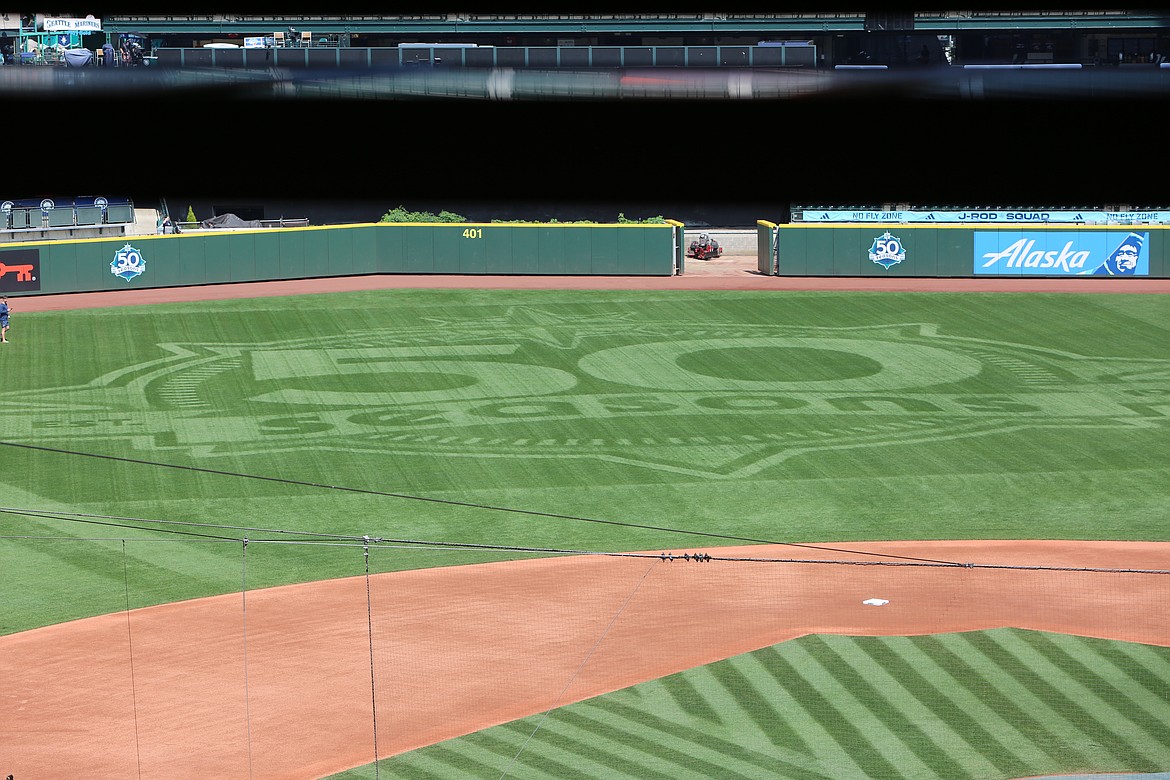
MOSES LAKE — When Nathan Cox started Desert Green Turf in 2006 at a farm in Moses Lake, the initial plan was to sell to local landscapers and homeowners. Fast forward 20 years and his business has grown into a consistent turf producer for major sports franchises – including the installation of the Seattle Mariners 50-year anniversary logo at T-Mobile Park on Friday.
“I thought it turned out great,” Nathan said. “I was able to tune in (Friday), and results came back very positive from the Mariners management and Kevin (Dvorak), the groundskeeper there, I think everybody was happy.”
A comprehensive process
The process to organize this tribute to Mariners history began a few months ago, after Desert Green had previously installed a logo for Randy Johnsons jersey retirement, said Nathan. The Mariners marketing team provided the logo design for them to work from. Once the design was cleared, the turf company’s job was simple in theory but complex in practice.
What is currently displayed at T-Mobile Park was done with precision and hours of detailed work. Instead of using paint to create images, Nathan and Desert Green were tasked with creating an image out of the grass. The 160 feet by 160 feet anniversary logo displayed at the center of the Mariners outfield was installed using a machine that utilizes air, geometry and sunlight to make the grass lay in specific ways to create an image.
“It's all on the laying in the angles of which that grass blade is laying, and then the way you're looking at it with the sunlight,” he said. “What you see if you're looking at grass and you see a light colored, the lighter coloring is laying away from you, and the darker coloring is laying towards you.”
The process began Thursday night and wrapped up Friday morning. They started with old-school tools — string lines and geometry — backed by cutting-edge tech.
The crew ran a string line down the center of the field, squared the layout and confirmed the dimensions before marking each corner, Nathan said. From there, they used a total station, a surveying instrument that uses lasers and a prism to fix locations down to fractions of an inch.
“It’s one of the most precise tools out there. It’s more precise than GPS,” Nathan said.
The total station locked onto a prism mounted on the printing machine, guiding every pass so the logo would sit perfectly square to the stadium sightlines and not appear crooked from the stands or on television.
The first night of work took about five to six hours, Nathan said. Triangulating points, checking 90-degree angles, solving a tablet-to-base-station communication glitch and setting up turning pads to protect the warning track. Once those wrinkles were ironed out, each full pass of the logo took about an hour and a half.
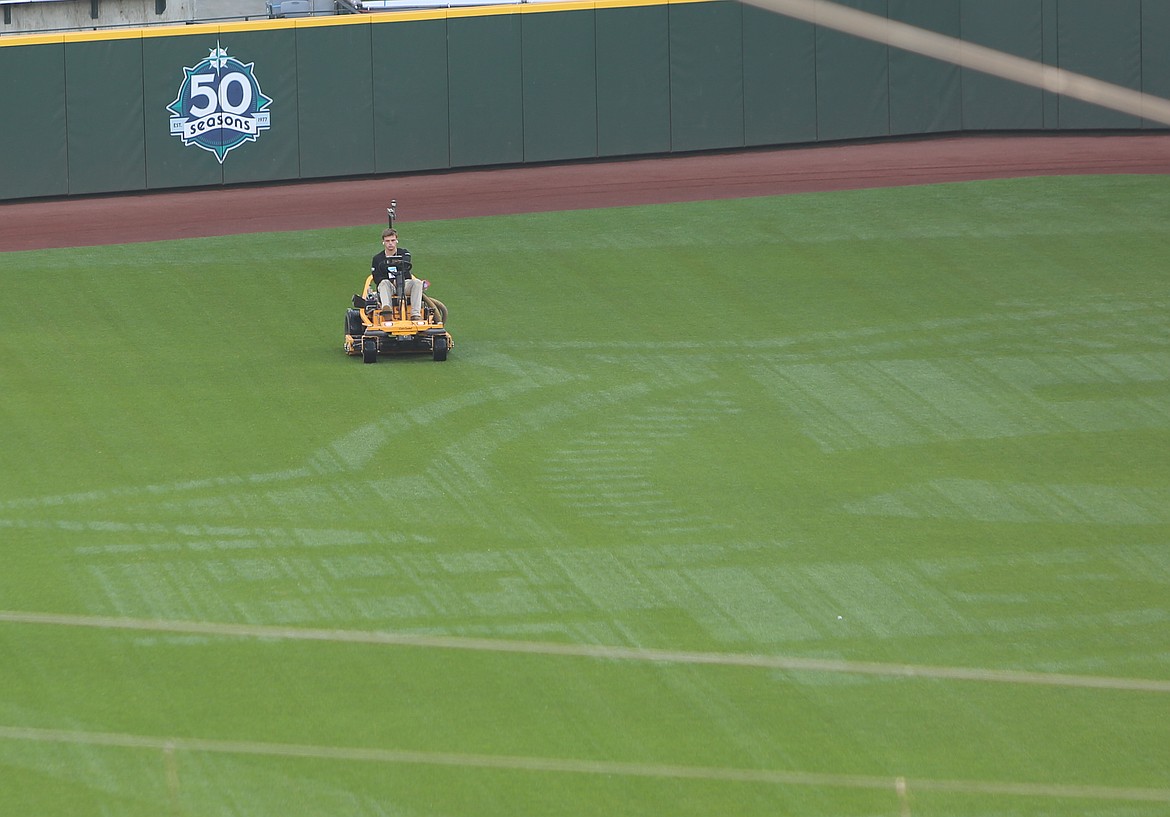
“We did it once (Friday), and then there's still tire tracks from the machine. So, then they hand broom once that pattern's been burned in, so they're laying the right way (and) you don't see the tire tracks as much,” Nathan said.
The conditions in which the grass is laid is important, as well. Moisture in the leaf — whether from overnight dew or recent irrigation — helps the blades hold their shape once they’ve been brushed into place. Heat helps more than cold, and the overall health of the grass matters. For instance, deeper, darker green turf produces sharper, more dramatic contrast.
Nathan and his crew are not new to this process either, on their own farm, they spend a lot of time practicing these procedures to prepare for these major projects they get to do for major sports teams. Placement can also be influenced by what time of day the logo will be observed, he said.
“You want the sun to your to your back at the time,” he said. “If we're doing a logo for our field days, ‘Okay, where's the sun at? What angle's the sun?’ If everybody's showing up at 10 a.m. and that's when we really want it to pop the most, then we'll position the layout of it the right way to give us the best look.”
Two decades and counting
When Nathan first helped start Desert Green, he never anticipated how fast the business would grow, he said. Within a year and a half, they were taking on projects for sports turf at golf courses, and his farm grew to over 600 acres.
“We got into golf and started doing putting greens, fairways and tee boxes and kind of specialized into that,” he said. “That market grew really rapidly for us and expanded very far. We've shipped to golf courses as far as Kansas, Southern California, Montana, Idaho, Washington, Oregon, Utah and Nevada. We have a really large span up into Canada, and once we kind of got that market in, 2012 the (Seattle) Seahawks called us because they’d heard what we had been doing with golf turf.”
Since then, Nathan’s business has grown its clientele by adding several more projects in the NFL, MLB, MLS, cricket and major soccer tournaments. His son Kyle Cox grew up watching his dad's business grow, he said.
“It was super cool, I kind of started working with him from a pretty young age,” Kyle said.
He has memories of helping his dad install baseball fields when he was eight years old, he said.
“He's been involved with this his whole life,” Nathan said. “He's stepped into a really huge pivotable role for us. He's still working on his college, he's finishing construction management at Central Washington (University), but he's one of our one of our key players here.”
Kyle works more on the operational side currently, he said. He spends a lot of his time working through contracts, general office work, job tracking, estimating tools and even building a website to provide an estimate.
Eyes on the future
As Nathan and Desert Green look ahead to the future, they hope to continue expanding their offerings. With the recent installation of the grass logo at T-Mobile Park, they plan to offer that on their website for other projects, too.
“There's a lot of usages for that,” Nathan said. “It already fits into what we do. We already run total stations on our field construction side of the business, so that's how we lay out all of our drainage irrigation designs. Our guys have already got experience running total stations and running equipment that have to read off of a prism and all that.”
This offering may not always be limited to sporting events either, Nathan said.
“I think we'll have a lot of fun with it,” he said. “It'll be interesting to see where it takes us. Also, I think there'll be some usages for it where maybe it's somebody's wedding at a golf course, and we're doing the picture of the bride and groom. You just never know where all the things will lie with that.”