Wednesday, April 22, 2026
52.0°F

Washington wolf population climbs to record high after 17% annual increase
by NANCE BESTON
Staff Writer | April 22, 2026 3:30 AM

OLYMPIA — Washington’s gray wolf population grew by more than 17% in 2025, reaching its highest level since wolves naturally returned to the state nearly two decades ago, according to a new annual report released April 13 by the Washington Department of Fish and Wildlife. 

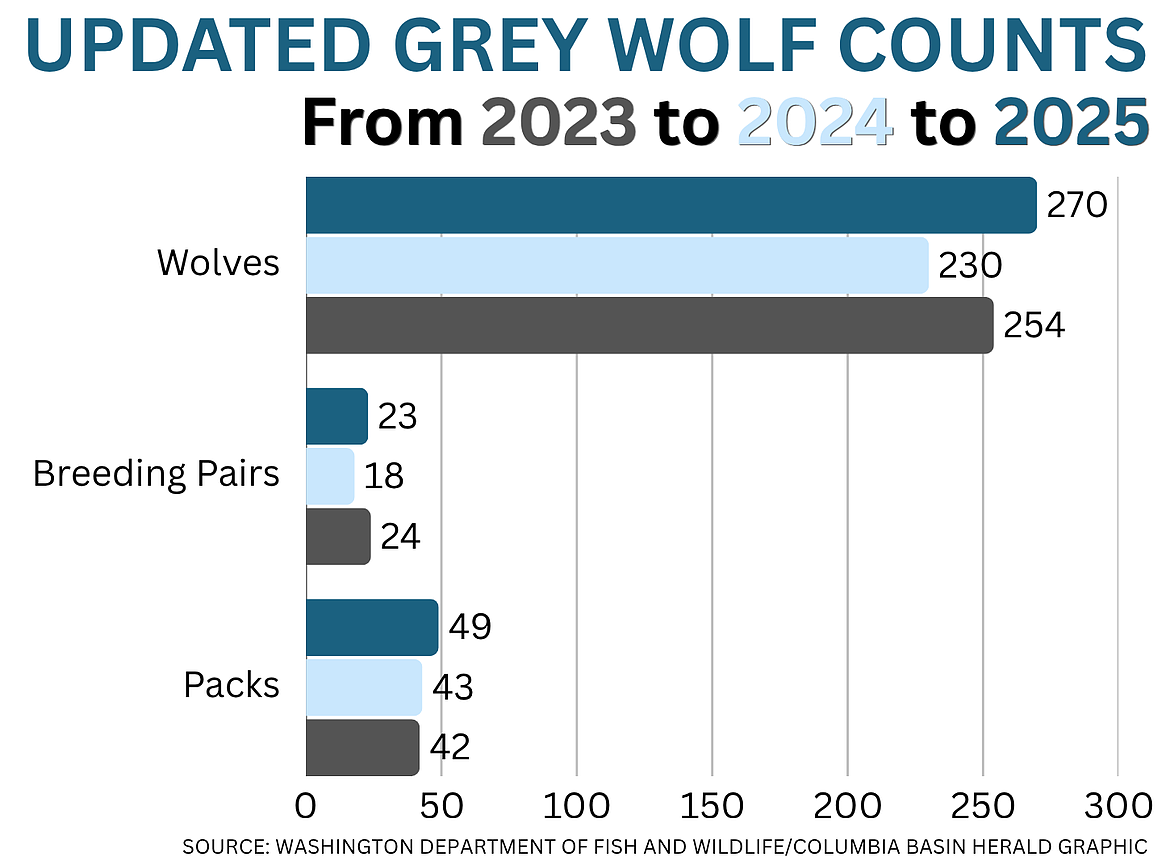
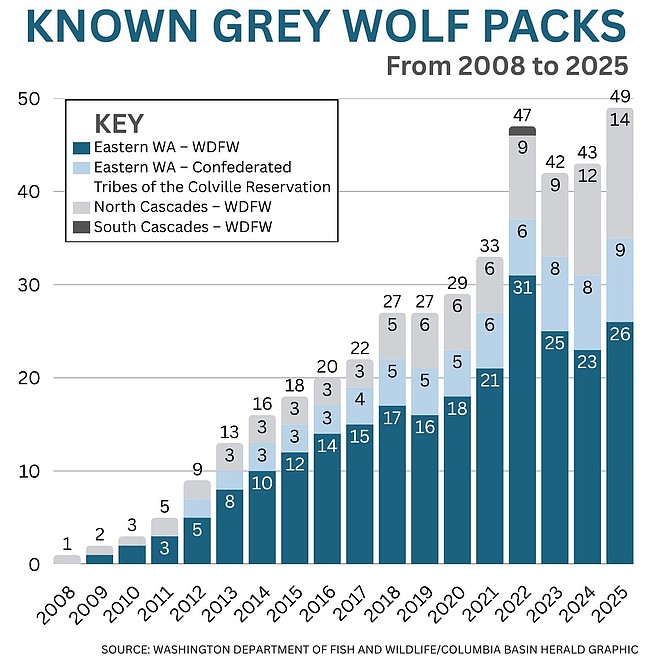
State and tribal biologists counted a minimum of 270 wolves, 49 packs and 23 breeding pairs as of Dec. 31, 2025. Which is up from 230 wolves, 43 packs and 18 breeding pairs the previous year. The count reflects the minimum number of wolves confirmed through aerial surveys, track observations, remote cameras and collar data, plus an additional 12.5% to account for lone wolves and dispersers. 

“We confirmed six new or reestablished packs in the annual count,” WDFW wolf biologist Trent Roussin said in the department’s announcement.  

Packs that reestablished included the Salmo, Smackout and Vulcan packs in northeast Washington, while new packs formed in the North Cascades and on the Colville Reservation. 

The growth follows a rare population dip in 2024. Since the state’s first modern pack was documented in 2008, wolves have expanded steadily across Eastern and North Central Washington. The 2025 report notes that the population has grown by an average of 21.5% per year over that period. 

Despite dispersal activity, including 14 collared wolves leaving their home territories and three traveling into Oregon, Idaho or British Columbia, no packs or breeding pairs were documented in the Southern Cascades and Northwest Coast Recovery Region. One collared wolf briefly entered the region, and another uncollared wolf was seen near Mount Adams, but neither remained through winter surveys. 

WDFW documented 28 wolf mortalities in 2025, including four wolves lethally removed in response to repeated livestock depredations, two killed while attacking livestock, two natural deaths, one capture‑related death, 12 legally harvested by Colville tribal hunters, and three wolves killed unlawfully. Three additional human‑caused mortalities occurred on tribal lands. 

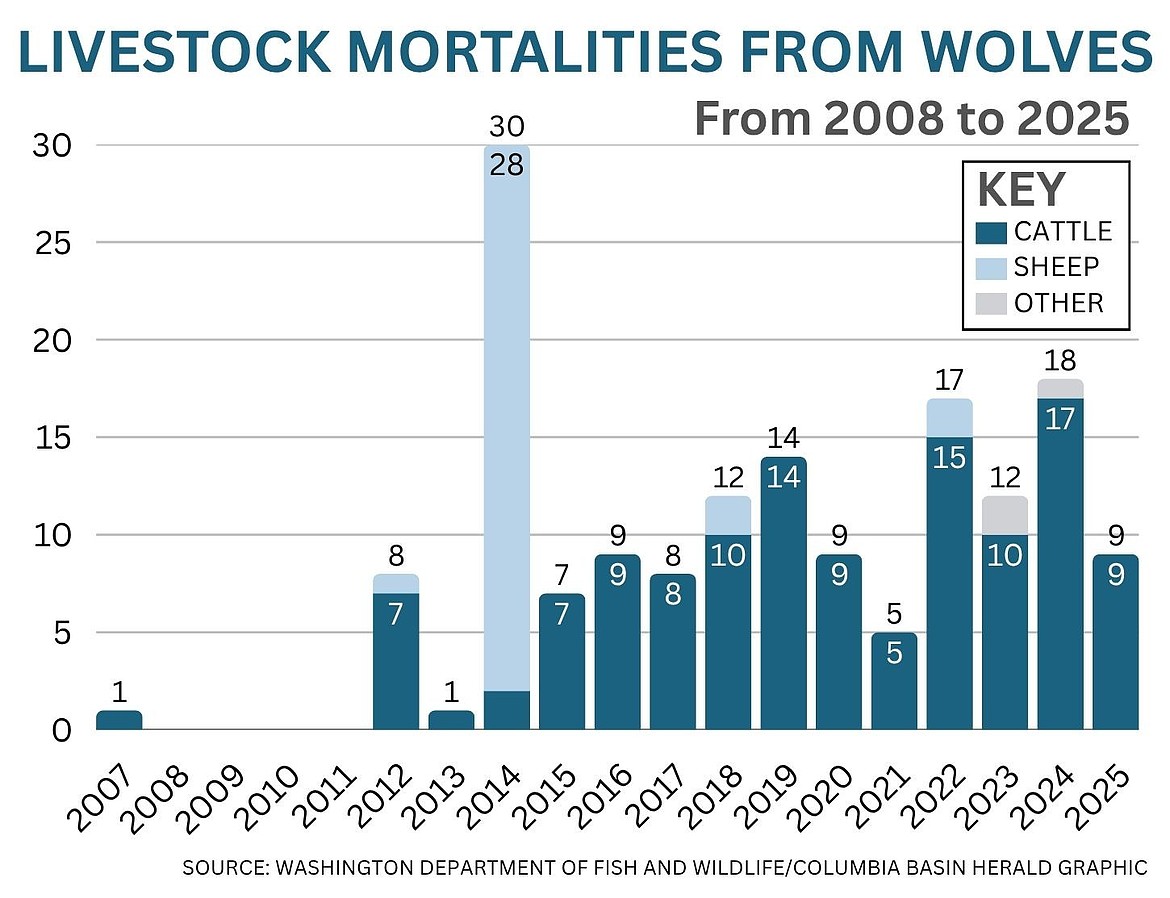
Livestock conflicts remained limited. The department confirmed 17 depredation events involving 19 cattle, including eight calves killed and eight injured. Five packs, about 10% of the state’s 49 packs, were involved in at least one confirmed or probable depredation. 

“That leaves 90% of known packs that were not involved in any known depredations in 2025,” Roussin said. 

WDFW spent nearly $2 million on wolf management last year, including nonlethal deterrents, range riding, compensation for livestock losses and research. 

Wolves remain listed as endangered under state law, and federal protections still apply in the western two-thirds of Washington. Recovery goals require successful breeding pairs in all three recovery regions before downlisting can occur. 

The full Washington Gray Wolf Conservation and Management 2025 Annual Report is available on WDFW’s website.