
Road 2 SW haystack fire unlikely to reignite but will smolder
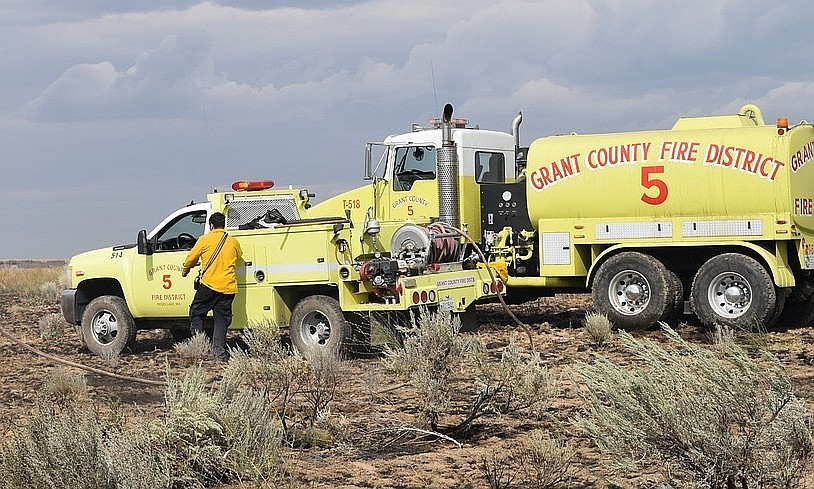
A haystack fire on Road 2 Southeast is likely to keep burning for a few days, according to Grant County Fire District 5 firefighters.
FILE PHOTO
MOSES LAKE — Drivers near the intersection of state Route 17 and Road 2 Southeast may continue to see smoke – and possibly flames – from a haystack fire that closed a section of Road 2 for two days.
The road was reopened Friday, said Sean Killion, battalion chief for Grant County Fire District 5. It had been closed since Wednesday afternoon.
Fire District 5 crews moved bales that hadn’t burned away from the flames, but fighting a haystack fire involves techniques that may seem counterintuitive.
“The best thing with the hay is to let it burn,” Killion said.
That’s because a hay fire is hard to fight, he explained.
“It takes copious amounts of water to put them out,” Killion said, and they’re likely to smolder for a month – or a couple of months, or more – before they finally die out.
When the fire is allowed to burn, the remnants will smolder for a week or so, he said, but the fire dies much more quickly.
“Probably by next weekend, it should be done and over with,” he said.
The arrival of warmer weather also means the arrival of wildfire season. It’s too early to tell how Washington’s fire season will play out, but there are ways people can – and should – prepare even as the snow in higher elevations is still melting. That's especially true for people who live outside populated areas.
Residents should build what’s called defensible space, where leaves and other debris have been removed, woodpiles and other flammable material have been moved away from buildings and trees have been trimmed. Trees work best if they’ve got some space between them, and if they’ve got some space between them and the buildings. Firewise USA, from the National Association of Fire Professionals, recommends trees be a minimum of 10 feet away from a building.
Any debris should be removed from the roof and gutters and anything stored under a deck or porch should be moved too. Deck and porch spaces should be screened with wire mesh.
Research has determined that embers and small flames are the biggest threats to a house or other structure, according to information from Firewise USA. The ‘home ignition zone,’ as it’s called, can be up to 100 feet from the house.
The house needs work too – any attic vents should be cleaned and screened and so should any vents in the eaves. Driveways, paths, patios and decks can act as fuel breaks. Lawns or grasses should be mowed regularly and kept to a height of four inches. Trees and shrubs should be broken up into small clusters so fire has more trouble traveling between them.
Wildfire smoke can affect everybody. The Centers for Disease Control recommends that people check air quality when it starts to get smoky outside and pay attention to its recommendations. Air conditioners should have filters that help clean any outside air they’re pumping in.