
Ephrata priest gets last-minute visa reprieve
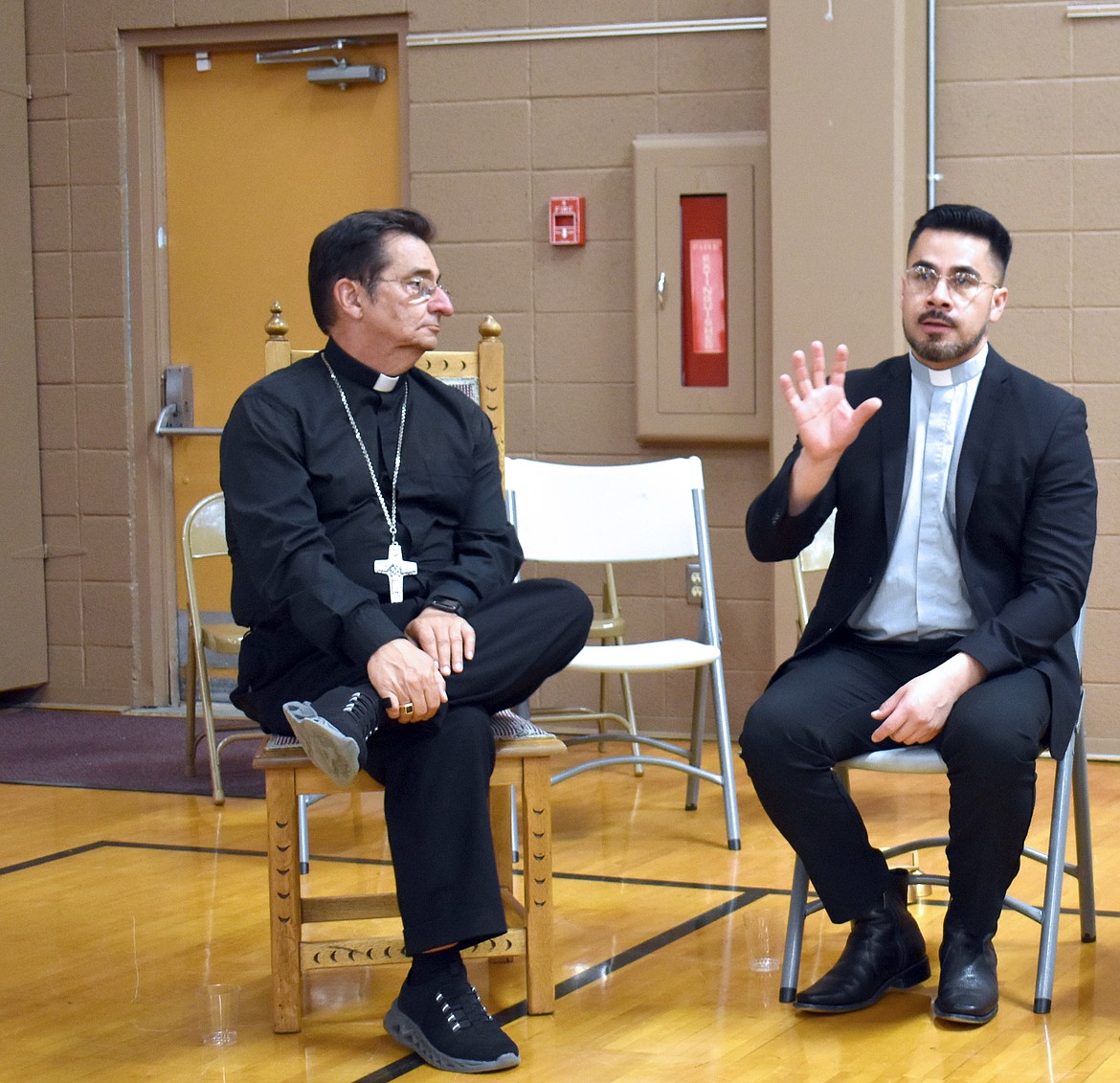
Father Cesar Izquierdo, right, talks about his experience with immigration law with Yakima Bishop Joseph Tyson at a forum at St. Rose of Lima Catholic School in Ephrata. Izquierdo is one of many clergy in the Basin who have had to navigate the labyrinth of immigration law to carry out their ministries.
JOEL MARTIN/COLUMBIA BASIN HERALD
EPHRATA — The Columbia Basin nearly lost a popular priest due to a government glitch. But in a twist that could almost be called miraculous, it didn’t happen.
“My visa … expired on June 30,” said Fr. Cesar Izquierdo, pastor at St. Rose of Lima Parish in Ephrata. “In order for me to continue (my work), I needed a permit because it’s a paid position.”
Izquierdo was working in the U.S. on an R-1 visa, which is a special visa issued to religious workers – priests, pastors, missionaries, nuns and so forth – to conduct their ministries in the United States. R-1 visas are good for a maximum of five years, and during that time, the holder can apply for a green card, which Izquierdo did.
“Usually what would happen is, two years into the R-1, you apply for your green card, you get approval and then it’s a two-year wait,” said Yakima Bishop Joseph Tyson. “Usually, the green card comes year four of the five, so by year five we’re in good shape … That (green card) line is now six to seven years long.”
Under the terms of the R-1 visa, the holder has to leave the country for at least a year and apply for a new one, which can take years. If Izquierdo stayed, he would be unable to do any sort of work at all and would have to rely on friends and family for support. He’d have no salary or medical coverage from the diocese.
“That would be really hard on a parish, to lose a pastor,” Tyson said.
In this case, not just one parish. Izquierdo is based at St. Rose of Lima Parish in Ephrata, but he also shepherds St. Joseph Parish in Waterville, St. Henry Parish in Grand Coulee and Holy Angels Mission in Coulee City. Besides the administrative work for all four, he trades off every Sunday with Fr. Ruben Melendrez to celebrate Mass at either St. Rose or all three of the other parishes, a round-trip drive of 170 miles. Then there are weekday and Saturday Masses in Ephrata and confessions in all four parishes. On top of it all, Izquierdo is the pastor for St. Rose of Lima Catholic School. In other words, an awful lot of people rely on him.
“I was willing to go,” Izquierdo said. “I was all packed. Of course I was sad, because I was a pastor here already … but that’s life.”
A religious worker visa wasn’t a possibility for the short term, but Tyson was already working on something else that might resolve the problem, he said: an F-1 student visa.
“Fr. Cesar is a very bright guy,” Tyson said. “We were looking around for a doctoral program that he could do remotely and still be able to be pastor.”
Izquierdo was accepted to a program through Mundelein Seminary in Chicago, but a student visa still took time, time that Izquierdo didn’t have.
“His R-1 was set to expire on a Monday,” Tyson said. “Sunday at the Masses we read a letter explaining that Fr. Cesar would have to leave. His R-1 status was ending, and the F-1 had not been approved.”
Monday morning Tyson had his chancellor, Msgr. Robert Siler, go through the process of removing Izquierdo from the diocese’s payroll. But first, Siler took one last look at Izquierdo’s status.
“He went to the (U.S. Citizenship and Immigration Services) website and bing, there was the F-1,” Tyson said. “It was approved in the last business hour.”
Aside from the nail-biting timing, Izquierdo’s story is not unusual. Roughly a fifth of the priests and seminarians in the Yakima diocese are on visas of some kind or another, Tyson said. Keeping them legal is no small task, he said.
“I think a lot of people are focused on the border and illegal (immigration) and I don’t think anybody’s paying attention to how hard it is to follow the law,” Tyson said. “About 10% of our diocesan donations are paying for legal fees … we follow immigration law with all of our staff and all of our clergy, so we are following the law strictly. We have attorneys to make sure we do this correctly.”
There may be some hope on the horizon. The Religious Workforce Protection Act, introduced in both the U.S. House of Representatives and the Senate, would allow an R-1 visa to be extended while the holder was waiting for a green card and would exempt them from having to leave the country for a year before they could get a new visa. The bill has received bipartisan support.
Izquierda’s commitment to his parishes is for six years, of which he has four to go. After that, he wasn’t sure what would happen, he said.
“Thank God I was able to stay here,” he said. “But for a priest, the Church is universal. We can work anywhere.”
The Religious Workforce Protection Act can be found at https://bit.ly/RWPAct.