
Youth and suicide: Knowing the signs and accessing resources can save lives, experts say
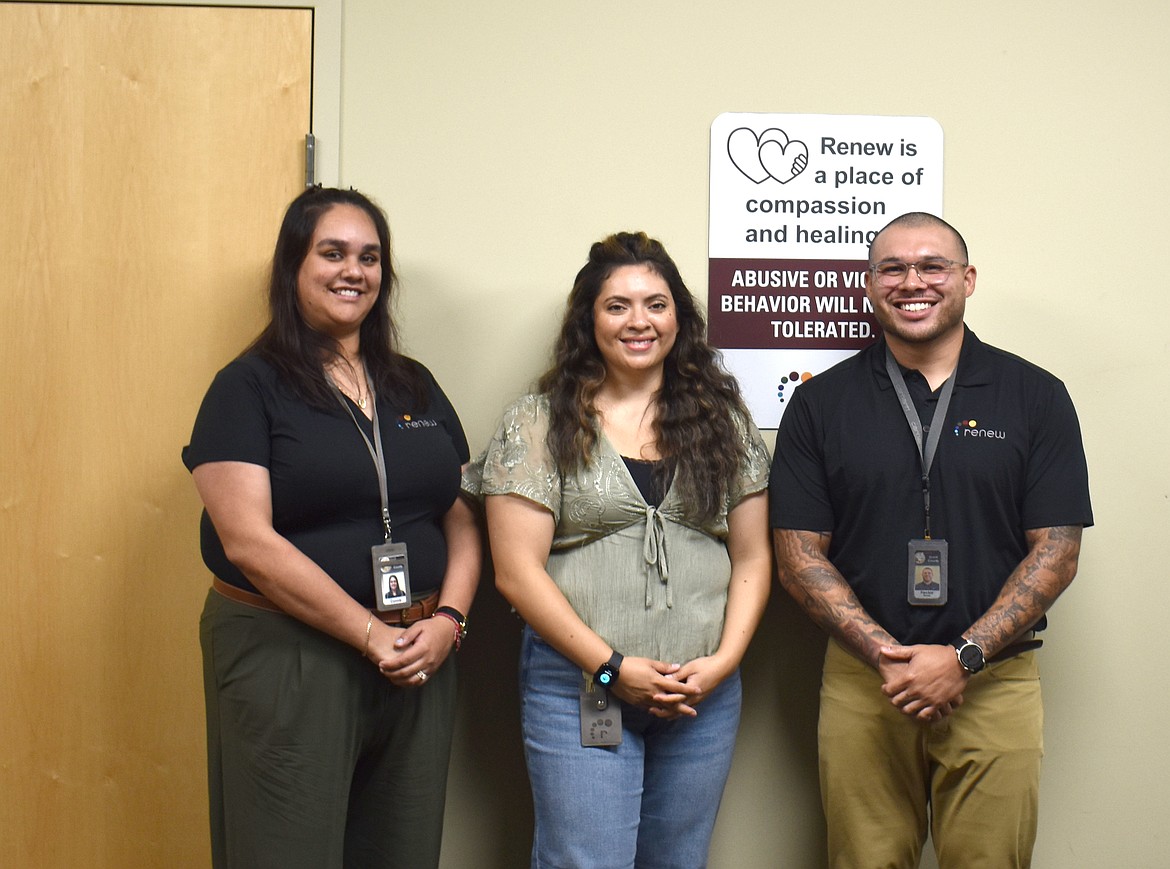
From left: Renew Therapist Conne Guerrero, Community Relations Manager Dayana Ruiz and Youth Mental Health Professional Hector Zavala.
JOEL MARTIN/COLUMBIA BASIN HERALD
MOSES LAKE — Suicide is the second-leading cause of death in Washington for people between the ages of 10 and 24, according to the Washington State Department of Health. Youth suicide is on the rise regionally, according to locals who work with people in crisis.
“Over the last five to six years, it’s increasingly gotten worse and worse and worse,” said Hector Zavala, a youth mental health professional with Renew. “Within the last 10 years, for sure, there’s been a significant spike. I think that could be related to the increase of smartphones and technology and social media and cyberbullying, but there's definitely been an increase in youth crisis and suicide.”
September is Suicide Prevention Awareness Month since 2008, according to the National Alliance on Mental Illness. It’s a time to discuss and think about a topic that’s too often greeted with silence or stigma, meaning people who need help the most are the most reluctant to seek help.
Youth in the state are facing a serious crisis when it comes to suicide. Zavala’s team is on the front line of that crisis, taking calls from counselors, families and emergency rooms that a young person is at risk of suicide and finding ways to stabilize the situation before the child does something irrevocable. The hope, though, is that people reach out to get help from him and his team before a suicide attempt occurs, Zavala said.
“If there are overall concerns that parents are having, or friends are having of others, noticing some red flags, you can always give us a call for us to be able to speak to someone and then connect them to services,” Zavala said.
Seeing the signs
Once Zavala’s team has made contact with a person or family, one of the people they pass the case on to is Conne Guerrero, a therapist who handles intakes for Renew. She’s based in Quincy, Guerrero said, but also does intakes for Royal City and Mattawa. She agreed with Zavala on the seriousness of the situation and said she’s seen an increase in suicidal activity. Part of the reason it’s more visible is that younger people seem to be communicating about it more than in the past.
“A lot of kids are talking about, and are saying, and are communicating, ‘Hey, I am feeling, I do have suicide thoughts,’” Guerrero said. “I think that's why it's increased too, because they're coming in. Kids aren’t afraid to say, ‘I'm not OK. I am having these thoughts. I do need help.’ And they are reaching out.”
Community awareness has improved as well.
“Parents and kids are also aware of these red flags and concerns to look for, which is a positive (thing),” Zavala said.
Those red flags include talking about suicide, giving away possessions, withdrawing or isolating themselves or being preoccupied with death, according to the WSDOH. Stressors like breaking up with a boyfriend or girlfriend or conflicts with parents can also cause suicidal ideation.
“If you notice somebody is isolating more than usual, (that’s a concern),” Zavala said. “Something that's common among youth today, or adults too, is reposting concerning things on social media. (There may be) sudden changes in mood, or if you notice people aren't sleeping well the way they used to, just overall big and sudden changes in mood or behaviors.”
The risk is much higher if a family member has committed suicide in the past, according to the National Institutes of Health. Being aware of that and other risks, especially among peers, can be a big help.
Living online
Due to the nature of social media, young people often see red flags before parents do, Zavala said.
“Something that is common is friends texting each other like, ‘I'm having these thoughts,’ or ‘I'm feeling depressed lately,’” Zavala said. “And friends … have access to be able to repost certain things. There'll be TikTok videos like, ‘I'm experiencing this, this and this,’ or ‘I feel alone, I feel sad’ and kids will repost those kinds of things.”
Because social media is such a constant presence in young people’s lives, it becomes a form of social currency, Zavala said. Children and teens often tie their self-worth to how many followers or likes they can get. It also opens them to cyberbullying.
“I've had intakes where kids will say other students are (telling them), ‘Kill yourself,’” Guerrero said. “I've heard that frequently.”
It’s hard to avoid when bullies can access victims through a device in their pockets.
“You can’t really escape it,” Zavala said. “You're going to get a notification on your phone, so it's like you can be tormented at school, and then you're going to go home and it continues.”
That can lead to depression and suicidal thoughts, and that’s when to seek help, Zavala said.
“If a kid is experiencing these type of horrible things, getting them into services gives them access to counselors and therapists to give them tools to combat those negative thoughts, learning positive coping skills to address those negative thoughts and to know that those things aren't true,” he said.
Educating young people on managing social media security, knowing when to reach out for an adult’s assistance and making sure they understand the consequences of online behavior is important.
“When it comes to social media, because we only have certain access, sometimes it goes beyond what we can do,” Guerrero said.
Reaching out
Part of what Guerrero does to head off suicidal risk is community outreach at events like the upcoming Farmer Consumer Awareness Day in Quincy, she said. Renew will have a table with information for parents to check out and maybe recognize things they’re seeing in their children.
“(At) a lot of those events, we see intakes being scheduled,” she said. “We see parents asking more questions. Sometimes I'm out there and they see a familiar face, and I'm like, ‘All you’ve got to do is just come in, schedule an appointment (or) call us.'”
Cultural attitudes play a part in getting information out, Guerrero said.
“(Some) cultures are more open, and they'll ask the questions,” she said. “Sometimes it becomes a struggle with some cultures still not having the full education, so we provide that psychoeducation for them. We can't make anybody do anything, but we educate and educate and educate.”
Educating and reaching out to higher risk communities like those of Hispanic descent, like Guerrero, are important, she said. It’s about breaking down barriers to asking for help.
The education materials Guerrero’s team provides are in both English and Spanish, to maximize their reach, she said.
Next steps
Some clients just need some tools for coping with unwanted suicidal thoughts, but sometimes more is required, Guerrero said. For those situations, Renew has a program called Wraparound with Intensive Services, or WISe, where mental health professionals will work with the child, parents and other family members facing the crisis. That’s a heavy investment in time and energy, but it pays off, Guerrero said.
“For WISe, they usually are complex cases,” said Renew Community Relations Manager Dayana Ruiz. “So, it's not that this child is experiencing something difficult; it's that they're likely involved with the juvies, maybe involved with foster care, maybe also involved with a lot of different things that have made it a complicated situation, and now the whole family needs support.”
Guerrero recalled the story of a juvenile who reached a crisis point and got the help they needed. Because the youth was over 13, they were able to refuse services until it reached a crisis point in the emergency room and law enforcement stepped in.
“(This) kid was a high risk,” Guerrero said. “A lot of suicide attempts, suicidal ideation … finally crisis stepped in and scheduled that intake. The kid agreed to come in and we got them into WISe services.”
The teen’s family received services as well, Guerrero said, because suicide doesn’t happen in a vacuum; things happening in the home are frequently a factor.
“Now the kid is thriving,” Guerrero said. “(They have) goals, wants to go to college … The parent is very thankful. She said, ‘I think the right people were put in the right path.’”
Where to find help
Renew has offices in Moses Lake, Quincy, Ephrata, Mattawa, Grand Coulee and Royal City. Renew also goes to schools, and for people with limited transportation there are telehealth options.
The whole thing starts with asking for help, Zavala said. The suicide hotline at 988 is staffed 24/7 with people who can help, not just in a crisis but for people who are having a bad day or need to talk before it gets to a crisis. But if there’s a serious, immediate risk of someone hurting themselves, don’t hesitate to take action, he said.
“If there are imminent safety concerns, please call 911 or utilize the emergency room,” Zavala said. “The emergency room is the safest place you can be. And then contacting law enforcement is the fastest way to get support to you. And then they would contact us.”
Flags of suicidal ideation:
• A previous suicide attempt
• Current talk of suicide or making a plan
• Strong wish to die or a preoccupation with death
• Giving away prized possessions
• Signs of depression, such as moodiness, hopelessness, withdrawal
• Increased alcohol and/or other drug use
• Hinting at not being around in the future or saying good-bye
SOURCE: Washington State Department of Health
What do you do?
If a friend or someone you know mentions suicide, take it seriously. If he or she has expressed an immediate plan or has access to a gun or other potentially deadly means, do not leave him or her alone. • Get help immediately. Talk to an adult you trust. Seek out a school counselor or nurse, physician, member of the clergy, suicide prevention or crisis line, or a friend for help.
• Contact 911 if you believe someone is in immediate danger of hurting themselves.
• To anonymously speak with someone or get a referral for local help, call 1-800-273-TALK (8255) or use online chat at www.suicidepreventionlifeline.org. You can also text “HEAL to 741741 if you ever feel in crisis and want to connect with a trained crisis counselor.
SOURCE: Washington State Department of Health