Friday, December 05, 2025
33.0°F

A promise fulfilled

by NANCE BESTON
Staff Writer | May 21, 2025 1:00 AM

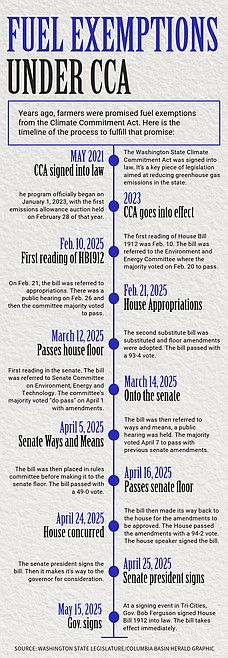
OLYMPIA — Washington farmers were promised fuel exemptions from the state’s Climate Commitment Act, and four years after its initial passage, Gov. Bob Ferguson signed House Bill 1912, which facilitates fuel exemptions for farmers under the CCA.  

“Washington’s agriculture is among the best in the world because of the hard work of Washington farmers,” Governor Ferguson said in a statement. “Our agricultural industries operate on thin margins, and they can’t afford to pay unnecessary fees.” 

The bill's sponsor, Rep. Tom Dent, R-Moses Lake, emphasized the necessity of the legislation as an important support mechanism for Washington's agricultural community, which continues to face mounting operational challenges. 

“The legislature promised our agricultural industry this exemption when the Climate Commitment Act was originally passed,” Dent said. “It was time we honored that promise to make it easier for farmers to access lower-cost fuel and lower the costs of fuel for our farmers.”  

History  

The Climate Commitment Act was signed into law in 2021, establishing stringent targets for reducing greenhouse gas emissions.  

Within this broad environmental framework, the act included exemptions for agricultural producers and transporters regarding fuel-related fees. Currently, an agricultural producer can apply for a rebate run by the Washington State Department of Licensing for up to $4,500. That amount for many farmers was much less than they lost from the CCA fee. 

However, despite the available exemptions, accessing exempt fuel proved to be significantly complicated in practice.  “The formula for figuring out the rebate program was so difficult and complicated for no reason, I know I am not the only person who couldn’t figure it out,” Dent said. 

Farmers found it challenging to navigate the complexities associated with obtaining exemption certificates, Dent said, exacerbated further by various logistical hurdles in the supply chain. 

“Farming is a tough place to be in,” Dent said. “We put in an additional tax on farmers, which is just killing them. Even though we put together a rebate program, the rebate program wasn't working very well. It was difficult. It's hard to get people that are already up to their eyeballs busy to do something like that.”  

Under the CCA, agricultural fuel users are exempt from compliance fees if they can provide the necessary documentation. This requirement, however, entailed a cumbersome application process that often deterred farmers from taking full advantage of the benefits, according to Dent.  

As a result, many farmers were left paying additional fees on their fuel purchases, further squeezing their already tight profit margins, Dent explained. This prompted calls for legislative action to simplify the process. 

“Most farmers don't sit on a computer every day,” Dent said. “This was not necessarily easy for them to do. Some use more technology than others, but it still challenges them to do that, especially in a time where their time is so limited. The idea around this bill was to give them their ongoing exemptions for agricultural fuel that they don't have to pay. They don't have to pay the fee, the tax at all, now.”  

Sen. Judy Warnick, R-Moses Lake, said she remembers fighting for the agriculture fuel exemptions in the Senate when the CCA was being passed. However, like Dent, she felt like the system that was in place was not working for farmers. 

“Part of that promise was that agriculture would not be impacted by the increase in gas prices or fuel prices,” Warnick said. “That didn’t hold true.”  

New law  

House Bill 1912 addresses these barriers by mandating the Washington Department of Ecology to create a comprehensive online directory for retailers selling exempt fuel.  

The bill also clarifies which types of fuels — gasoline, diesel, biodiesel and propane — are eligible for exemption under the CCA.  

The exemption is extended for an additional two years, maintaining it until Dec. 31, 2029, enabling further access to a relief mechanism that many farmers have found essential. 

“Agriculture, it's very hard,” Dent said. “To give them some relief on taxes, and then the whole idea was to get it where they wouldn’t pay the tax and then get a rebate two or three or four months later. If it's 50 cents a gallon and you bought 20,000 gallons of fuel. It adds up quickly. We didn't want them to have to wait on that money.”  

The legislation has been positively received across party lines, passing the House with a vote of 93-4 and the Senate unanimously.  

“Well, every little bit helps,” Warnick said. “It really does. I think it depends on how many farmers actually apply for this or are paid for fuel usage. I'm hoping it'll have an easier impact than it has been. It was too difficult. It was kind of a complicated process, and so hopefully this will make it a lot easier.”  

Dent noted that the bipartisan support stemmed from a collective recognition of the vital role agriculture plays in Washington's economy. The positive response from the agricultural community underscores the desire for collaborative solutions that support farmers and acknowledge their contributions, he said.  

“I'm excited because the legislature and governor have recognized the importance of agriculture and the fact that they really need the help,” Dent said. “They need financial help, and we finally got it.”  

As the bill establishes clearer guidelines for fuel exemptions, it is also designed to simplify the process for obtaining exempt fuel, thus alleviating some of the financial strain on farmers.  

Under the new structure, farmers will be able to reference the online directory created by the Department of Ecology to find local sellers of exempt fuel more easily—an approach that Dent said will directly benefit the agricultural sector. 

Looking forward  

While House Bill 1912 marks an important moment for Washington farmers, Rep. Dent expressed that this initiative is only the beginning.  

“I don't think I'm finished with this yet, but that being said, I need a year, and perhaps two years, to see how this thing unfolds,” Dent said. “Now begins more work with and also the success of the Climate Commitment Act.” 

He has plans to work on further improvements beyond the lifespan of this legislation, potentially extending exemptions indefinitely.  

“We have to keep the momentum going,” Dent said, elaborating on the need for continuous legislative efforts to support agricultural producers in a rapidly changing economic environment. “Agriculture is a community endeavor, and it’s imperative we fortify our systems to ensure they thrive.” 

Another piece, Dent said, he would like to see returned is a fuel exemption for natural gas for the agricultural industry.  

“We use natural gas in different areas, like they use them in greenhouses and things like that,” Dent said. “I would like that back there, too. You take small bites. Did I get everything I wanted? No, but I view it as a big win. We're just going to continue on to see if we can add to it.”  

As various pieces of legislation intersect with agricultural practices, continued advocacy for farmer support remains paramount, he said.  

“This is not a new thing, and I think we have to be aware and support and strengthen our farm economy and our farmers, in general,” Dent said. “One of the things that Franklin D. Roosevelt did, when he was president, that was when the cheap food policy came along. He put together a farm program to keep our farmers, hold our farmers up, keep them in business, because he knew how important it was that we grow our own food. I think it's really important that we grow our own food. We shouldn’t depend on another country, when we have done it ourselves and can do it ourselves.”  

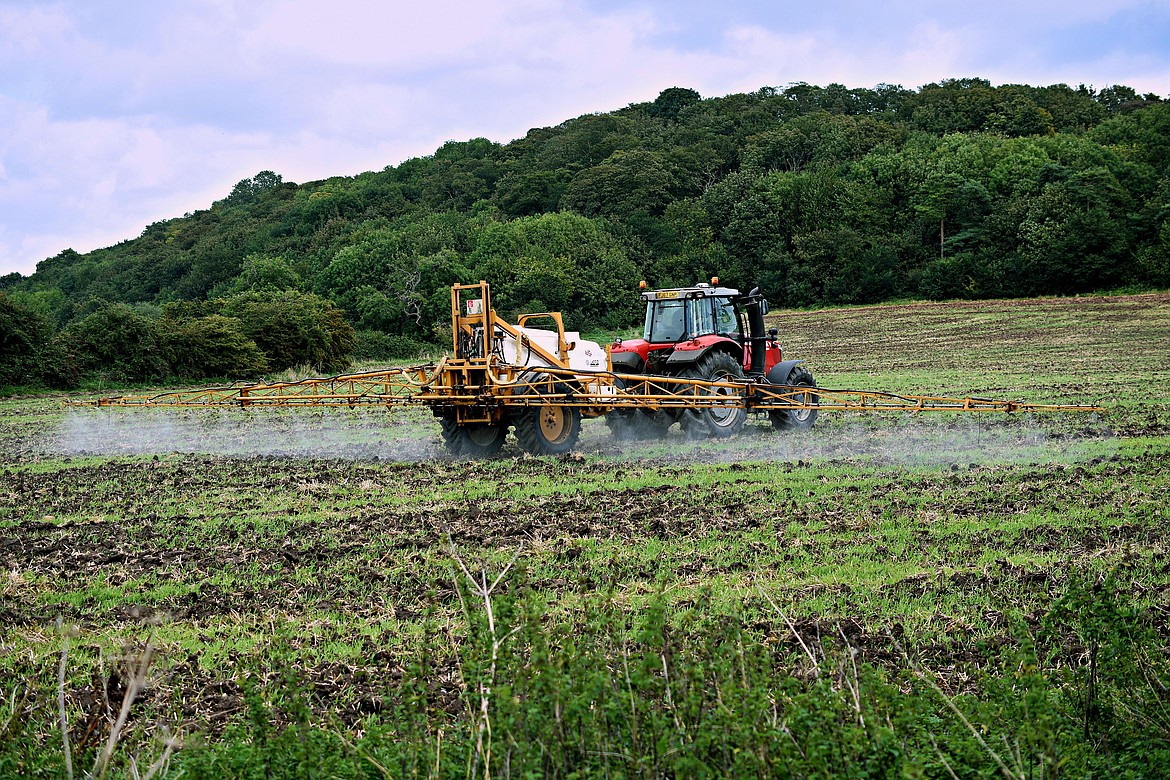
    Farmers will now be able to get Climate Commitment Act tax exempt fuel at various gas stations around the state after House Bill 1912 was signed into law. Sponsor, Tom Dent, R-Moses Lake, said the rebate process was cumbersome and difficult. He is hoping this bill streamlines the process.