
Big Bend expanding BAS programs
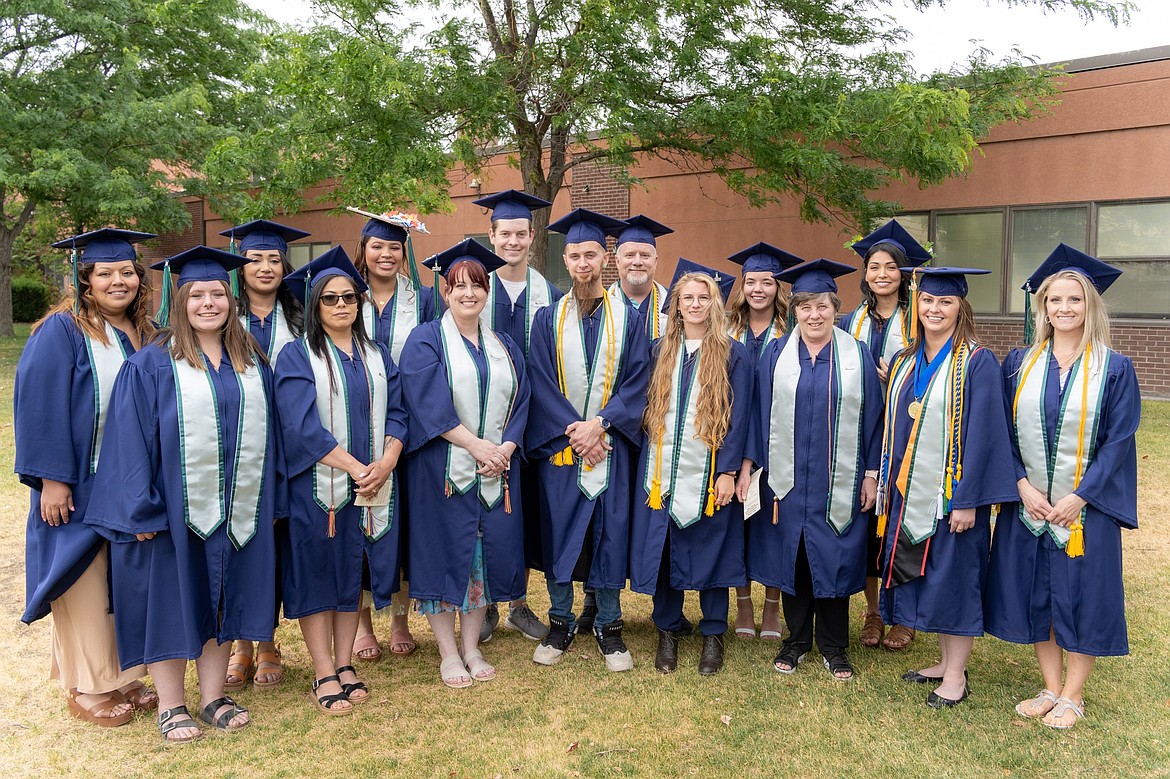
A lineup of graduates from the BAS-AM program in 2024. The BAS-AM programs work in partnership with local companies to prepare students for the workforce.
COURTESY PHOTO/BIG BEND COMMUNITY COLLEGE
MOSES LAKE – Big Bend Community College has added new Bachelor's in Applied Science programs in the last few years and updated existing programs to meet the needs of local businesses.
“Big Bend strives to empower our students to achieve their dreams, but also to strengthen our community. By collaborating with local businesses and industry, we can create enriching educational opportunities that benefit both our students and the community we serve,” said Dr. Sara Thompson Tweedy, President of Big Bend Community College. “Both of our bachelor’s programs were created out of a need we saw locally in our service district of Grant and Adams counties.”
The two newest programs at the college are the BAS Management and BAS Behavioral health programs. Anne Ghinazzi, Director of Title V and Other Grants at Big Bend, has played a major role in the development of both of these programs.
“It really was developed in a response to the needs of the community,” said Ghinazzi. “Local employers told us that they needed more bachelor prepared workers, and the students were seeking the higher education option within the community.”
The BAS programs are designed to build off any already existing associate's degree and supports students who have completed workforce education programs such as welding, automotive technology, medical assistant and early childhood education, so they can bring the skills earned in a workforce degree and add on the breadth of general education, said Ghinazzi.
The first to make headway in this growing need was the development of the BAS Management program. This program launched in the fall of 2021 and has played a key role in changing the educational landscape of what is available to people in their service district who might be working, have limited financial resources and have come through workforce education, she said.
She said that employers have been actively designing the curriculum and creating capstone projects since the beginning of the program. These capstone programs take place in the final quarter of their schooling, where they work with a local organization to identify and solve a problem or opportunity at a company to apply their learning.
“We are seeing students going into management positions, we’re seeing students be promoted within their own company or organization after graduation,” she said. “We’re really encouraged by the results.”
Digna Rodriguez is a recent graduate of the BAS Applied Management program, and she has used her degree to gain a Quality Manager position at Group 14.
“Attending the BAS-AM program was actually a very rewarding experience,” said Rodriguez. “The program offered a lot of courses and pertained to the leadership business strategy and just overall in organizational management which at the time I found it immediately applicable to what I was doing.”
Rodriguez said that balancing the program while working full-time and attending to family responsibilities was challenging but it taught her ways to be more efficient and focused. She said that completing the program was not just an academic achievement, but also a personal milestone to prove to herself what she is capable of.
“I saw how applicable the coursework was to the manufacturing industry,” she said. “Once I was further in my education, a position had opened up for Group 14 and I felt a little bit confident and I went ahead and applied as a quality manager, which then led me to this job now.”
The other program, the BAS in Behavioral Health, is an even newer program set to launch in the Fall of 2025, said Ghinazzi. BBCC is admitting and enrolling its first cohort of students into the program during the late Spring and Summer of 2025.
The program is directly addressing a Behavioral Health workforce shortage in Northcentral Washington and improving the availability of local services, she said. This degree will be designed to meet the new bachelor-level credential in Washington called the Behavioral Health Support Specialist position and will be offered in partnership with Wenatchee Valley College.
“Students are going to come away with practical knowledge and skills necessary to enter the behavioral health workforce,” said Ghinazzi.
The program is going to be a combination of general education courses and then specialized and practical experience courses in behavioral health. This will give students a strong understanding of human behavior, mental health disorders and treatments, counseling case management and will end in the second year with a three-quarter field practicum working directly in behavioral health clinics.
“The reason why this is important is because it’s going to prepare bachelor-level practitioners to be able to provide intervention for common behavioral health issues like depression, anxiety and PTSD,” she said.
Funding for the BAS-AM programs came from the support of the Title V E3 grant as BBCC has been designated as a Hispanic-Serving Institution and the funding for the BAS-BH program received backing through a Career Connect Washington grant administered by Thriving Together NWC, said Ghinazzi. Further support has come from the Grant County Commissioners, who awarded BBCC American Rescue Plan Act funds targeted at strengthening its Allied Health programs.
Big Bend programs such as nursing, agriculture and manufacturing have been seeing a rise in enrollment. These are some of the main areas benefiting from the addition of the BAS degrees and have increasing support from local organizations.
Graduates from the nursing program at BBCC have a high success rate in finding employment in their first year out of college and have consistently received positive feedback from employers, said Katherine Christian, Director of Allied Health programs at Big Bend.
“We’re just getting ready to see our next incoming group,” said Christian. “Our current cohort will be finishing up this summer and those people will be working in doctors' offices and clinics around the Basin.”