Superintendent Lewis provides update on MLSD finances
Key Points:
- Moses Lake School District is following the fiscal plan set in place at the beginning of the year after last year's budget issues.
- The district, looking into the next school year, will begin to make responsible additions to programming.
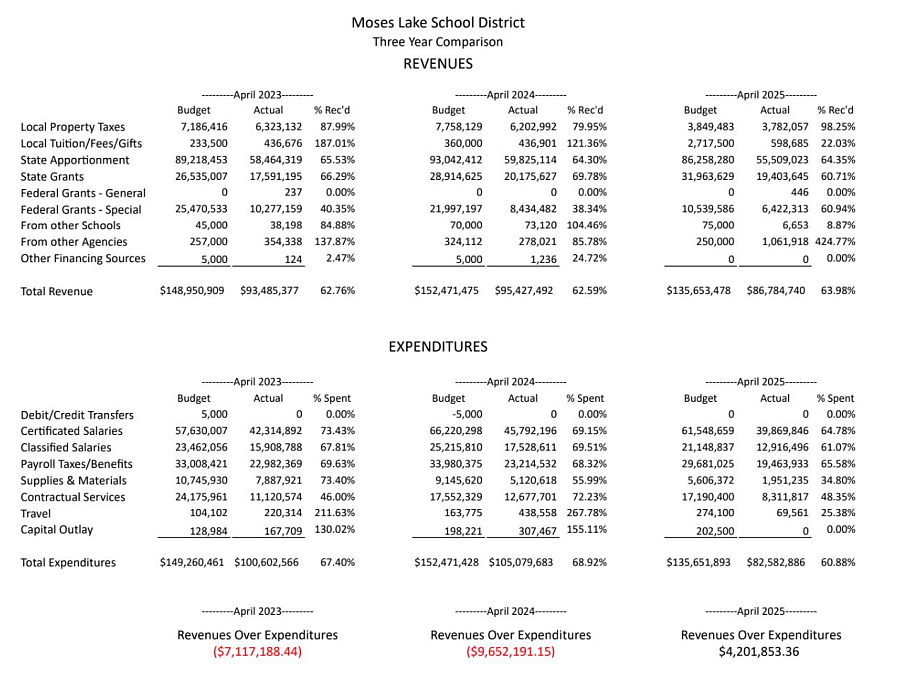
- The district’s revenues were higher than expenditures by $4.2 million. The previous two years' expenditures were higher than revenues.
- MLSD plans to have a healthy fund balance by the end of the 2027-28 school year.
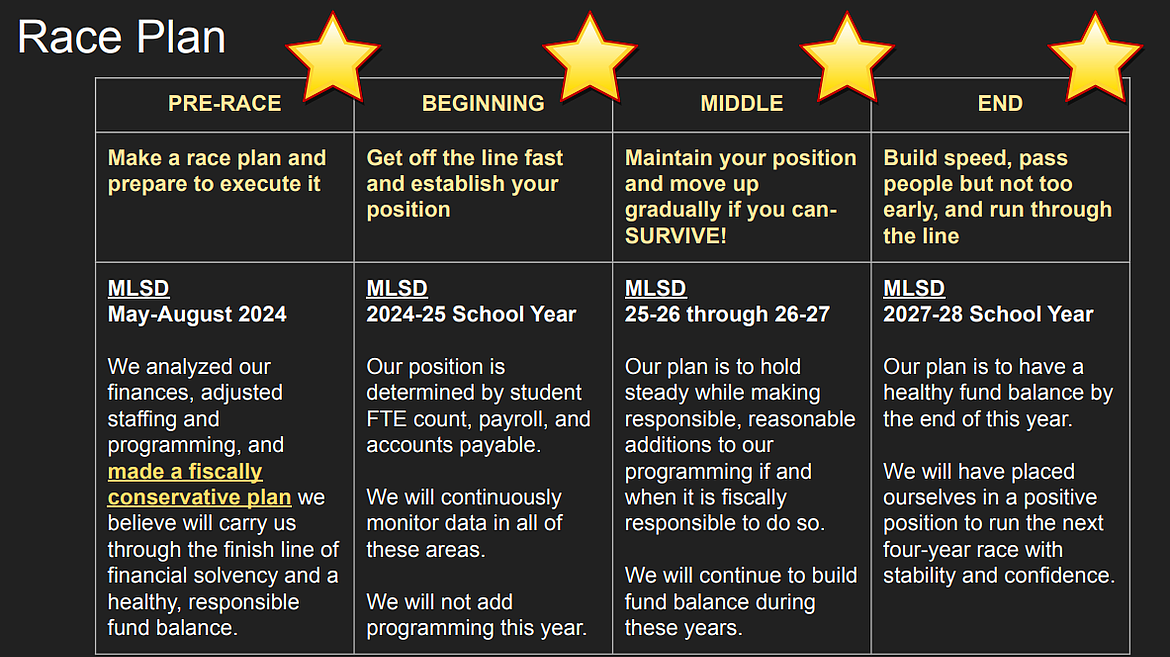
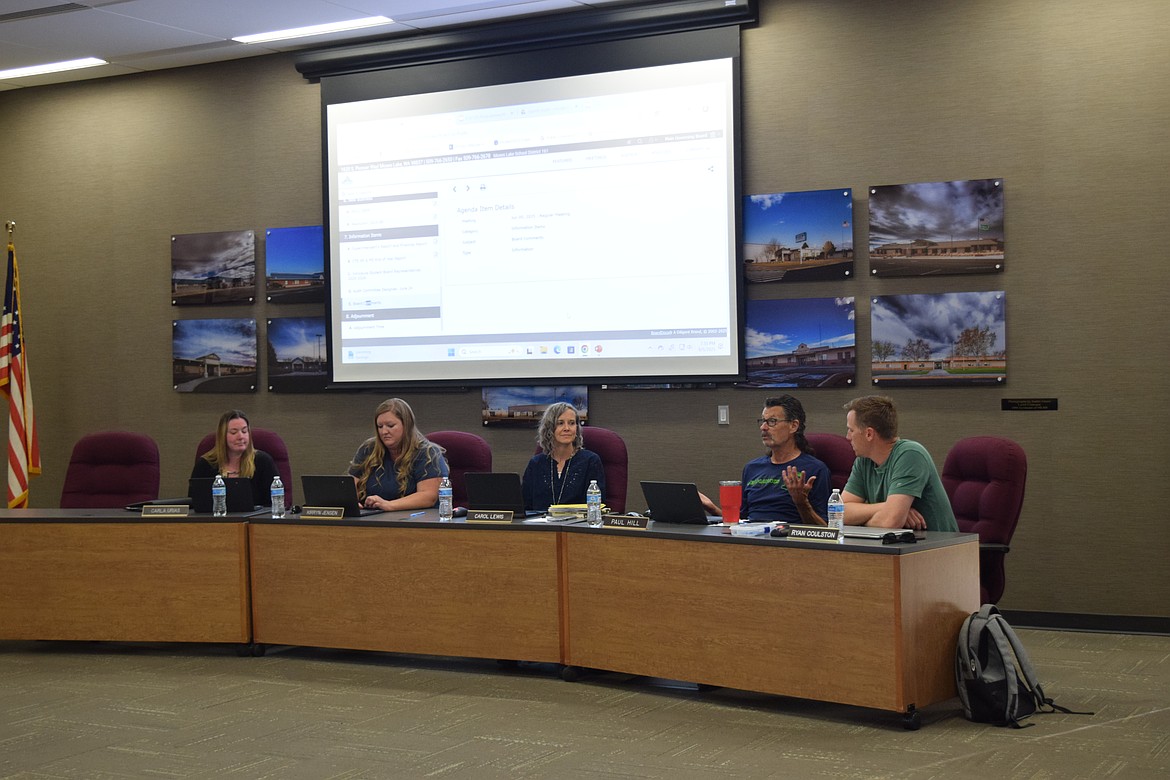
MOSES LAKE – During the regular Moses Lake School District board meeting held Thursday night, Superintendent Carol Lewis delivered a report weaving together elements of the district’s financial status and academic strategies, leaning into a prior cross-country race analogy for the next four years.
“I talked about how the four years that we had coming up are going to be like a long cross-country race and that we were just at the start,” Lewis said. “And we're still, we're off the starting line, and we're in the first part of the race now.”
The “pre-race,” which went until August of 2024, included analyzing district finances, adjusting staffing and programming, and making a fiscally conservative plan, which Lewis said she believed will carry them through the finish line. The goal is to ensure financial and educational program stability.
The superintendent drew out her race metaphor further, saying, “Beginning a long race is about getting off the starting line fast and establishing a position. That’s what this school year represents. The middle is the hardest part, where we must maintain our position and improve as we go, and finally, we want to build speed toward the finish line in the last year of our four-year plan.”
This strategy aims to correct MLSD's financial situation by focusing on being fiscally conservative, Lewis said.
The beginning of the “race,” was the 2024-25 school year, wherein the district considered its position based on student enrollment, payroll and accounts payable. This part of the plan required the district to closely monitor related data. There was no programming added this year.
This initiative is essential given the significant fiscal challenges faced by school districts across Washington state, which are compounded by political factors on both state and national levels, Lewis said. Along with the fiscal challenges all districts are facing, MLSD also struggled with around a $20 million budget shortfall coupled with a double levy failure in spring 2025, leaving the district without a levy for the last half of the 2024-25 school year and the first half of the 2025-26 school year. Voters approved a levy in February with 58.77% of the vote in favor. Funding from the new levy will begin to come in May 2026. The district is currently working on building reserves back, Lewis said.
Looking at the three-year revenue and expenditures comparison, the district has around $4.2 million more in revenues than expenditures. The past two years, the district had been overspending by around $7.1 million in 2023 and about $9.7 million in 2024, per Lewis’s presentation. Since being named interim superintendent and subsequently superintendent, and with the help of the MLSD board, Lewis has reigned in the overspending.
Lewis said the change is a positive sign that indicates the district is using funds more conservatively.
Lewis said it is important that the district continue to communicate with the community and be transparent in how the district’s funds are managed.
"It’s critical that the board and the public understand the multiple factors at play when it comes to budgeting for the upcoming school year," Lewis said.
Lewis said declining enrollment is affecting the district, which affects funding. That has been mitigated through more detailed money management, though.
“Although our enrollment is declining, we are currently faring better than expected and managing our funds effectively,” she said.
The total Full-Time Equivalent enrollment figures, an aspect in determining funding, have shown a gradual decline, but not to a degree that jeopardizes the district's financial plans, Lewis said.
According to the North Central Education Services District, MLSD gets about $12,600 per student from the state of Washington.
The superintendent outlined future initiatives centered around responsible programming enhancements, stressing the importance of fiscal responsibility.
“Next year, we plan to make reasonable additions to programs only when we know it is financially sound to do so," she said.
Lewis said the district will enter the middle of the “race” going into the 2026-27 school year. The plan is to continue with conservative budgeting and programming with the goal of continuing to rebuild the district’s reserve fund. This includes fulfilling promises to the community regarding academic support, extracurriculars, elementary specialists, maintenance and custodial, supplies, secondary courses, safety, security, health and technology.
She said she believes the district will soon be able to reintegrate certain activities and support essentials that had been cut due to the financial concerns faced over the last 18 months.
Also looking into next year, Lewis had a list of key functions that need to improve in the 2025-26 school year, with further information coming soon. (See graphic.)
Lewis noted that administrative staffing is not funded by local levy dollars but only through state funding. Staffing will be kept minimal but some administrative positions are necessary to oversee federal and categorical programs mandated by law.
Looking at the end of the “race,” or into the 2027-28 school year, Lewis said the plan is to have a healthy fund balance to close out that year, putting the district back where it should be.
The report culminated with Lewis's reiteration of the core mission of the school district.
“We do not exist to employ people; we exist to responsibly use taxpayer money to educate our students,” Lewis said.
Key functions MLSD seeks to improve by 2025-26:
- Curriculum review and adoption
- Identification of common essential standards across the district, including professional development
- Preliminary audit feedback indicates a need to greatly improve administrative oversight of federal programs
- Student and staff safety initiatives, including standardized emergency procedures
- Migrant programming, including parent involvement efforts
- Homeless student program
- Truancy program
- Teacher/principal evaluation program; next year, we are required to convert to a new rubric, and we can’t do that without support
- Security staff training and coordination
- Support for beginning teachers and principals
- Required training for paraeducators
- Communication with staff about state requirements
- State-required employee wellness program
- Proactively address discrimination issues
- A firmer threat assessment process
- Implement systems to proactively address harassment, intimidation, and bullying
- Implement support for district counselors
- Coverage for principals when they are out sick
- Improve compliance with state and federal grant requirements
- Meet requirement to have a dedicated assessment coordinator at the district level