


Othello council approves Hampton annexation request
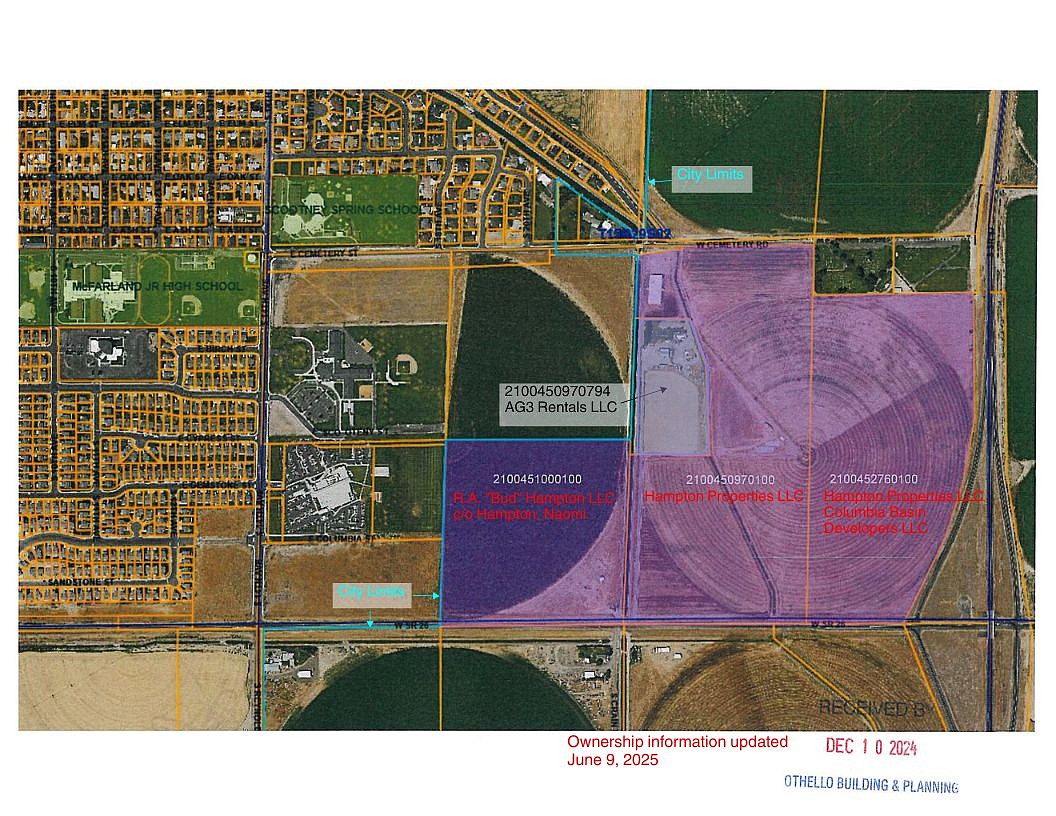
Othello City Council members have approved the annexation of 164 acres into the city limits.
COURTESY PHOTO/CITY OF OTHELLO
OTHELLO — One piece of property submitted for annexation to the city of Othello was accepted by the Othello City Council, but the vote on a second annexation request was delayed. Council members unanimously approved the annexation of 164 acres, which, said council member Corey Everett, fit the annexation criteria.
“All in all, there are seven guidelines,” Everett said. “This property fits perfectly within all seven of those guidelines.”
The property, called the Hampton development, is between Cemetery Road and State Route 26, and east of Wahitis Elementary School and the Columbia Basin Heatlh Association clinic. It's bordered by State Route 17 on the west. No one testified against the proposal during public hearings June 23 or July 14.
Evan Mann, representing the property owners, said some residential areas are planned with a substantial portion being zoned for commercial development.
“We actually are following the city’s comprehensive plan. The land uses that the city anticipated for the comprehensive plan are what we followed (in this proposal),” Mann said at the July 14 Othello council meeting.
Anne Henning, Othello community development director, said Tuesday that the developers originally considered asking that land along SR 17 be rezoned as commercial property but changed their minds. That land is still zoned as residential, Henning said.
In answer to a question from council member Genna Dorow, Mann said the developers do anticipate businesses will have access along SR 26.
“There is the anticipation that Columbia Street will be extended,” Mann said. “And obviously, there will be more feeder roads and local access roads in this area.”
Improvements also are planned for Cemetery Road, he said.
“Keep in mind, any development roads that we propose, we have to build,” he said. "The developer is responsible.”
When the proposal was first presented to the council in February, Mann said the pace of development depends on a lot of factors, including planning and extending the water and sewer lines.
Development could start within the next couple of years, he said, but full development could take up to a decade or more.