Moses Lake council sets priorities at 2-day workshop
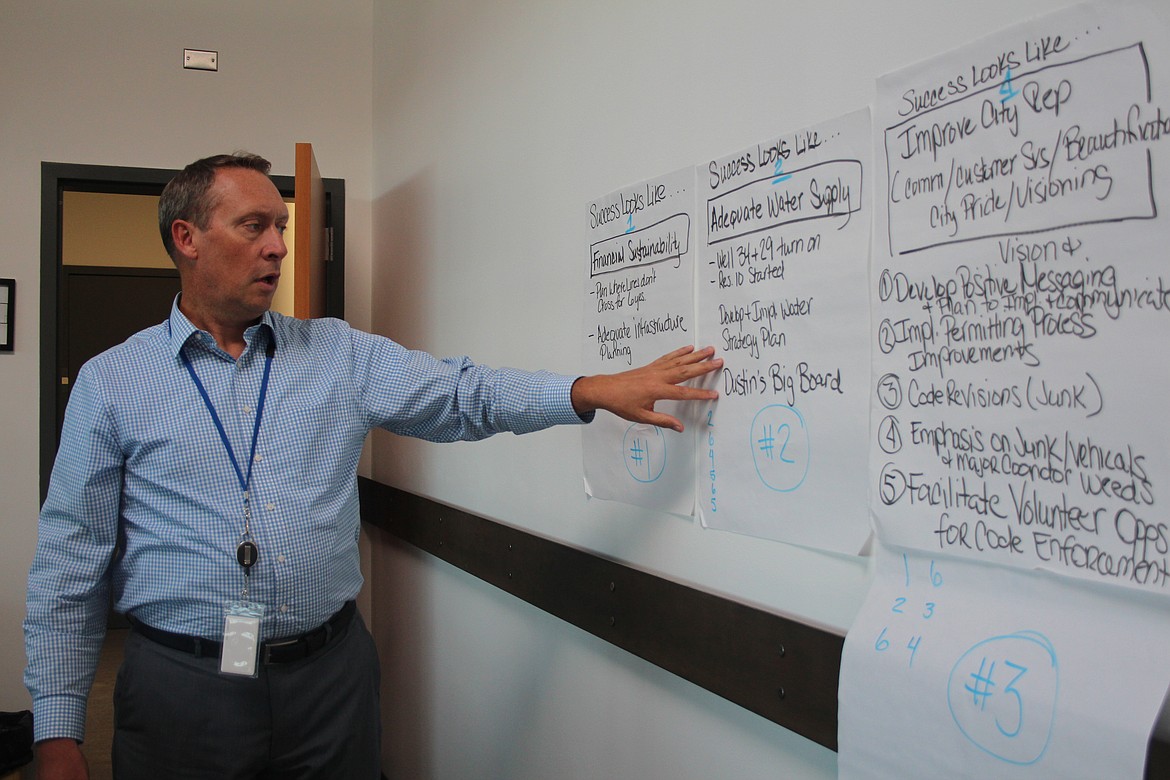
MOSES LAKE — Moses Lake City Council members will review a plan July 22 detailing a set of priorities established by council members during two days of discussion earlier this month. City Manager Rob Karlinsey said the plan, whenever it’s approved, will be an important component as city officials make decisions for the future, beginning with the 2026 budget.
“What are some key things, or key priorities, that you want to get done?” Karlinsey said. “So (council members) created a list. They came up with seven things.”
Mayor Dustin Swartz said it was an illuminating process.
“I found it to be an interesting process — somewhat surprising at times,” Swartz said.
While each individual might’ve come up with some different priorities, all of them have one thing in common, Swartz said.
“They’re somewhat varied, but they’re all important to us,” he said.
Council members went into the process with a specific goal in mind.
“The main focus of it was to create actionable items,” Swartz said.
How those goals will be met is still to be determined, but council members reviewed the seven challenges identified and ranked them in order of importance. Financial stability was at the top of the list.
“There are some big questions to ask about that,” Swartz said.
The city’s general fund, which pays most of the expenses for things like personnel and city operations, and the street fund are in the red, Karlinsey said.
“The general fund pays for the big city services. You think of police and fire (departments) road, parks, planning and building permitting and all those other things,” Karlinsey said.
The second priority was ensuring the city has adequate water for its needs, and the third was improving the city’s reputation. The fourth and fifth priorities involve emergency services, focusing on a third fire station on the north side of town and a new police station.
The sixth and seventh priorities are a second crossing of Moses Lake and a stronger relationship between the city and the Washington Department of Transportation.
How those goals will be met is still to be determined, but Karlinsey said the work starts with the city budget.
“Step one is finding out what’s important to the city council, to get our marching orders from them, and knowing that, then we can build a budget,” he said.
That process has already started for 2026, with a preliminary budget to be presented to the council sometime in October.
Council members didn’t include social services on the list.
“With the closure of the sleep center, the council said we just need to focus on basic city services. These goals reflect that,” Karlinsey said.
Financial forecasts from the staff indicate that on its current trajectory, expenses will be larger than income for the next six years, he said. That’s mostly due to the city’s general fund and street fund.
“Those are the two funds (where) we don’t have as much control over the revenue and they’re also the biggest funds,” he said. “Water and sewer, we can set the rates for how much money we bring in, but with the general fund, we’re at the mercy of the economy. In the general fund, our largest source of revenue is sales tax, and we don’t have control over that. It goes up and down with the economy.”
While increasing taxes and fees will help make up the difference between expenses and revenue, Karlinsey said council members are not interested in raising either taxes or fees. The city’s other option to balance its budget is to cut expenses.
“There are really four ways to balance the budget. One is tightening your belt and becoming more efficient. The second one is looking at our service mix — how we’re getting and receiving our services. The third one is service level reductions, so either reducing or eliminating programs. And the fourth one is increasing taxes,” he said. “Of those four, the first three are focused on expenditures.”
Balancing those options will be the focus of budget preparation, he said.