
More rain for Cascades, high winds for Columbia Basin this week
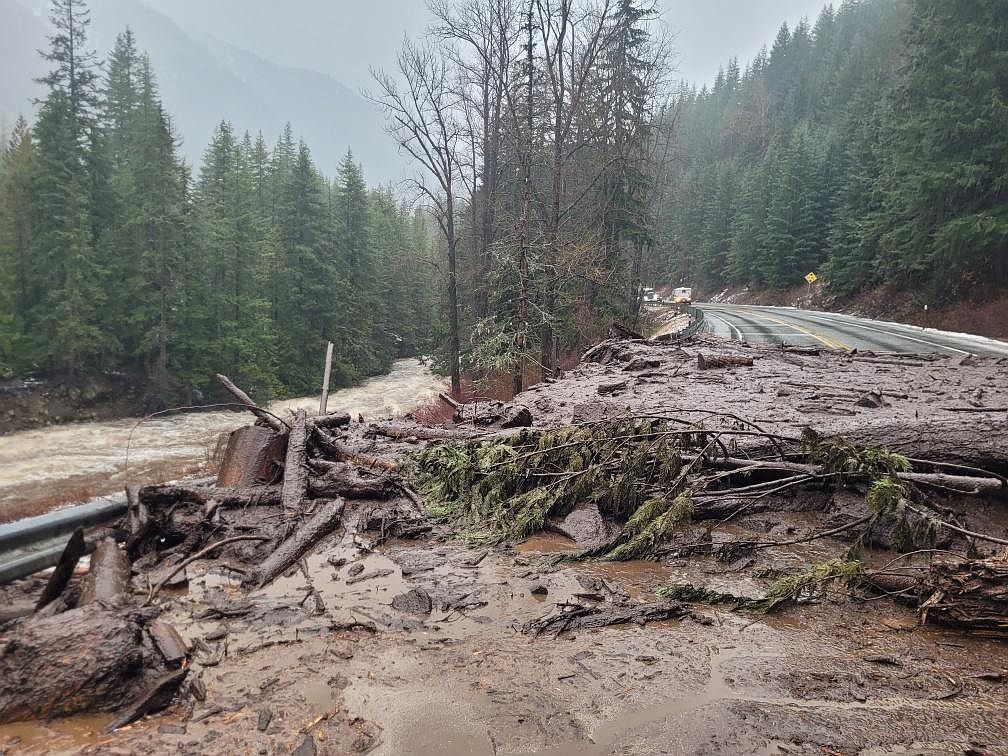
Heavy rains and melting snow closed a section of US 2 west of Leavenworth, and the road will remain closed through Monday.
COURTESY PHOTO/WASHINGTON DEPARTMENT OF TRANSPORTATION
LEAVENWORTH — A second strong winter storm is projected to hit Washington this week, bringing heavy rains back to areas that were hard-hit by rain and flooding last week. Steve Bodnar, meteorologist with the National Weather Service office in Spokane, said rain is forecast to start Monday, but won’t last as long.
“Another round of medium to heavy rains for the Cascade crest,” Bodnar said Saturday. “This will not be as long a duration — we are looking at less rain.”
Last week’s storm resulted in seven to 13 inches of liquid along the crest of the Cascade Mountains, following the mountains through Eastern Washington and North Idaho. Bodnar said Monday’s storm is projected to last about 48 hours, followed by colder temperatures, snow through the mountains and strong winds in the Columbia Basin. Precipitation is projected to be three to four inches along the mountain ridges.
“(Precipitation) is going to come in waves, too, in that 48 hours,” he said.
The storm is projected to cause rivers and streams in the affected areas to rise again, but not as much as last week, he said.
While the Columbia Basin and North Central Washington are not forecast to get much, if any, rain, they’re not escaping the storm.
“The one thing to pay attention to would be the winds,” Bodnar said.
Winds in the Basin are expected to increase from Monday through Wednesday; peak wind gusts in the area are forecast to reach 30 to 40 miles per hour Monday.
“The real period to watch is going to be Tuesday night going into Wednesday morning,” he said.
Wind gusts could reach 40 to 60 miles per hour in the Columbia Basin during that period, he said.
The Washington Congressional delegation requested an expedited emergency declaration from the Trump Administration, which was issued Friday.
“The good news is that federal support is on the way to help those local officials and first responders who have been working 27/7 to get a little bit of relief,” said U.S. Sen. Maria Cantwell, D-Washington.
Gov. Bob Ferguson joined in the emergency declaration request, and state Sen. Judy Warnick, R-Moses Lake, said she was glad to see it.
State and local agencies have been working during the storm, and Warnick said she was thankful for their efforts. Warnick has family and friends in the affected area.
“I give a lot of credit to the first responders, the power guys (and other emergency responders),” Warnick said.
While the emergency declaration will mean federal assistance, the state will have a role to play in recovery, Warnick said, but it’s not clear what that will be yet.
“We’re all going to learn that,” she said. “We’re all trying to learn what that component will be.”
The state faces a budget shortfall, and state legislators will have to determine what the state can do and can afford, she said.
“That’ll be the first thing we have to deal with when we get back (in session) in January,” she said.
State Rep. Tom Dent, R-Moses Lake, said state officials will have at least one task.
“We’ve got to get the infrastructure fixed,” Dent said. “That’s on the state, that’s for sure.”
Along with major flood damage in Western Washington, last week’s storm caused flooding and damage along the Wenatchee River and Icicle Creek, in the Stehekin area and along the Naches River in Yakima County. It closed 49 miles of U.S. 2, Stevens Pass, between Skykomish and Leavenworth and caused intermittent closures of U.S. 97, Blewett Pass, and eastbound lanes of Interstate 90, Snoqualmie Pass, for cleanup of mudslides and downed trees.
The Wenatchee River flooded sections of Leavenworth and Peshastin and knocked out power throughout the Leavenworth area. It caused the cancellation, at least for the weekend, of the town’s annual winter lights festival, according to a Washington Department of Transportation press release.