
Friday, December 12, 2025
46.0°F

Sheriff talks crime, enforcement at Mattawa town hall
| December 12, 2025 4:31 PM

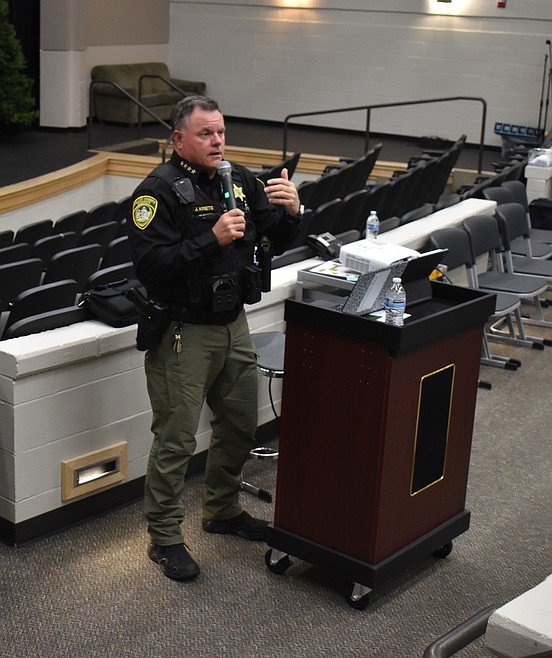
MATTAWA — Grant County Sheriff Joey Kriete held a town hall meeting at Wahluke High School Dec. 9, discussing law enforcement issues affecting Mattawa and Desert Aire. 

“You're going to probably hear me say a million times. We can't do this alone,” Kriete told the attendees. “We have to have our communities out here to help us and share information with us and give us ideas. We get a ton of new and great ideas from the community.” 

Between 30 and 40 people turned out for the town hall, which was organized by the Wahluke School District and the South Grant County Chamber of Commerce. WSD Superintendent Andy Harlow introduced Kriete, who in turn introduced the deputies he had brought with him: Chief Deputy Phillip Coats, Undersheriff Gary Mansford, Chief Deputy Beau Lamens and Lt. Nick Overland. Multi-Agency Communications Center Director D.T. Donaldson and Grant County Commissioner Cindy Carter were in attendance as well. Grant County Prosecutor Brandon Guernsey had planned to attend but was ill, Kriete said. 

Crime reduction 

One of the things Kriete was proudest of was the formation of the Crime Reduction Team, or CRT, which he created in mid-2024. For many years, he said, patrol deputies would respond to calls for burglaries, assaults and vehicle prowls, while the Major Crimes Unit and the Interagency Narcotics Enforcement Team dealt with large-scale drug crimes. 

“So, we had this big gap,” Kriete said. “We just weren't able to address the crimes proactively from the first calls that come into the major crimes that were happening. That's the gap was that was affecting everybody sitting in this room. Those are your rural thefts that happen at farms. Those are your burglaries that happen during the daytime while you're at work. Those are the vehicle prowls that happen when you're in town, or you're gone shopping and somebody breaks into your car. Gas thefts, wire thefts. Those are the things we are actively able to address proactively.” 

The CRT was able to follow up and investigate crimes that the patrol deputies didn’t have the time or resources to, Kriete said, through surveillance, cameras and tracking devices. The team’s efforts have borne fruit, Kriete said. 

“We have over 1,000 fewer calls in 2025 so far than we've had compared to the same time frame in 2024,” Kriete said. “The reductions that we have - attempted theft of property was down 68%, residential burglary was down 42%, theft of gas down 65%, theft of motor vehicles down 45%, vehicle theft down 25%, wire theft down 60% … They’ve recovered a ton of stolen property. They’ve recovered a lot of guns.” 

Grant County has more miles of county roads than any other county in Washington, Kriete said, and is the fifth largest in area. That’s a lot for a shift of eight patrol deputies to cover, he said. 

“A couple times in the past I've called, and I've always gotten a call back and the patrolman says, ‘well, I'm an hour away.’” said Debra Doebler, who said she and her husband John Doebler own an orchard north of Mattawa. “How does that prevent anything from happening? Because I see the crimes that are being committed have already happened. So, what is done to prevent them?” 

The GCSO has two people assigned to the south end of the county every night, Kriete said. 

“That was a priority of mine when I got elected, to make sure we had deputies assigned down here,” Kriete said. “That’s … why we sent people down to the schools (and) special events, because I want to be seen here. It's important not only for the community but for bad guys too. They need to know we’re down here.” 

John Doebler asked Kriete about a case that happened in August where a landowner attempted to protect his own property. 

“Richard Ferguson, who most of you know, a longtime citizen here caught some thieves stealing sprinklers in this apricot block down off the hill here,” Doebler said. “There was an altercation. The guy ran; he got away. The next thing Richard knows, the sheriff's department shows up on his doorstep, arrests him and hauls him to jail.” 

Ferguson was charged with second-degree assault – deadly weapon and felony harassment – threats to kill, according to court documents. He is accused of threatening to kill Manuel M. Testa Galeana, with a deadly weapon enhancement because he was allegedly armed with a handgun. Testa Galeana told the MACC dispatcher that he had been hit in the eye, according to a GCSO report.  

“I have a gun,” Doebler said. “If I’m going to catch a thief, I have a gun. I think that’s only fair. It could have been any of us, really.” 

Kriete explained that the decision to charge Ferguson lay with the prosecutor’s office, not with the GCSO, but that the law generally does not allow a landowner to use force to defend property. 

“If I catch somebody coming to my house and stealing a plant from my porch, I can't hold them by the throat and attempt to cut a hand off because they stole my plant,” Kriete said. “If I grabbed your plant you can’t shoot me on your porch for grabbing your plant.” 

It is legal to detain a thief until law enforcement arrives, and some people have done that, Kriete added. 

Donnie McBride said he had called the Sheriff’s Office many times to report illegal goings-on at a neighboring property and gotten either no response or an ineffectual one. 

“I’ve been broken into three times,” McBride said. “I used to not stay over here … I’d leave at the end of the summer, come back in the spring, and they stole everything. It’s amazing. And I’m supposed to say, ‘That’ll be fine, I’ll call the cops.’” 

Thefts like that are exactly why the Crime Reduction Team exists, Kriete said. 

“We’ve had contractor sites that have generators stolen or tools stolen or things like that,” he said. “We’ll take a piece of equipment and we'll put a tracker on it and we'll let people steal it, and we'll track them and find them and get it back and arrest them.” 

Immigration 

One attendee asked whether the recent increase in activity by Immigration and Customs Enforcement was affecting the crime rates in Grant County. 

“I've never asked for their data,” Kriete said. “My personal opinion and my professional ones sometimes don't always overlap. And this is kind of one of those ‘ish’ times. In the state of Washington, we are not allowed to help ICE on cases that are infraction cases. If somebody came into the country illegally and ICE found them and deported them, that's classified as an infraction on the federal level. If that person, after being deported, reenters the country, now it turns into a criminal matter. Those are the cases we can help ICE with as far as assisting them with an arrest, whatever that may be.” 

Local law enforcement is not allowed to ask about a person’s immigration status if they’re involved in a car accident or a similar contact, Kriete said. 

“If we're looking for somebody from a collision that ran on a hit and run case, a criminal case, we'll still look for him,” Kriete said. “What we won't do is contact ICE and say, ‘What’s their immigration status?’ We can't do that. But if we arrest them and ICE sees their name on the jail roster, they may have a conversation with (the person) when they're released.” 

Mental health 

Law enforcement officers deal with some pretty traumatic things sometimes, Kriete said, and the GCSO has established some procedures for helping them get through it.  

Most civilians only witness a few traumatic things like violent crimes or fatal accidents a few times in their whole lives, Kriete said. 

“A lot of times, our patrol staff and our corrections staff are seeing those four to six times a day,” he said. “Over time, that tends to wear on individuals. Back in the old days … we used to take those little feelings that we had, and we’d fold them up and put them in a little square, and we'd shove them in a box, we'd shut the lid and we'd push it in the corner. We'd never deal with it again.” 

To deal with those traumas in a healthier way, the GCSO has a Critical Incident Stress Management program that allows emergency personnel to deal with each incident as it happens, and also a peer support network to cope with the overall mental and emotional strain through someone they already know and trust. 

“If I have something that’s bothering me, I can go to Chief Coats,” Kriete said. “I feel good going to him and I know that when I talk to him, it’s going to stay between us."


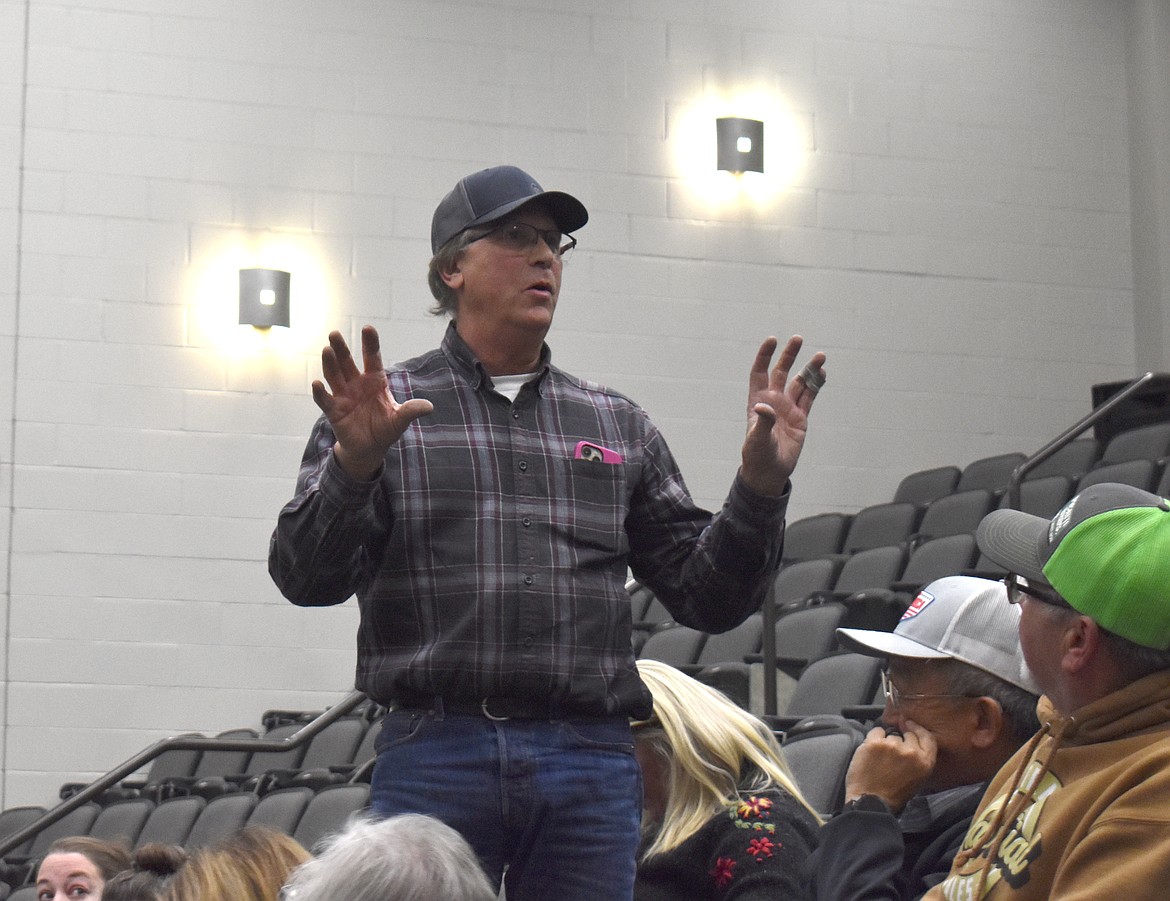
    Mattawa-area farmer John Doebler asks a question at the Mattawa town hall meeting Dec. 9.