
Grant PUD: New rate policy looks forward, not back
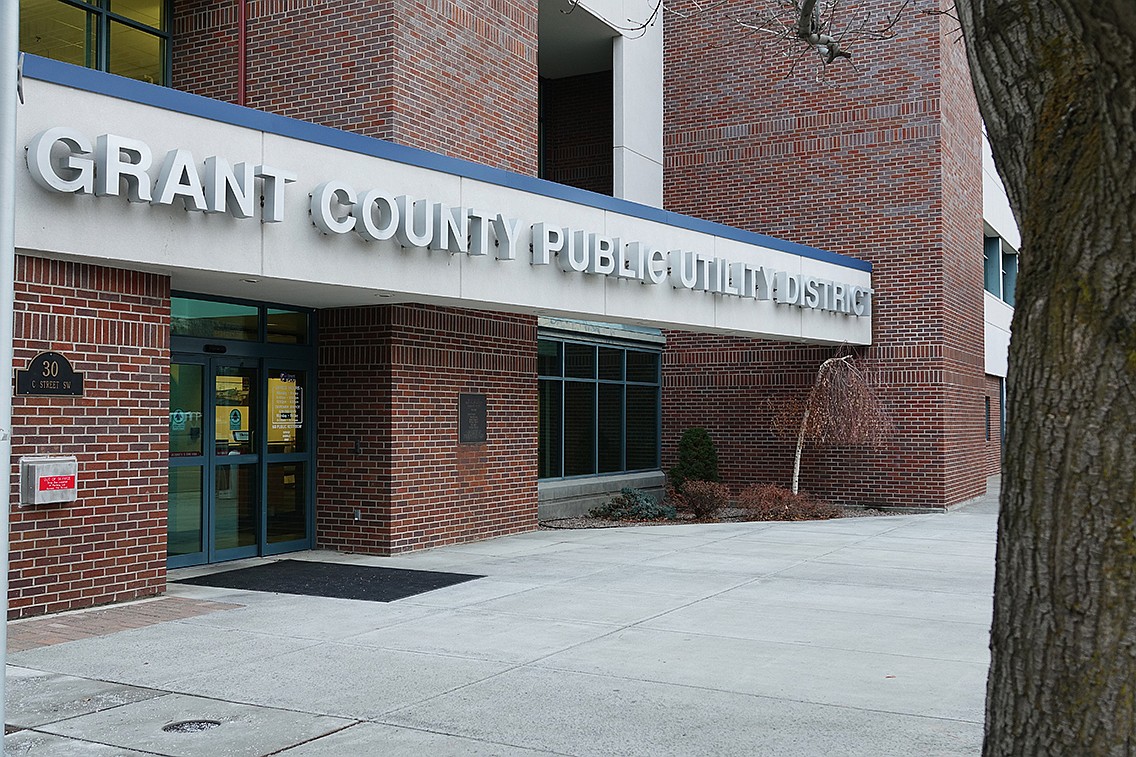
Rate-setting policy will look to the future, not the past, when determining Grant County PUD rates under the terms of an updated resolution approved by PUD commissioners.
CHERYL SCHWEIZER/COLUMBIA BASIN HERALD
EPHRATA — Customers designated as core customers will be first in line for the lowest Grant County Public Utility District rates, according to a new rate policy unanimously approved by PUD commissioners Tuesday. Ty Ehrman, senior vice president of retail operations, said there will be less emphasis on the cost of actually providing service to customers, a process he called unbundling.
“That is meant to support the premise (that) growth pays for growth. And most of our growth has ended up being in the industrial sector,” Ehrman said. “We want to make sure that we’re not unduly burdening our core customers with those higher-cost sources of power. And most of the growth (in demand) is actually occurring elsewhere.”
The core customer classes include residential, small business and agriculture customers, and their demand has remained relatively stable over the last 10 years, according to information presented Tuesday. Demand from larger businesses, agricultural processing and smaller industrial customers has also remained relatively stable. Demand from large industrial customers, however, has increased dramatically in the last 10 years. That demand has reached the point where the PUD is projected to use up its entire allocation of the power from Priest Rapids and Wanapum dams by next year, and if new customers keep coming the PUD will have to find additional sources of electricity. Any of those additional sources, Ehrman said, will be much more expensive.
“That is a significant change, and it really changes the way that we set rates for all of our customers by taking power costs out of the way that we’ve traditionally set rates; utilizing cost of service is one of the factors that we consider,” Ehrman said. “(Saying to) core customers, ‘You are going to get Priest Rapids Project power.’”
The resolution stipulates that core customers will be the first to access the lowest-cost power, which is from the Priest Rapids Project.
The new rate policy will, Ehrman said, mean big changes in how possible rates are evaluated.
“Going to an unbundled rate is an important step for us, but it also offers some challenges,” he said. “That means that we’ve got to shift from the way we’ve done things in the past, where we’ve taken the cost of service, maybe looking back a year, to understand what our costs are, and then set rates one year ahead based upon that data. If we’re going to be serious about being able to set rates based upon future power costs, and as we have to add more resources, we’ve really got to shift that to a forward-looking model.”
With the change, rates for all classes will be based in part on projections of future costs.
“We are now taking a look on a 10-year forward-looking basis at all of our costs, including the power costs, and understanding where we’re going to have to set rates, on average, for core and non-core customers, in order to make sure that we’re covering costs and that we’re appropriately covering the cost of those incremental resources, in particular incremental generation resources,” Ehrman said.
Rather than using the cost of providing electricity to each rate class, rates will be evaluated on overall operation costs.
“That means that we take a 10-year forward look; we say, ‘It looks like core customers need to be at X percentage on average over that 10-year period, and non-core need to be at Y percentage,’” he said.
Customers designated as core customers use about one-third of the electricity generated by Priest Rapids and Wanapum dams, known collectively as the Priest Rapids Project. The remaining two-thirds of Priest Rapids and Wanapum power is available to other customers, including the large industrial customers.
“Non-core customers will get the remainder of that lowest-cost power, in this case, PRP, and then any additional power sources that we need to bring on, they all come at higher costs, and non-core will bear those costs,” Ehrman said.
Within the non-core customer class, bigger businesses, smaller industrial companies and agricultural processors are broken into their own sub-category. Large industrial customers, evolving industries and commercial electric vehicle chargers have their own sub-category. Rates could be different within those sub-categories.