Tuesday, December 09, 2025
45.0°F

Public opinion sought on Grant PUD rate proposals
by CHERYL SCHWEIZER
Staff Writer | December 8, 2025 5:08 PM

EPHRATA — Grant County PUD customers are invited to give their opinions about electrical rates for 2026 and beyond at a public hearing at 2 p.m. Tuesday at the PUD’s main office, 30 C St. SW, Ephrata. It’s the start of a two-week public comment period on the new rate proposal.  

Ty Ehrman, senior vice president of retail operations, said PUD employees will recommend a schedule that increases rates for all customers every year over a 10-year period. He said that’s a sign of the growth that has caused the PUD to reach the limit of its available resources. 

“Our customers let us know on a regular basis that long-term, low rates is the first priority. And we do focus on that,” Ehrman said. “What we’re seeing that causes the shift (in rate structure and rates) is hitting this inflection point and needing to source higher-cost power. We’ve been in a spot that has been very, very good for a long time, and now we’re in a spot where, if we’re going to continue to grow, it comes at a cost.”  

The proposal will include a 3.5% overall rate increase each year for 10 years for residential, agriculture and small business customers, and 9.5% each year for 10 years for industrial customers. That’s an average – the actual rate increase could be more or less than that for individual customer classes. Commission workshops on the rate proposal are scheduled for Dec. 16 and Jan. 13, with a new rate schedule adopted at the Jan. 27 commission meeting. The new rates will go into effect April 1, 2026. 

“We’re going to end up updating that (rate) trajectory annually in order to understand where we need to adjust rates,” Ehrman said. 

Residential, ag and small business customers are considered “core customers,” and new rate-setting polices will emphasize ensuring they have first access to the lowest-cost power. Ehrman said core customer demand averages about 225 megawatts of electricity each year. Average production of electricity at Priest Rapids and Wanapum dams is about 750 megawatts per year. About two-thirds of the annual power production is available to non-core customers, he said. 

Low-cost power has attracted industry to Grant County, and the demand for power has gone up as a result. The PUD gets a percentage of the power produced at Wanapum and Priest Rapids, and demand has grown to the point that the utility is using almost all of its share of the power produced by the two hydroelectric facilities. The PUD also must meet targets set by the state to reduce reliance on energy sources that generate carbon.  

Ehrman said other sources of power, whatever they are, are more expensive — a lot more expensive than hydropower. 

“Some of the lowest-cost next options are still three times more expensive than Priest Rapids Project power,” he said. “The differential is not small.” 

A 2023 analysis of costs, included in the materials for today’s meeting, showed that almost all customers pay less than it costs to provide service. Large industrial, industrial and evolving industry customers pay more than the cost of providing them service.  

Since the PUD is almost using all of its share of hydroelectric power, new requests from customers mean the utility will have to look for other sources. The new rate resolution under consideration by commissioners Tuesday will require customers asking for additional power to pay the costs of bringing that into Grant County. 

“As we grow industrial load, we serve that load at a profit, and any additional profit that we do get, we utilize in order to keep rates low for core customers. It still ends up being an advantage for all of our customers. We're still tremendously competitive in the industrial space,” Ehrman said. “We are incredibly competitive in both (core and non-core customer classes). So, even as rates are going to have to increase on the non-core side, they're going to continue to be some of the most competitive around and there's still a lot of motivation from that standpoint for businesses to locate here. We want to continue to foster that growth, and we get to do it in a way that helps to keep core customer rates low, and keep them among the lowest in the nation, too.” 

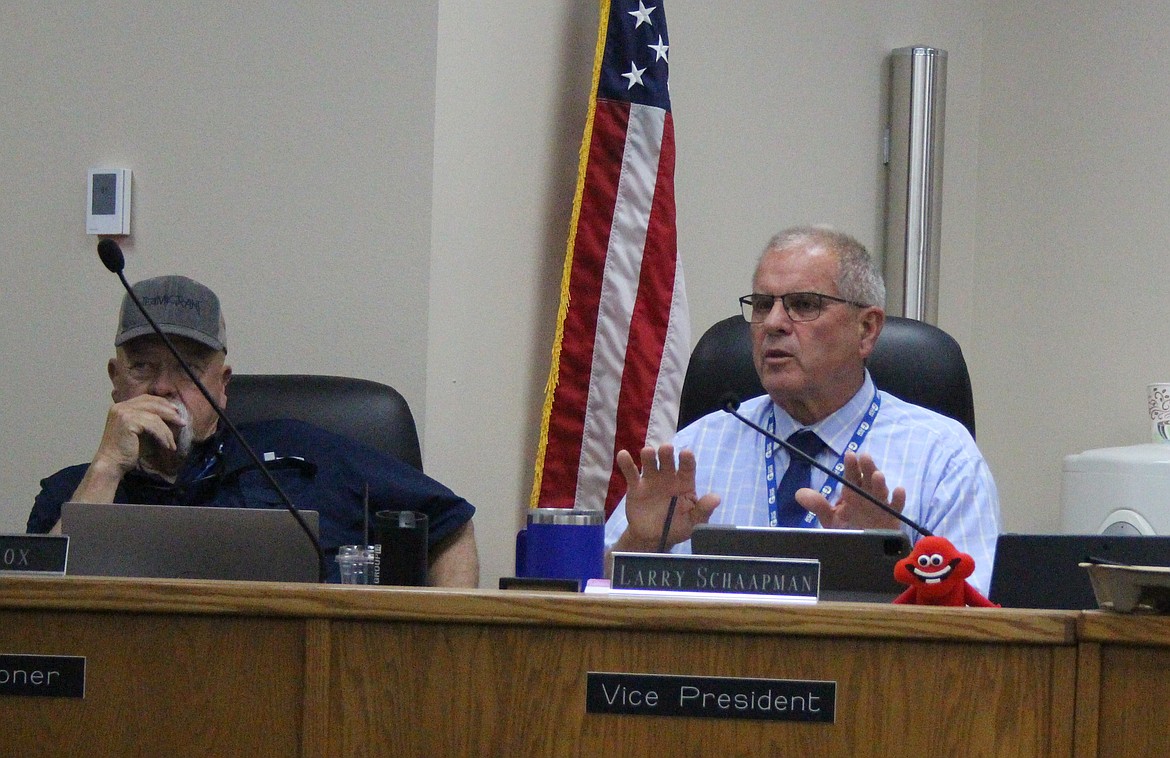
    Commissioners Larry Schaapman, right, and Nelson Cox, left, during a discussion of PUD fees in May. Commissioners will have a public hearing today on proposed electrical rates for 2026 and will be taking public comment through Dec. 23.