
Opinions differ on bill limiting peace officers’ use of force
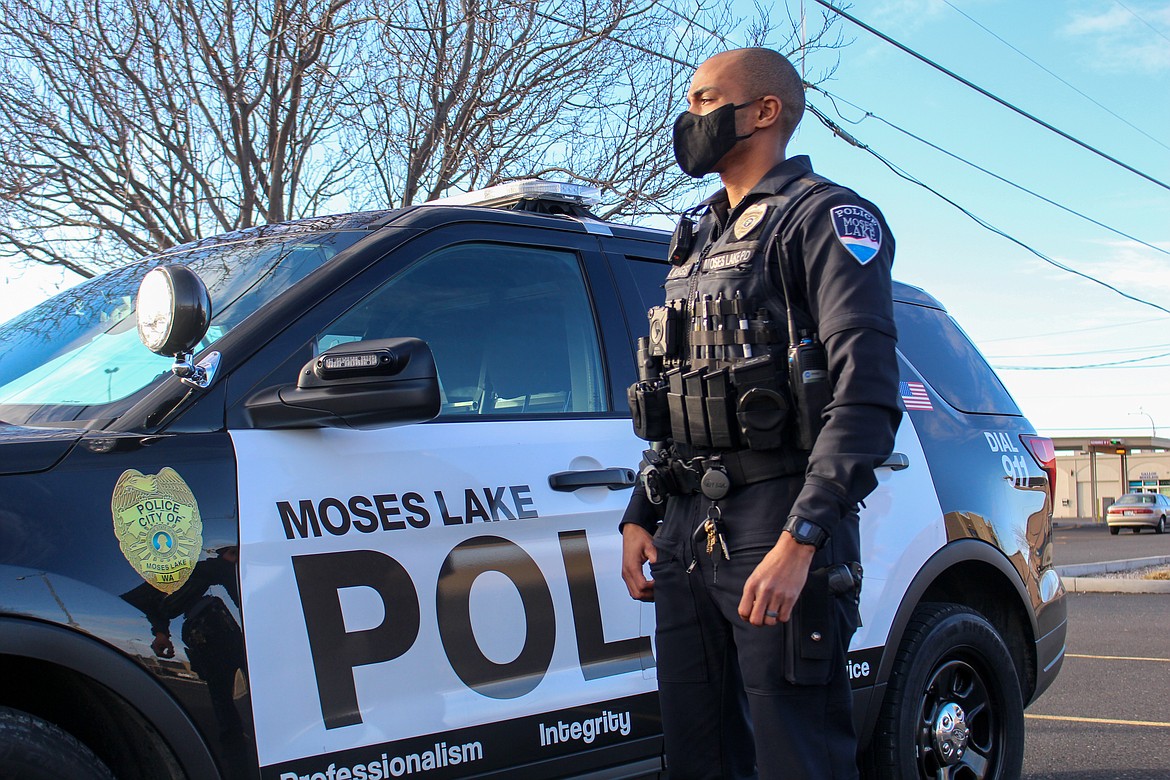
MLPD patrol officer Yoni Mengist watches cars pass by as he stand beside his patrol vehicle in downtown Moses Lake on Thursday afternoon.
Casey McCarthy/Columbia Basin Herald
State legislators behind a bill introduced in the House Public Safety Committee are looking to limit peace officers’ use of force.
Under House Bill 1310, a peace officer can exercise deadly force only as a last resort. Physical force may be used when arresting an individual or preventing an escape. An officer must use reasonable care when deciding whether the use of force is needed.
A peace officers’ criminal liability protection, which includes the good faith standard and instances where deadly force is permissible, would be replaced in HB 1310. Instead, the use of deadly force would be justifiable when used as a last resort.
Rep. Jesse Johnson, D-Federal Way, the primary sponsor of HB 1310, said during a virtual legislative hearing Wednesday it has been two years since the passage of Initiative 940, a measure regarding police reform, but there have been multiple killings by police officers statewide.
“Communities of color have been sounding this alarm for decades,” Johnson said.
Johnson said state law currently allows peace officers to make an arrest by any means necessary, which is a “broad authorization” of power and force. HB 1310 aims to reduce instances of violence between police officers and the public.
Danielle Bargala Sánchez, a member of the Washington Coalition for Police Accountability, testified in support of HB 1310 during the hearing. She recalled a time when police officers visited her foster sister for a wellness check, and she was shot a minute after they entered the home.
“There was no danger to anyone but my sister,” Bargala Sánchez said.
HB 1310 will increase safety for residents and officers, Bargala Sánchez said, and it will make use of the de-escalation training peace officers receive.
Jeff DeVere, contract lobbyist for the Washington Council of Police & Sheriffs, testified against HB 1310 during the hearing. He said the bill does not take into consideration the unique situations law enforcement officers face on a day-to-day basis.
“To judge an officer without facts and without considering what they reasonably believed in the moment is flat wrong,” DeVere said. “These situations must be judged for what they are, not what we want them to be.”
Marco Monteblanco, president of the Washington State Fraternal Order of Police, also testified against HB 1310. He said passage of HB 1064, a bill on police reform, during the 2019 state legislative session already helped build trust with law enforcement officers.
“(We want to) honor that historic achievement two years ago and allow for the rules to be completely implemented that we worked so hard to create,” Monteblanco said.
Tammy Morales, a member of the Seattle City Council, testified in support of HB 1310. She said the bill sends a strong and clear message that police officers must slow down to avoid confrontations and, in many instances, death.
“This is the only way to end a situation peacefully,” Morales said. “To allow the person to live to see another day.”
According to the bill’s text, a peace officer should avoid situations where the use of force may be required. De-escalation tactics should be done before using physical force. If physical force is needed, it should be used to the minimal degree necessary. Officers should also use less-lethal alternatives before considering deadly force.
If HB 1310 becomes law, by Sept. 31, 2022, law enforcement agencies must also adopt use-of-force and de-escalation policies developed by the state attorney general. The attorney general would develop the policies by July 1, 2022.